Archive for the Music Category

The Brian Jonestown Massacre’s “Revelation” Is Perfectly Named

Posted in Music with tags , , , on May 19, 2014 by johnbuckley100

Beginning in 2010, when Who Killed Sgt. Pepper was the follow-up to My Bloody Underground, we began to think of the Brian Jonestown Massacre as a superb live band with one of the great back catalogues in rock, but not really a band whose who new album would engender much excitement.

But then came 2012’s Aufheben, which had a number of songs as good as anything Anton Newcombe had ever written, with “I Want To Hold Your Other Hand” and “Blue Order New Monday” taking up permanent residence inside our earbuds.  We began to get excited about what tricks Anton still had up his sleeve.

Revelation, which officially comes out tomorrow but happily was available to download last night, is so good, we wonder if it might be the Love and Theft to Aufheben‘s Time Out Of Mind, a portent not just of a return to greatness after a less-than-great creative patch, but an indicator that Newcombe’s best work, like Dylan’s, might someday be understood to have been made when his youth was behind him — to be not what he produced when he was a young and brash punk, but what came after a hard-earned perspective.  I mean, there were days when few people might have expected Anton would be around to make an album in 2014 — but to discover that he’s produced one of the best albums of his career?  Yeah, it’s got the right name: Revelation.

The album begins wonderfully, with the Swedish rocker “Vad Hande Med Dem” giving way to the Kurt Vile-ish “What You Isn’t.”  By the time we get to “Memory Camp,” it doesn’t matter which members of the large tribe that have variously performed as BJM are playing behind Anton, it doesn’t matter that we’re in Berlin, not California, no other band or set of musicians — not even ones like the Morning After Girls who worshipped the sticky ground on which Anton walked — could produce a Brian Jonestown Massacre album half as good as this. By the time we got to “Food For Clouds,” we were grinning ear to ear.  At “Memorymix,” we were ready to take the day off and just hole up, having committed to memory the phone number to the Dominos delivery folks.  By “Xibalba” we were dancing around the house.

Over the past few weeks, as Dan and Joel and Matt, as Ricky and Frankie descended upon Austin like the Hole In The Wall Gang getting together with Butch and Sundance to go rob a bank, excitement mounted.  They came together to play at the Austin Psych Fest, and then do a few West Coast shows before heading off to Europe, and reports came fast and furious that the band was in fine form.  Interviews with Anton found him completely on his game, honest about the past, a sober father with a great sense of humor.  Revelation reveals marriage, fatherhood, and sobriety have not diminished his creativity one wit.  And of course, as is so often the case, as a sober artist, these days he’s more capable of hitting his mark.

We expect to be playing Revelation until the hard drive on our device gives out.  Most important — and we are struggling to convey this to the band of weirdos to whom this really matters — based on the evidence available here, it’s time to raise our expectations and settle in for a late run.  The albums the Brian Jonestown Massacre are producing in the mid-’10s are as good as what they produced in the ’90s.  We may be ahead of ourself thinking that Anton’s on a run like the one that Dylan went on between ’97 and, oh, 2010.  But our hopes are high again.
 

Pink Mountaintops’ “Get Back” Reveals More of Stephen McBean’s Multiple Personalities

Posted in Music with tags , , , , on May 1, 2014 by johnbuckley100

In the early years of Black Mountain and Pink Mountaintops, the meme developed that the latter band was an “alternative side” of Stephen McBean’s personality.  In retrospect, that’s a little hard to figure, or it is at least a little simplistic. Stephen McBean is such a protean figure that his constant alternatives to his last invocation could rapidly resemble a hall of mirrors.

And anyway, are the two bands, the two… aspects… of McBean’s songwriting, singing, and most excellent guitar playing, really so different? Let’s rewind to the beginning. Pink Mountaintops’ brilliant 2006 album Axis of Evol could easily be seen as coming from a similar sensibility as, say, Black Mountain circa its first record or the Druganaut E.P.  “Cold Criminals” sounded like it was the product of someone who’d spent a lot of time listening to Pere Ubu’s The Modern Dance, while “Bicycle Man” was steeped in the No Wave sound of New York circa ’78.  Are those different sides?  So far away from one another?  Not really.

To us, McBean has always been one of the great dabblers, an ambitious throwback who could in the span of two years record one of the best Velvet Underground-sounding songs — Pink Mountaintops’ “The Gayest of Sunbeams” — and one of our favorite invocations of Led Zeppelin — Black Mountain’s “The Hair Song.” The only people who split the difference between Zep and the Velvets while in the same rough phase of their careers are those who, as the lyrics to the great Black Mountain song “Voices” would have it, have come down with the same bug all of us at Tulip Frenzy are riddled with: “Rock’n’roll voices on the radio/I’ve been in love with you since I was five years old.” He loves it all: all those rock’n’roll voices: Lou’s, and Bowie’s, and Robert Plant’s, and often in harmony with a singer as great as Amber Weber, which brings us to such pairings as Exene and John Doe and Sonny and Cher.

While his shambling, hippy-era countenance might give off a hash and patchouli perfume, leading you to think of McBean as a slacker, and while the pace of releases since 2005’s eponymous Black Mountain album might not seem like he breaks a sweat, the sheer volume of not just good, but thoroughly excellent music McBean’s been responsible for over the last nine years is pretty remarkable.  If his interest was simply in being a rock star, he probably would have helped corral the Black Mountain Army to keep pushing through in support of Wilderness Heart, which caused a stir in 2010.  But instead the band put out some new songs on the Year Zero film soundtrack, toured a bit, and did not sustain the momentum.  It’s easily recaptured, they’ve built a good following.  But McBean’s not interested, it seems, in such straight forward careerism.

Enter Pink Mountaintops’ Get Back, in which with an imposing posse behind him — J. Mascis on guitar, Daniel Allaire from Brian Jonestown Massacre on drums, Rob Barbato of Darker My Love on bass, etc. — McBean invokes everything from Station to Station-era Bowie to “All Along The Watchtower.”  Ensconced in Los Angeles these days, McBean continues a Canadian-style assault on greatness: low-key, humorous, thoroughly competent.

We think “Ambulance City” may be the most infectious rocker out this year, which is saying something since John Dwyers’ Thee Oh Sees have already released an album.  “Through All The Worry” sounds like something you wish Social Distortion was still putting out.  “Wheels” is the “All Along The Watchtower” analogue, though obviously invoking the Hendrix version.  Whether that’s Mascis or McBean on lead, we don’t know, but it is like sonic dental floss, cleaning out the cavity between our ears. We can see the members of Crocodiles smiling when they hear “Sell Your Soul,” one of those songs that makes you remember how mid-70s Bowie was so influenced by early Springsteen, he borrowed Roy Bittan to play piano. “North Hollywood Microwaves” is Not Safe For Driving With Children Or Spouses, an hilarious novelty.  By the time we get to the closer, “The Last Dance,” we’ve returned to mid-’70s pre-punk, to the Station To Station sound with which the album began.  It’s an impressive, Rockist tour de force.

How Get Back ultimately fits into McBean’s canon is unknowable at this time.  What we know is that his multiple personalities are given full vent, and that a figure whose bands have called to mind Deep Purple and Led Zeppelin, the Velvet Underground and Pere Ubu, and Bowie, always Bowie, is as well-rounded an artist as there exists today.  Selfishly, we can’t wait to see the set of characters McBean inhabits on the next slab of Black Mountain.

Quilt And Woods At The Rock & Roll Hotel Were More Like Rock & Roll Heaven

Posted in Music with tags , , , on April 27, 2014 by johnbuckley100

Quiltwoods1

Quilt, Leica C

It wasn’t accidental that two bands that each have produced one of the best albums released so far in 2014 played last night at D.C.’s Rock & Roll Hotel, for Quilt and Woods are, at present, joined like family members.  Woods’ Jason Taveniere produced Quilt’s second album, Held In Splendor, and on this tour at least, Quilt drummer John Andrews plays organ with Woods.  They have more kin connections than a village in West Virginia, and the show last night was one long stream of gorgeous melodies, guitar wizardry, a solid backbeat, and the occasional psychedelic rave-up.

Quilt wrapped us in Held In Splendor, their warm and radio-ready platter o’ harmonic convergence punctuated by intricate pop finger picking and gritty power chords.  Anna Fox Rochinski is a lyrical lead guitarist and an understated, somewhat shy front-woman, but when she and Shane Butler matched their vocal interplay with guitar fire, it brought to mind favorite two-guitar bands like Luna, the Soft Boys, even Television.  Quilt’s sound is jangling ’60s pop with three-part harmonies contained within the parameters of garage, folk, and psychedelica, which is pretty great territory to ply.  In fact, their new album is desert isle material, and the set last night proved they can do it live every bit as powerfully as in the studio.

Quiltwoods2


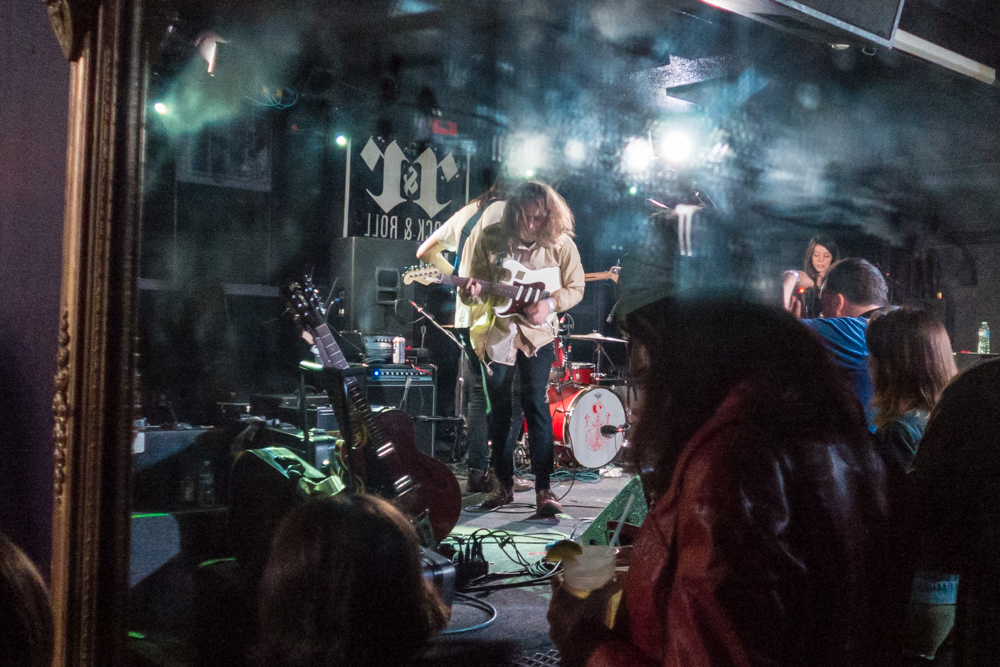
Quilt, Leica C, via the Rock & Roll Hotel’s mirror.


The crowd’s reaction to the best songs — “Mary Mountain,” “Just Dust,” “Tired & Buttered” — proclaims Quilt has, by their sophomore outing, established themselves as one of a handful of American bands worth tracking as they rise to what, should the cosmic order be proven, can only be inevitable world conquest.

Since the release a few weeks ago of  Woods’ With Light And Lovewe’ve concluded it is every bit the equal to Bend Beyond, which some will remember we called 2012’s best album, and even more than that: an absolutely perfect record. It should go without saying, this is a hard feat to pull off once, never mind twice.  But With Light And Love is astonishing — even prettier than its predecessor, and last night, despite a bad sound mix from the club, Woods revealed just what a treasure they’ve become.

Quiltwoods3

Woods, Leica C

The new bass player, Chuck Van Dyke, steps well into Kevin Morby’s shoes, and with Quilt’s John Andrews playing organ throughout, Woods’ sound had an emollient undercurrent that was as surprising as it was delightful.  They started out with “Leaves Like Glass,” which on the album sounds like an outtake from a mythic Dylan set and last night sounded like it was a jam in Memphis’ Ardent Studios. Jeremy Earl played acoustic through the early songs, including “Cali in a Cup,” but it was later in the set, when he had strapped on his electric guitar to play two of the highlights from the new album — “Moving To The Left” and “Twin Steps” — that it became clear how, even as amazing an album as Bend Beyond was, With Light And Love takes a giant step into the commercial mainstream, which we mean as a compliment.  They played the title tracks to both recent albums, which means 20 combined minutes of getting your head scalped, and we survived the pyrotechnics, a groggy smile on our putzes.  But it’s where Woods now confidently step into well-crafted pop songs that perhaps the band’s hidden ambitions begin to see the light.

A clue to the ground they currently occupy can be found on the sequencing on the new album of the songs “Full Moon” and “Only The Lonely.” On the former, Jason Taveniere plays George Harrison-inflected slide, and the latter is the title of a different Roy Orbison song.  Are they trying to emulate The Traveling Willburys?  No, they’re still a Brooklyn-based band of artisanal pop craft, still weird and wooly, though it could be said that invoking Roy Orbison is one way of placing Jeremy Earl’s astonishing voice, his high plains croon, in a more recognizable context.

We’ve seen Woods three times in 18 months.  In November 2012, when they played across the street at the old Red Palace, it was like seeing Sun Ra come back to Earth, fireworks going off in the mind.  Last night, with a new bass player and the sound of an organ ladling sweet honey on the guitars, the band was every bit as remarkable, but in a way that those with less adventuresome tastes could relate.

How delightful it is to see two so great bands in a club with a couple of hundred souls.  It’s only because of the injustice of life that we would see these bands on the H Street corridor and not downtown at the Verizon Center.  Optimists that we are, we think both bands will get there.


Pink Mountaintops “Ambulance City” Is Song Of The Year

Posted in Music with tags , , , , , , on April 26, 2014 by johnbuckley100

We have only to wait until Tuesday to get our mitts — our ears — our ear mitts? — on Pink Mountaintops’ Get Back.  But just from what’s been released so far, we know this is going to be one of the highlights of the year.  “Ambulance City” may be the finest rocker yet released by any unit of Stephen McBean’s Black Mountain Army — and represents a return of Pink Mountaintops to the upbeat rocking form present on 2006’s Axis of Evol, partly missing on 2009’s Outside Love.  Powered by Brian Jonestown Massacre nuclear instigator Daniel Allaire on drums, both “Ambulance City” and the hilarious “North Hollywood Microwaves” rock harder than anything we’ve yet heard from HQ-band Black Mountain, nor any of its lethal units, Blood Meridian, Lightning Dust, etc.  Tulip Frenzy thinks we will declare a holiday Tuesday, and just reach for our headphones.

Thee Oh Sees “Drop” The Big One

Posted in Music, Uncategorized with tags , , , , on April 19, 2014 by johnbuckley100

Just before Christmas, as the staff at Tulip Frenzy World HQ were deep into the eggnog, word spread that Thee Oh Sees were going on “extended hiatus.”  Even allowing for the notion that for a band as prolific as John Dwyer’s SF outfit has been since 2006, that probably meant only a few months delay until the next ‘un, it cast quite a pall.  Everyone avoided the mistletoe.  By the time the lights were pulled on the Xmas tree, by the time the pizza crust was swept into the trash bag, everyone was ready to go home.

Thankfully, Dwyer’s just released Drop, and though the “band” is missing the delectable Brigid Dawson and that red-hot rhythm section of Petey Dammit! and Mike Shoun — the cohorts who helped propel Floating Coffin into the coveted #2 spot on the 2013 Tulip Frenzy Top 10 List (c) — this is a real Thee Oh Sees album. Which is to say it is a work of undiluted, 100 Proof rock’n’roll genius.  It will be the soundtrack to Tulip Frenzy’s Easter Egg Hunt tomorrow, let us tell you. The Easter Bunny will surely bounce his little cottontail off.

So Dwyer has moved from San Francisco to Los Angeles, in search of lebensraum.  Oddly, Drop was recorded in Sacaramento, but rather than bring along his pals from the most recent incarnation of Thee Oh Sees, he holed up with producer Chris Woodhouse (who plays decent enough drums) and a gang that includes Mikal Cronin.  If you are expecting some vast departure from the sound that has so delighted us on the last two Thee Oh Sees records — the amazing Putrifiers II and of course Floating Coffin — you’ve probably misunderstood just what Dwyer has evolved into.  He could recruit the checkout clerks from a Vons Supermarket and quickly get them up to snuff, churning out melodic punk rock that spans the gamut from the Ty Segall Band to the Beatles.

We will no doubt report in more in the days ahead; overnight, this thing dropped into our iTunes library like a Faberge egg.  Let us just say that the polymath Mr. Dwyer, whose production chops helped actualize Tim Presley’s White Fence project into one of the best albums of 2013, whose Vinegar Mirror was such a cool photo project somehow we are staring at two of them, and whose last several albums with Thee Oh Sees — however they are configured — could singlehandedly restore our faith in the magical elixir that is real rock’n’roll… let us just say that it already is clear that Drop is the Big One, a career-worthy collection of songs that could be a desert-isle compilation of raw goodness.  Happy Ishtar.

Woods’ “With Light And Love” Bends Just Slightly Beyond Their Prior Masterpiece

Posted in Music with tags , , on April 16, 2014 by johnbuckley100

Last time out, in 2012, Woods’ Bend Beyond shocked the Western world when it beat out Ty Segall to take Tulip Frenzy’s Album of the Year honors.  Maybe their amazing show at DC’s Red Palace helped sway the judges.  But as we noted then, Bend Beyond was one of those mythical Perfect Albums, as rare as a pitcher’s Perfect Game, with an astonishing sound and not a note out of place.

We saw them again in the summer of 2013, and they gave hints at what a good album With Light And Love, released this week, would turn out to be.  It is a bright, confident follow up to a masterpiece, and there is no let down, no disappointment.  Does that automatically make it, too, a masterpiece?  Not necessarily, though it means we have come to expect the extraordinary with Woods, and they seem perfectly at ease in delivering it.

With Aaron Neveu now a full-fledged member of the band, and we presume that’s Kevin Morby on bass — their photo on the Woodsist website does not have Morby, whose excellent solo album, Harlem River, was released late last year, but we think that’s him — the twin-guitar sound of Jeremy Earl and Jarvis Tavaniere continues to ply the line between the best Topanga Canyon 12-string chimes and the sonic-rocket-to-the-moon psychedelia for which their lives shows are so notable.  And Jeremy Earl’s voice continues to be a sui generis marvel, causing Robert Plant, Al Green, and the Dean Wareham of Galaxie 500 to all stand back, their mouths agape.

What’s different here is evident from the start, wherein album opener “Shepherd” has a pedal steel and Nicky Hopkins piano sound, a postcard from whatever country locale Woods has arrived in, far out of town and in touch with their Flying Burrito Brothers.  We suppose that Woods — a Brooklyn band that records Upstate — has a shorter distance to travel than Darker My Love did when they veered into chiming ’60s country rock with Alive As You Are ( another Perfect Album that took Tulip Frenzy Album of the Year honors.  And in fact, Tim Presley plays on this ‘un.) The country vibe sure is lovely, but better yet comes the Dylanesque “Leaves Like Glass,” whose instrumentation sounds like the tape was left rolling during the Blonde On Blonde sessions. We would dare anyone to listen to “Twin Steps” and not immediately plan on proceeding, with the missionary zeal of a programmed zombie, to catch this band live.  And while the 9:07 title track sums up this band’s virtuosity and complexity in spades, it’s “Moving To The Left” that harkens, ironically, to the right of the radio dial, where in a perfect world it would remain, being played over and over throughout the summer months.

This doesn’t mean we expect Woods to storm the record charts.  We’re both realistic and at completely at odds with the way hits are manufactured to by this time have hope that a band this fine will be properly rewarded in this lifetime.  We should note, however, that there is not an insurmountable difference between With Light And Love and a Broken Bells record; we could actually imagine a radio programmer listening to “Moving To The Left” and being inspired to do the right thing, his corporate masters notwithstanding.

Perhaps, you say, it is too much to expect that even a band that creates Perfect Albums can rally the masses.  Perhaps we should think of Woods like that restaurateur that has foodies flock from across the globe to eat in his 32-seat epicurean marvel, the strange combination of sea urchins and wholesome grains utterly beguiling, with a smallish but knowing army of disciples certain they’ve discovered something special, even if it would be hard to get everyone to understand.

No, we reject that concept.  Woods are a marvel, worthy of superstardom, and if you’ve yet to understand this, start here, With Light and Love.

And go see them next weekend, with Quilt, at The Rock and Roll Hotel in D.C.

Philip Parfitt Is Not The Man He Used To Be

Posted in Music with tags , , , , , on April 9, 2014 by johnbuckley100

It may have been a heartfelt stroke of honesty, it might have been an effort to inoculate against the facile criticism he expected, but whatever it is that prompted Philip Parfitt to call his first album in 20 years I’m Not The Man I Used To Be, it certainly seems accurate.  For this album is very, very different from what Parfitt has done in his prior lives, his prior bands.

It’s no disgrace if you don’t know who he is. Parfitt’s last album came out before, oh, Oasis hit the scene. The Perfect Disaster may be best remembered now for having given Josephine Wiggs to The Breeders, but to those of us who remember the late 1980s, they gave us an enormous amount of pleasure.  Some of that pleasure, to be sure, was what a great guitarist Dan Cross proved to be, but it was Parfitt’s singing and songwriting that made The Perfect Disaster worthy of being spoken of in the same sentence with the Velvet Underground.  Here’s how we described them in 2009:

“The Perfect Disaster were an interesting, sometimes thrilling late ’80s British band headed by Parfitt, with the glorious Dan Cross on lead guitar, what had to be Mo Tucker’s illegitimate son Jon Mattock on drums and, before she left for The Breeders, Josephine Wiggs on bass and vocals. Their album Up is what got me started, especially “Time To Kill.” They had a chugging, Velvets sound, had spent plenty of time listening to the Buzzcocks and Modern Dance-era Pere Ubu, and Parfitt was a wonderfully sneering front man, limited in vocal range, but of course that made sense, since the model was Lou Reed. Heaven Scent came out in 1990, and to my ears was stronger than Up (though britcrits seem to prefer the former.) It had a little less urgency than its predecessor, but by now Parfitt’s songwriting craft had more facets and dimensions, yet was more contained. Great things seemed in store, and … poof. They disappeared.”

But then came Oedipussy, whose 1994 album Divan we called “the great lost album of post-punk British rock.”  It was more dynamic, more explicitly commercial than The Perfect Disaster, and while their (his?) lone album was incredibly different from what had come earlier, it was no less satisfying.  Two years after we posted our piece on Oedipussy, this comment suddenly appeared:

““thank you ladies and gentlemen. I am well.its very very lovely that people appreciate my work. i’ve not stopped writing or recording since Divan, just haven’t got ruond to releasing much; I am though planning to get a new album out this year 2011. there! I’ve said it! one step follows another step, even when you are walking backwards.”

It was signed, simply, “philip.”  And for three years, these two Tulip Frenzy posts have gotten steady traffic, as the world hasn’t forgotten about Philip Parfitt.

And then two weeks ago, someone tweeted us that Parfitt had a new album out, and sure enough, I’m Not The Man I Used To Be hit the iTunes store.


When you listen to the opener, “Big Sister,” it’s not Lou Reed that comes to mind so much as Nick Drake.  This is a quiet album, handcrafted before the fireplace, as rain hits the window.  It is no less the beautiful for it.  Whether or not Phil Parfitt has changed — and let us simply assume that he was writing in character when, on Up‘s closer, “Time To Kill,” he announced it was “time to pull the trigger and/time to die” — this music is lovely.  And every bit as special as anything he did in his harder rocking past.

The Perfect Disaster has gotten us through many a late evening: car rides, plane rides and the like.  I’m Not The Man I Used To Be is that next album to play on a rainy Saturday after Beck’s Morning Phase is over, you’ve just poured another cup, and the dog is snoring at your feet.  To say this is a quiet album is the finest praise.  We’re glad he’s back.


Dean Wareham’s Living Retrospective At DC’s U Street Music Hall

Posted in Music with tags , , , , on April 5, 2014 by johnbuckley100

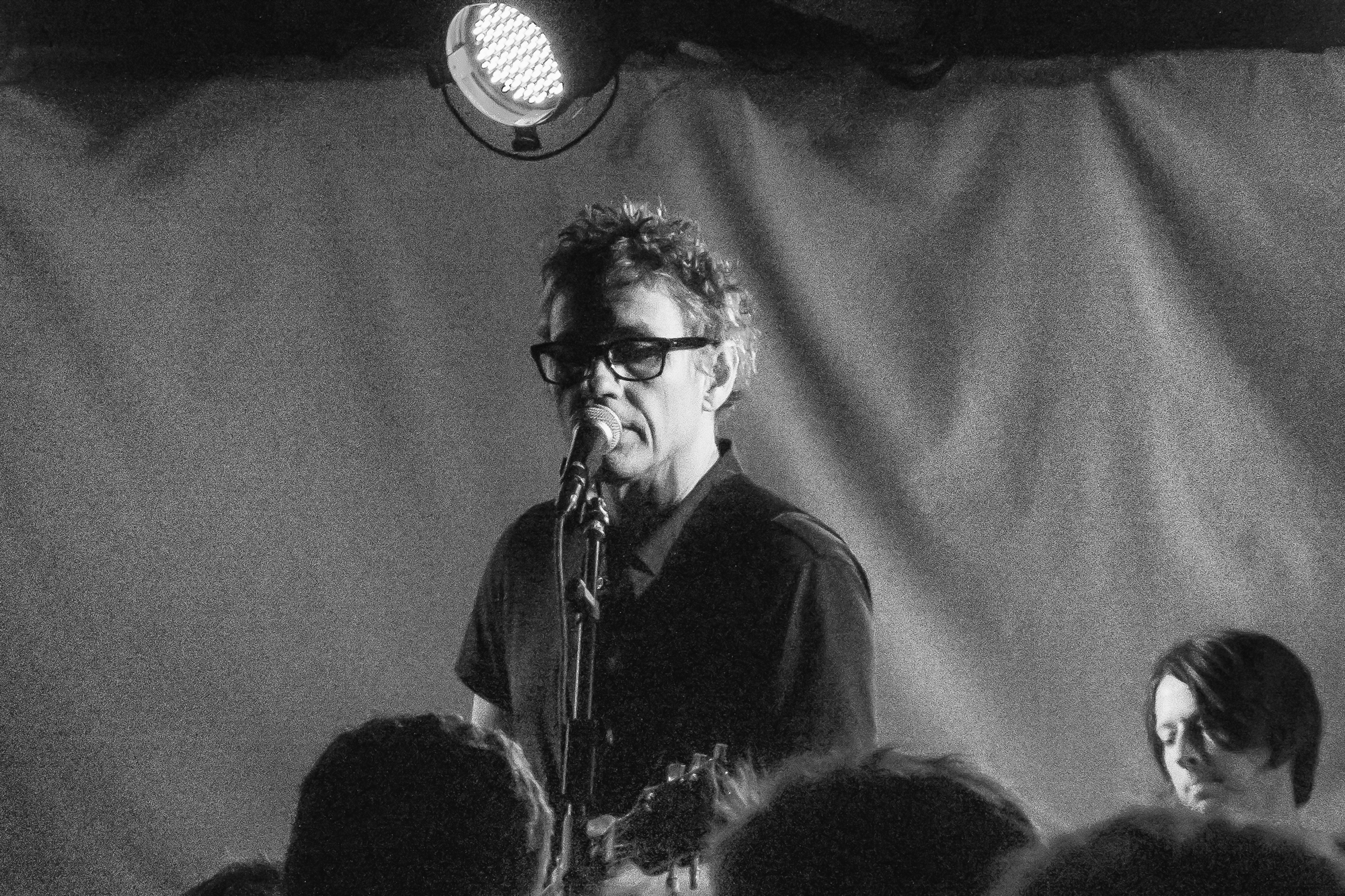
Wareham 2

In the art world, museums sometimes wait until an artist’s demise before putting on a full retrospective of his or her work.  Dean Wareham’s only 50, but last night at the dark and dank U Street Music Hall we were treated to almost a full career’s worth of his brilliant songwriting, canny guitar playing, his emotionally distant but vibrantly alive sensibility. The set began with “Blue Thunder,” from Galaxie 500’s On Fire, which was released in 1989, and ended with that same band’s “Tugboat.”  In between came some of our favorite Luna songs — “Tiger Lilly,” “Lost In Space” — the title track from last year’s Emancipated Hearts mini-album, and an assortment of good ‘uns from the new Dean Wareham  solo album.  His final cuts, which you knew would include covers, were the Luna staple “Indian Summer” (Beat Happening) and New Order’s “Ceremony.”  Yeah, that’s a career-length assortment, minus anything from Dean & Britta’s best — 13 Most Beautiful — which it seems he likes to play in full, not piecemeal in a set like this.

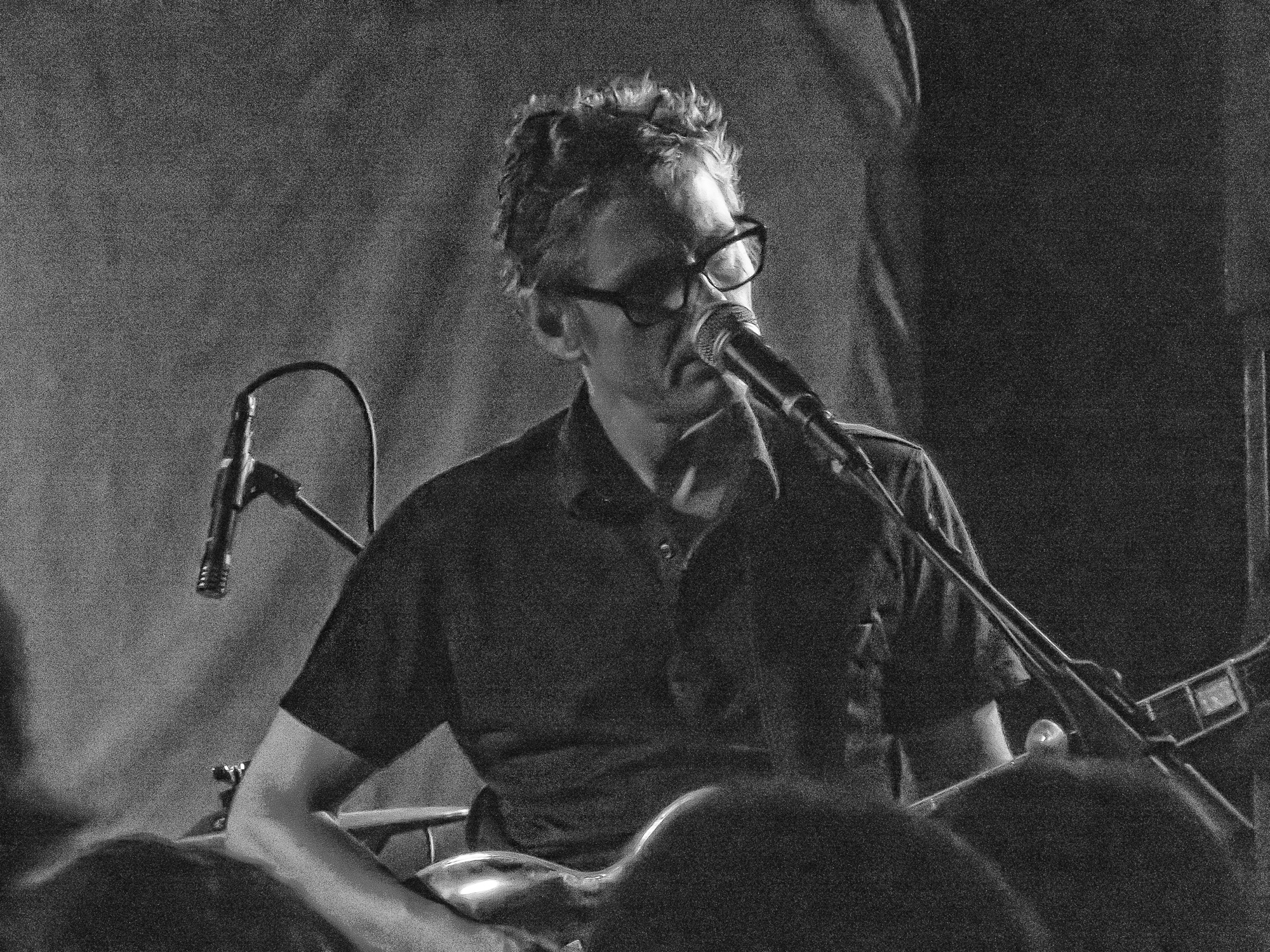
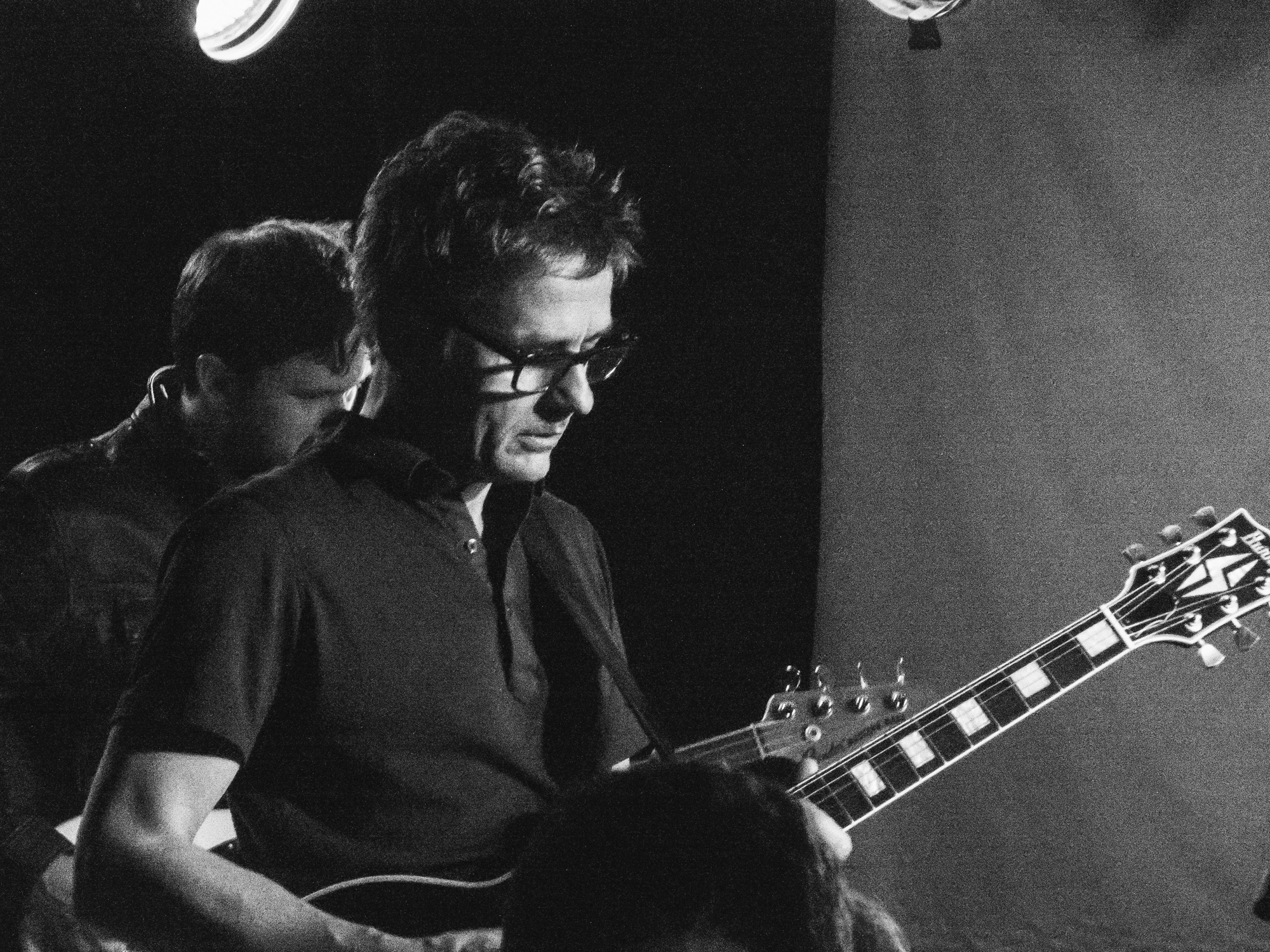
It’s been about 10 years since we’d seen Wareham, nine years since Luna, our favorite band for many years, called it a day.  We did not seen any of the shows that Dean & Britta played showcasing the Galaxie 500 songbook, so last night was the first time we ever heard them play “When Will You Come Home,” the first time out of the maybe 15 times we’ve seen Wareham play that he reached into his grab bag and uncoiled the astonishing guitar work he exhibited as a 25-year old half of his lifetime ago.  He’s got grayish hair now, and wears solid-framed glasses, looking more like a Harvard professor than the Harvard student he was when Galaxie 500 began, but he can still play. OH man, can he still play.  Which is more astonishing, the solos uncorked in “When Will You Come Home” in 1989 or last night?  Well, 25 years ago, Galaxie 500 made our jaws drop (as we heard them on record), because Wareham and his two bandmates had found a more compelling way to jack into the Sterling Morrison-led version of the Velvet Underground than any band we had at that point heard.  Today, it’s every bit as glorious.

Wareham 3

In recent interviews, Wareham has hinted at a return of Luna, or at least that there is a possibility of this happening, whereas there’s no chance he’ll get back together with Damon and Naomi and play Galaxie 500 songs with the original band.  We loved Luna, and our rock’n’roll life has been just that wee bit emptier without them.  But now that Wareham has released, in the span of four or five months, two collections with songs as amazing as “The Deadliest Day Since The Invasion Began” and “Holding Pattern,” and is willing to tour dipping into a playbook that spans 25 years, we’ll be very content.

Dean Wareham Returns To DC

Posted in Music with tags , , , on April 5, 2014 by johnbuckley100

Playing songs from his latest album album all the way back to Galaxie 500’s “Tugboat Captain.” More anon.

Wareham 1-2

We Were Right That Richard Hell Wrote The Best Essay On The Velvet Underground, But…

Posted in Music with tags , , , , , on April 1, 2014 by johnbuckley100

The evolutionary trend by which rock critics become rock’n’roll musicians seems more typical than a rock star becoming a critic, but it’s not like the latter is a crime against nature or anything.  After all, said rock musician probably gravitated toward his calling out of a deep love for music, and certainly we know bands going all the way back to the Beatles and Stones began to bash around on guitars out of the sheer cussed joy of wanting to emulate their idols.  So let’s just take as a given that rock’n’rollers have great knowledge about the music that lit their particular match.  Nonetheless, it’s unusual for a musician to become a rock critic, and highly unusual for one to become anywhere near as erudite as Richard Hell is.

Last week, we wrote with admiration that Richard Hell’s piece on the Velvet Underground in New York Magazine was the best essay ever written about that band.  We were right and wrong.  Hell did write the best essay ever on the Velvets.  The thing is, it was a different essay, published in 2008 in a book called Rock And Roll Cage Match, edited by Sean Manning, in which Hell had the Velvets post up against the Stones, out of which he called a winner.

We’d never seen the book or read the essay ’til Richard pointed it out to us in the series of emails in which he let us know that the new Velvets essay was, in fact, online.  He sent us the earlier essay, and we also went out and found the book.  And we have to say, his piece on the Velvet Underground vs. the Rolling Stones is one of the best essays about rock’n’roll we’ve ever read.   We won’t go so far as to mimic the book and set up a fantasy cage match battle between Hell and Lester Bangs, or John Mendelsohn, or Byron Coley, or Richard Meltzer, or even Robert Palmer.  Let’s just say that posting Hell up against any of our fave rock critters, he’s indomitable.

The Velvet Underground are not our all-time favorite band, but they sit cross-legged near the settee in the middle of our pantheon, and let us give ourselves credit where it’s due, they have been so since we were a mere boarding-school vinyl-head, and we glommed onto Loaded upon its release.  Yes, the last of their albums released while the band was extant, even if the worst of their four core albums (VU, which came out in ’85, had enough good stuff on it that at the time we’d never before heard that it deserves to be considered as one of their original records.)

But much as we have loved the Velvet Underground for more than 40 years, if we had to testify to who our favorite band ever was, it would be the Rolling Stones.  Yes, we’ll admit it, even though  if you look at the Tulip Frenzy “About” section, we make no mention of the Stones.  That’s because, from the moment that Ron Wood replaced Mick Taylor, from the time Nicky Hopkins no longer got their phone calls, and Bobby Keys and Jim Price were no longer paired as the horn section, it has been all downhill.  But no band has ever had that command of our attention, that claim on our affection, as the Stones did in the early ’70s.  We were out-of-our-heads excited in ’79 to see the Clash; it doesn’t begin to compare to how excited we were to see the Stones play in Boston Garden, and then Madison Square Garden, in 1972.

So Hell writes an essay about both bands together, or shall we say, about the Velvets and Stones in opposition, and it is brilliant.  He sets up the hugely successful Stones versus the commercially unsuccessful Velvets in a way that is incredibly insightful and amusing.  And then he does a position comparison like it’s the first game of the World Series and you have to give one team or the other the edge at First Base.  We’re not going to quote it here.  We’re going to try sending you to the book, so you can buy it.  But let us just say that Hell gives the best description ever of what one wants from a front man in a rock’n’roll band, defines the essence of the Rolling Stones — which of course we already knew was Keith, but also — by a single word: soul.  He gets a few things wrong, in our opinion — we are higher on Beggars Banquet than he is.  He gets so much else so right.

Okay, okay, we have to quote, listen to this insight on Lou Reed’s songwriting: “Reed’s lyrics probably do come the closest to poetry of any in rock and roll.  Dylan is his only competition.  Dylan rules, but I’d venture that the lyrics on The Velvet Underground are the best as a suite, as an album set, of any in rock and roll history.”

So true!  If we were a teenage girl reading a favorite novelist, we might even underline that six times and put an exclamation point in the margins.  As it is, we just have to nod and agree.  As we do, interestingly enough, with his ultimate conclusion.  (You already know from what he wrote in New York that he would put the Velvets on the podium just above the Stones.  In our rock’n’roll dotage, we are now inclined to agree.)

Go buy the book.  Better yet, go buy his books, especially I Dreamed I Was A Very Clean Tramp.  We’ve long known the man can write.  His essay on the Velvets vs. the Stones is even better than his recent essay on the VU, and one of those pieces of rock critterdom that is as breathtakingly thrilling as even Richard Hell and the Voidoids playing “Time.”