It is kismet, or something even more magical, that accounts for The National Gallery of Art opening an exhibit on street photography just as the new Leica Store in Washington opens a few short blocks away. As an exhibition, “I Spy: Photography and the Theater of the Street, 1938 – 2010” is a visual tour de force, even as its curators have taken a curious approach to defining street photography. Showcasing work by Walker Evans, Robert Frank, Bruce Davidson, Philip-Lorca DiCorcia, Harry Callahan, and Beat Strulli, the curatorial emphasis is not on capturing the momentary slice of life that photography of real people, in real situations on the street, on the subway, or other public theaters, provides. It is on the artifice involved in the technique by which they’re captured — the hidden cameras, the telephoto lenses, the shots of people taken from a bus. And unfortunately this gives an opening to a critic who doesn’t really understand what street photography is all about.
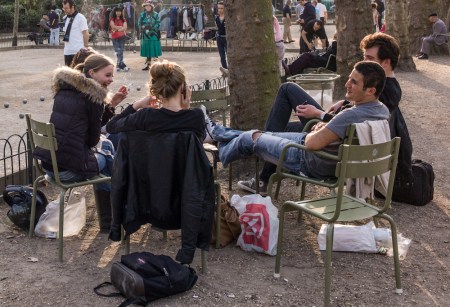
Leica M9, 35mm Summilux, Luxembourg Gardens, March 23rd, 2012
Philip Kennicott’s parched and somewhat misleading review in The Washington Post, focus on the techniques invoked to fool people — the “I Spy” emphasis of the curators — rather than the images themselves. “The assumption driving these (photographic) experiments,” Kennicott writes, “is simple but problematic: By masking the presence of the photographer, one can get a deeper, more unguarded truth about people. As Evans put it, he wanted to capture people “in naked repose,” with their guard down and “the mask” off. Whether it’s Freudian slips of tongue, unwanted conversations caught on a hot mike or leaked videotape from cameras no one knew were on, we tend to believe the spontaneous self is the honest self. But it’s a quirk of modernity to believe that the social mask is false and that there is some kind of genuine authenticity underneath it.”
But this misses the point. And unfortunately the equating of street photography with spying using deceptive techniques allows him to get away with it.
There is a simple reason why street photography matters, why it is interesting as a documentary artform. People are always the most interesting subject for a photographer. Landscape photography is aesthetically pleasing. But photographs of real people engaged in living are fundamentally more interesting than images of mountains and rivers, no matter how lovely. We love Ansel Adams’ work, but Henri Cartier-Bresson’s put down — that Adams and others were taking pictures of rocks while the world of the mid-20th century was coming apart — rings true.
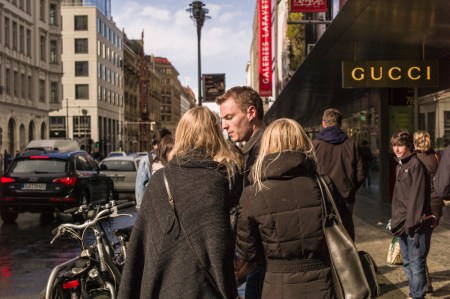
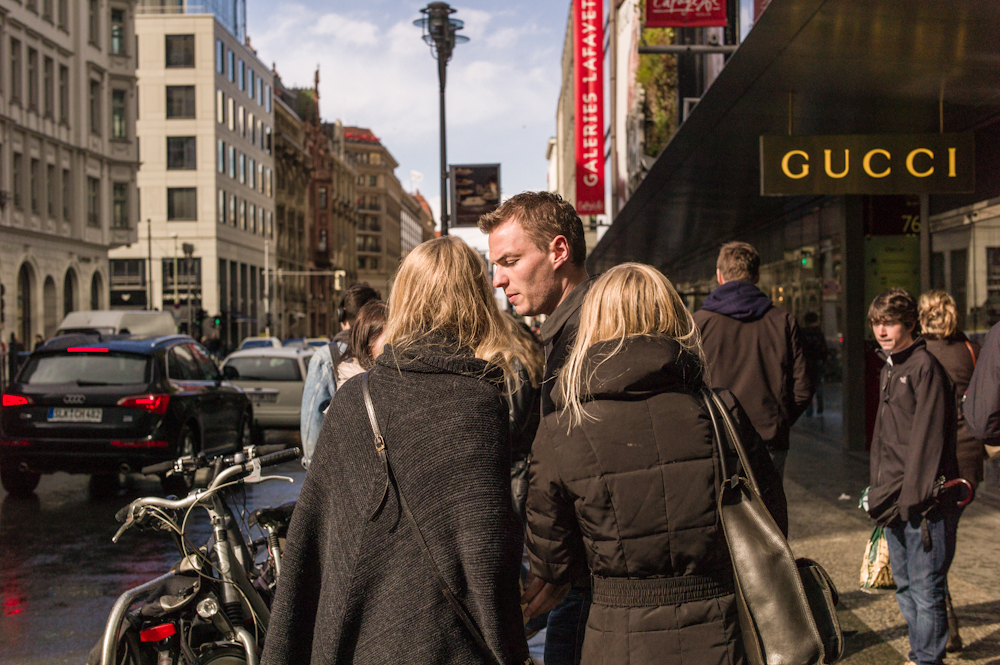
Spontaneously capturing people going about their business doesn’t need the subterfuge involved in “I Spy.” You just lift your camera to your eye and capture what’s coming your way.

Leica M9, 35mm Summilux, Friedrichstrasse, Berlin, March 30th, 2012
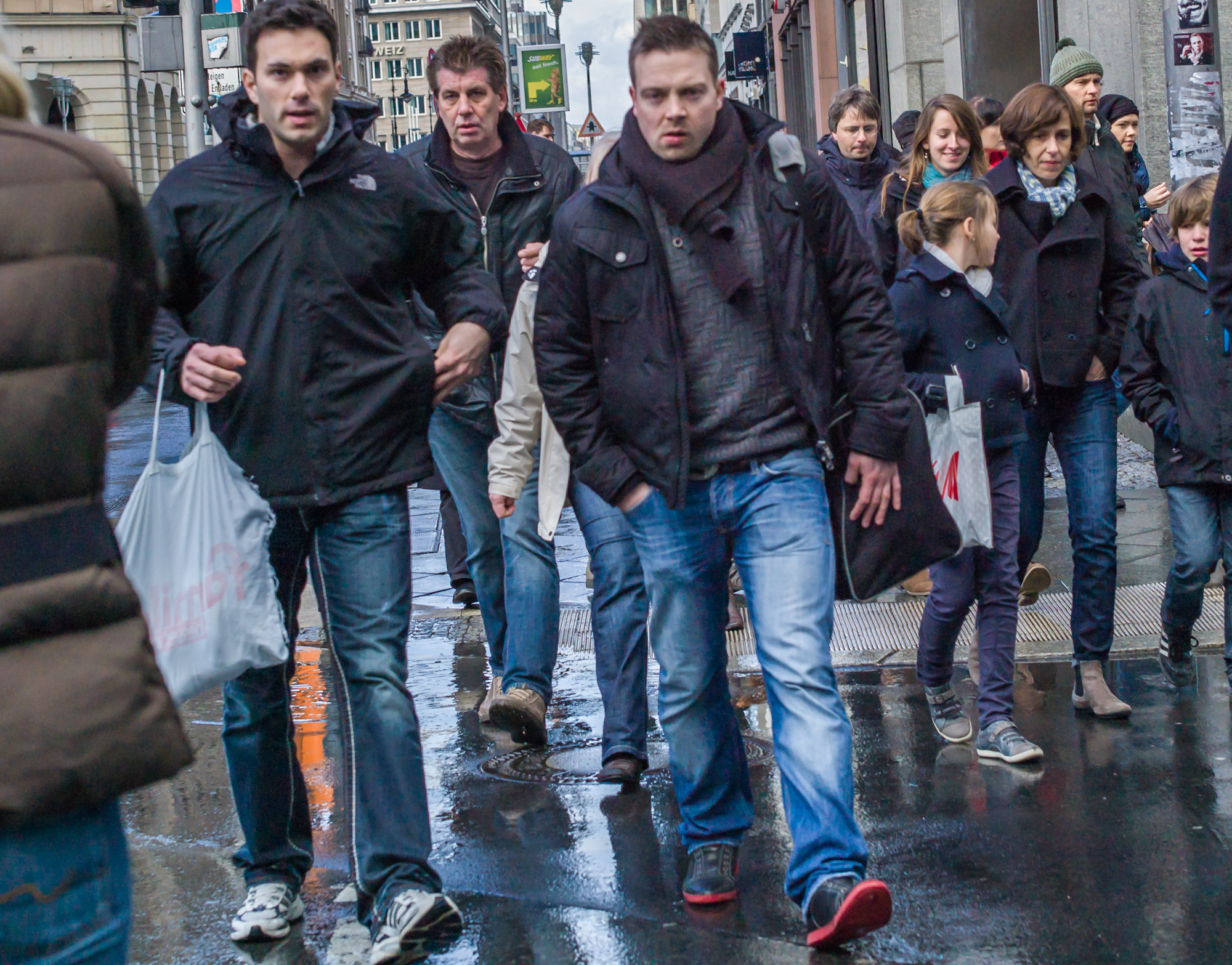
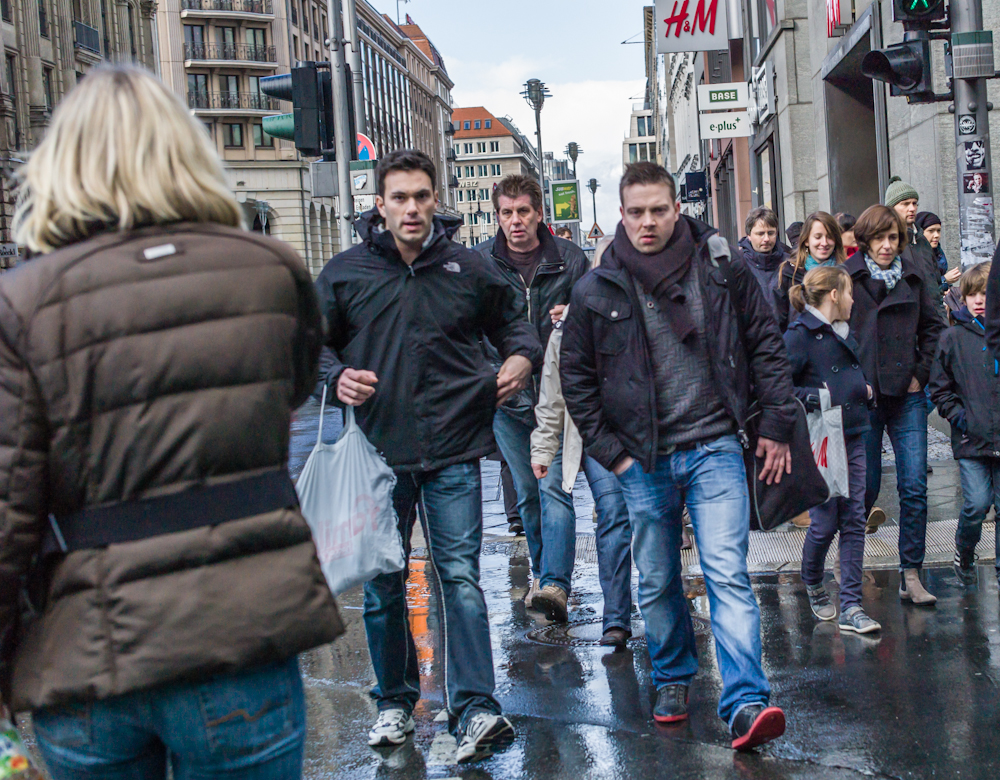
“I Spy” focuses on street photographers using the most extreme mechanisms for capturing their slice of life. In reality, street photographers are more likely to use wide-angled lenses, freely shown, than telephoto lenses from the equivalent of a duck blind. The images taken by artifice in “I Spy” — Harry Callahan’s capturing of women on the streets of Chicago from a fixed position with a telephoto lens, Walker Evans’ use of a camera hidden in his shirt — really could as easily have been captured via a more straightforward manner. And in fact, there are dozens of street photographers that could have been included in this exhibit that use less extreme techniques.
Leica M9, 35mm Summilux, Friedrichstrasse, Berlin, March 30th, 2012
The best single subset of the exhibition are Magnum photographer Bruce Davidson’s images taken in the New York City Subway system in 1980. It captures all the grit, all the reality of what life was like in New York in that year of the subway strike, of The Clash playing at Bonds, of chaos and disorder. Today New York is closer to antiseptic Singapore than it is to its old 1970s sexy self. Davidson captures this long-ago slice of life, not by artifice, but in search of straightforward truth: he carried his camera onto the subway openly, taking his camera, and his life, in his own hands.
Cartier-Bresson said, “Photographers deal in things which are continually vanishing and when they have vanished there is no contrivance on earth that can bring them back again.” Davidson captured a vanished world, with realism and truth. He didn’t need to spy to capture the truth. He just need to get out there in search of the most interesting topic that art can ever serve up: people in the act of living their lives.

 Tulip Frenzy