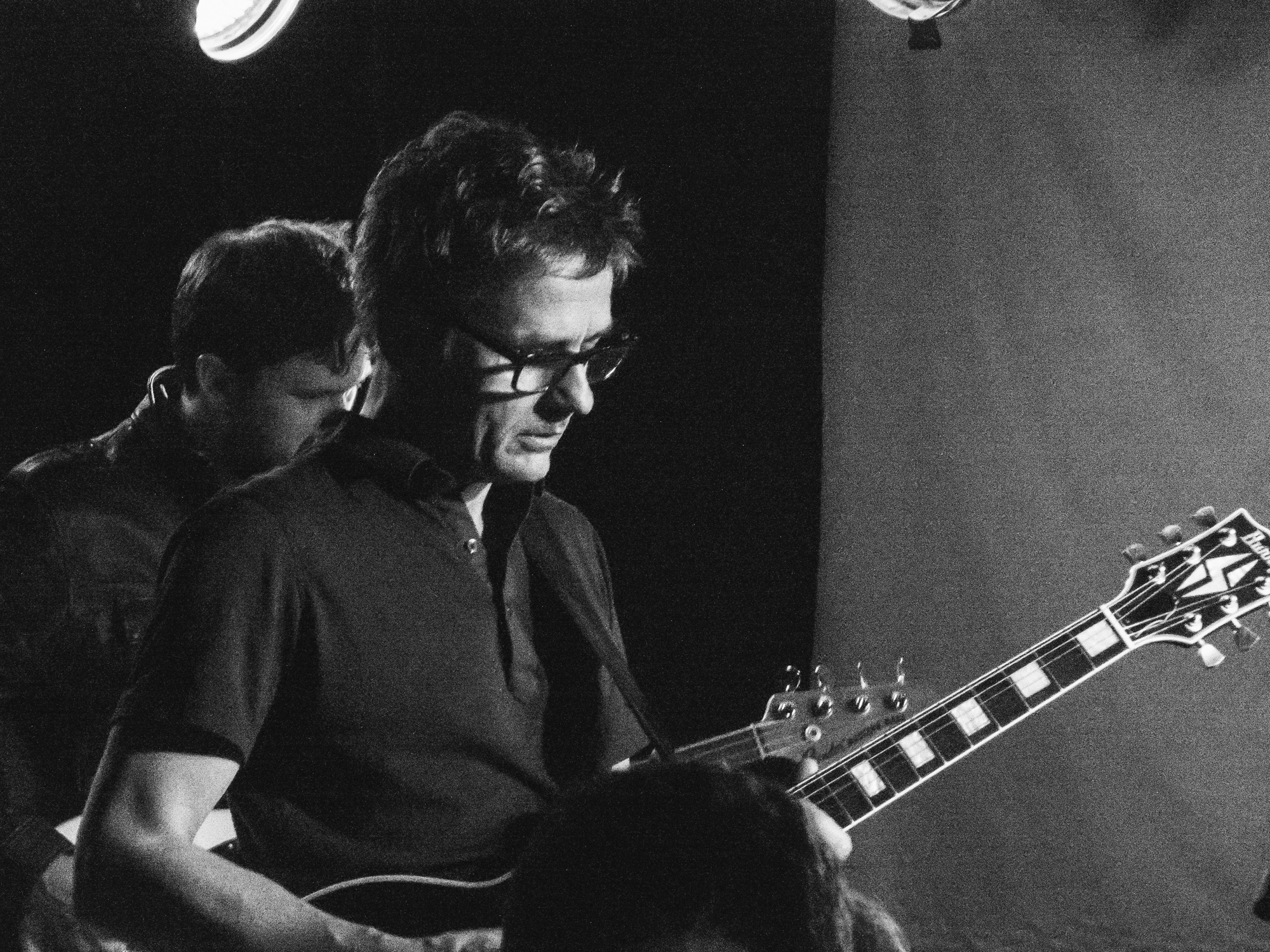
Leica M, 50mm Noctilux 0.95, ND filter, LR into Nik Viveza.

Leica M, 50mm Noctilux 0.95, ND filter, LR into Nik Viveza.

In the art world, museums sometimes wait until an artist’s demise before putting on a full retrospective of his or her work. Dean Wareham’s only 50, but last night at the dark and dank U Street Music Hall we were treated to almost a full career’s worth of his brilliant songwriting, canny guitar playing, his emotionally distant but vibrantly alive sensibility. The set began with “Blue Thunder,” from Galaxie 500’s On Fire, which was released in 1989, and ended with that same band’s “Tugboat.” In between came some of our favorite Luna songs — “Tiger Lilly,” “Lost In Space” — the title track from last year’s Emancipated Hearts mini-album, and an assortment of good ‘uns from the new Dean Wareham solo album. His final cuts, which you knew would include covers, were the Luna staple “Indian Summer” (Beat Happening) and New Order’s “Ceremony.” Yeah, that’s a career-length assortment, minus anything from Dean & Britta’s best — 13 Most Beautiful — which it seems he likes to play in full, not piecemeal in a set like this.
It’s been about 10 years since we’d seen Wareham, nine years since Luna, our favorite band for many years, called it a day. We did not seen any of the shows that Dean & Britta played showcasing the Galaxie 500 songbook, so last night was the first time we ever heard them play “When Will You Come Home,” the first time out of the maybe 15 times we’ve seen Wareham play that he reached into his grab bag and uncoiled the astonishing guitar work he exhibited as a 25-year old half of his lifetime ago. He’s got grayish hair now, and wears solid-framed glasses, looking more like a Harvard professor than the Harvard student he was when Galaxie 500 began, but he can still play. OH man, can he still play. Which is more astonishing, the solos uncorked in “When Will You Come Home” in 1989 or last night? Well, 25 years ago, Galaxie 500 made our jaws drop (as we heard them on record), because Wareham and his two bandmates had found a more compelling way to jack into the Sterling Morrison-led version of the Velvet Underground than any band we had at that point heard. Today, it’s every bit as glorious.

In recent interviews, Wareham has hinted at a return of Luna, or at least that there is a possibility of this happening, whereas there’s no chance he’ll get back together with Damon and Naomi and play Galaxie 500 songs with the original band. We loved Luna, and our rock’n’roll life has been just that wee bit emptier without them. But now that Wareham has released, in the span of four or five months, two collections with songs as amazing as “The Deadliest Day Since The Invasion Began” and “Holding Pattern,” and is willing to tour dipping into a playbook that spans 25 years, we’ll be very content.
Leica M, 50mm APO-Summicron-ASPH.

Playing songs from his latest album album all the way back to Galaxie 500’s “Tugboat Captain.” More anon.
“Do The Manta Ray,” kept going through our heads, and let us say, when you are snorkeling in water the color of Gatorade Cool Blue you really don’t want to be thinking about the Pixies. Do you? Leica M, 50mm APO-Summicron-ASPH.

The evolutionary trend by which rock critics become rock’n’roll musicians seems more typical than a rock star becoming a critic, but it’s not like the latter is a crime against nature or anything. After all, said rock musician probably gravitated toward his calling out of a deep love for music, and certainly we know bands going all the way back to the Beatles and Stones began to bash around on guitars out of the sheer cussed joy of wanting to emulate their idols. So let’s just take as a given that rock’n’rollers have great knowledge about the music that lit their particular match. Nonetheless, it’s unusual for a musician to become a rock critic, and highly unusual for one to become anywhere near as erudite as Richard Hell is.
Last week, we wrote with admiration that Richard Hell’s piece on the Velvet Underground in New York Magazine was the best essay ever written about that band. We were right and wrong. Hell did write the best essay ever on the Velvets. The thing is, it was a different essay, published in 2008 in a book called Rock And Roll Cage Match, edited by Sean Manning, in which Hell had the Velvets post up against the Stones, out of which he called a winner.
We’d never seen the book or read the essay ’til Richard pointed it out to us in the series of emails in which he let us know that the new Velvets essay was, in fact, online. He sent us the earlier essay, and we also went out and found the book. And we have to say, his piece on the Velvet Underground vs. the Rolling Stones is one of the best essays about rock’n’roll we’ve ever read. We won’t go so far as to mimic the book and set up a fantasy cage match battle between Hell and Lester Bangs, or John Mendelsohn, or Byron Coley, or Richard Meltzer, or even Robert Palmer. Let’s just say that posting Hell up against any of our fave rock critters, he’s indomitable.
The Velvet Underground are not our all-time favorite band, but they sit cross-legged near the settee in the middle of our pantheon, and let us give ourselves credit where it’s due, they have been so since we were a mere boarding-school vinyl-head, and we glommed onto Loaded upon its release. Yes, the last of their albums released while the band was extant, even if the worst of their four core albums (VU, which came out in ’85, had enough good stuff on it that at the time we’d never before heard that it deserves to be considered as one of their original records.)
But much as we have loved the Velvet Underground for more than 40 years, if we had to testify to who our favorite band ever was, it would be the Rolling Stones. Yes, we’ll admit it, even though if you look at the Tulip Frenzy “About” section, we make no mention of the Stones. That’s because, from the moment that Ron Wood replaced Mick Taylor, from the time Nicky Hopkins no longer got their phone calls, and Bobby Keys and Jim Price were no longer paired as the horn section, it has been all downhill. But no band has ever had that command of our attention, that claim on our affection, as the Stones did in the early ’70s. We were out-of-our-heads excited in ’79 to see the Clash; it doesn’t begin to compare to how excited we were to see the Stones play in Boston Garden, and then Madison Square Garden, in 1972.
So Hell writes an essay about both bands together, or shall we say, about the Velvets and Stones in opposition, and it is brilliant. He sets up the hugely successful Stones versus the commercially unsuccessful Velvets in a way that is incredibly insightful and amusing. And then he does a position comparison like it’s the first game of the World Series and you have to give one team or the other the edge at First Base. We’re not going to quote it here. We’re going to try sending you to the book, so you can buy it. But let us just say that Hell gives the best description ever of what one wants from a front man in a rock’n’roll band, defines the essence of the Rolling Stones — which of course we already knew was Keith, but also — by a single word: soul. He gets a few things wrong, in our opinion — we are higher on Beggars Banquet than he is. He gets so much else so right.
Okay, okay, we have to quote, listen to this insight on Lou Reed’s songwriting: “Reed’s lyrics probably do come the closest to poetry of any in rock and roll. Dylan is his only competition. Dylan rules, but I’d venture that the lyrics on The Velvet Underground are the best as a suite, as an album set, of any in rock and roll history.”
So true! If we were a teenage girl reading a favorite novelist, we might even underline that six times and put an exclamation point in the margins. As it is, we just have to nod and agree. As we do, interestingly enough, with his ultimate conclusion. (You already know from what he wrote in New York that he would put the Velvets on the podium just above the Stones. In our rock’n’roll dotage, we are now inclined to agree.)
Go buy the book. Better yet, go buy his books, especially I Dreamed I Was A Very Clean Tramp. We’ve long known the man can write. His essay on the Velvets vs. the Stones is even better than his recent essay on the VU, and one of those pieces of rock critterdom that is as breathtakingly thrilling as even Richard Hell and the Voidoids playing “Time.”
Sometimes nature does all the work, and you’ve only to point the camera, in this case, down. Sebastiao Salgado brought back the most beautiful untouched regions in the world depicted in black and white. We’re not sure what’s below is untouched. We are sure it deserves to be rendered in color. Leica M-240, 50mm APO-Summicron-ASPH, very light touch in LR5, colors certified accurate.

 Tulip Frenzy