Archive for the Music Category

Bryan Ferry Casts His Vote At The Strathmore

Posted in Music with tags , , on October 4, 2011 by johnbuckley100

Leica Digilux 3

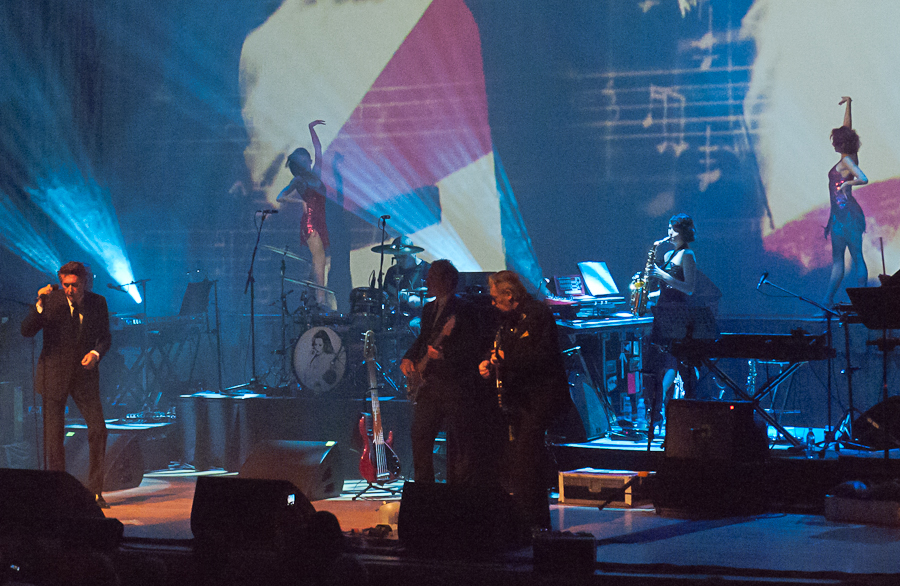
Before seeing Bryan Ferry for the first time since Roxy Music’s Siren tour — which occurred right around the time Gerald Ford was handing out WIN buttons — we wondered which Bryan Ferry would show up.  Would it be the hurricane that hit rock as a Category Five force, adding art and glamour to the old three-chord shuffle?  Or the Eurosmoothy whose solo albums since the ’80s have been like a ride in a Bentley, elegant but sensationless?

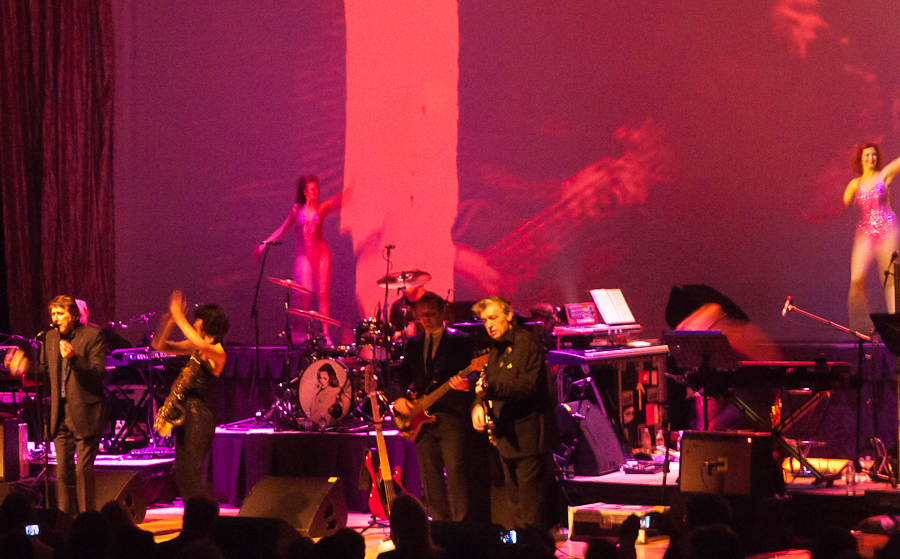
It’s such a pleasure to declare that Ferry played two-one hour sets reminding us how great Roxy Music and those early solo albums were.  Maybe his audience has forgotten just how revolutionary a song like “If There Is Something” was when that first Roxy Music album came out, but judging from the enthusiasm with which Ferry and his 9-piece band played it, he hasn’t.

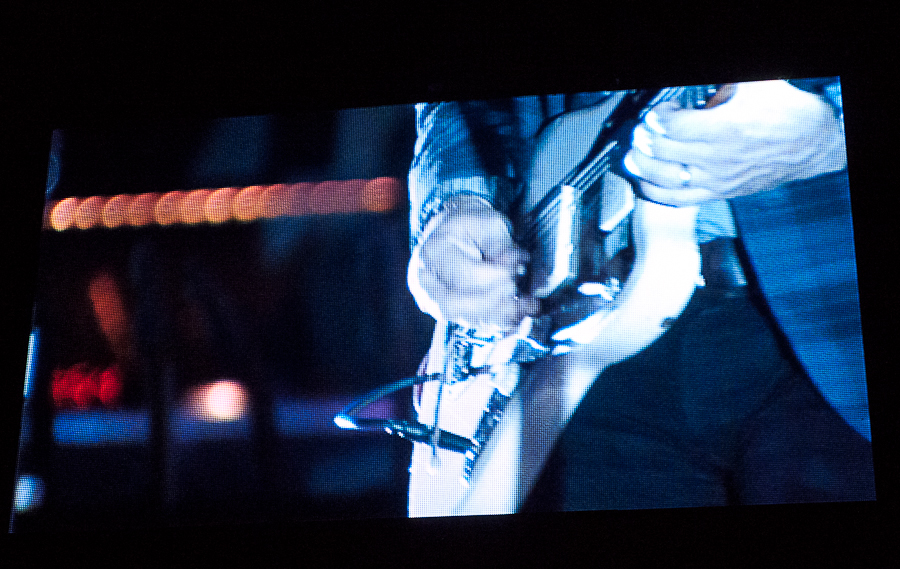
It’s not often that you come back from a concert and comment on how well it was art-directed, but this is who we’re dealing with.  While the two go-go dancers writhed, and the chick singers sang along, the screen behind the band was a roiling sea of images, some from cameras on the band, some from a familiar iconography of party scenes that may as well have been the Titanic, so doomed and distant was that world.  The band was fantastic — with Roxy’s Paul Thomas on drums and the great Chris Spedding putting on a guitar clinic.  The flash young guitarist on the other side of the stage would wind up to take a furious solo, and when he was done, the old pro would barely tip his quiff toward his axe before blowing the young ‘un off the stage with a solo as concise as it was explosive.
Leica Digilux 3

Ferry’s voice was hoarse, and missing its trademark warble.  What once was so dominant and yet so easy to parody that Eno could nail it in “Dead Finks Don’t Talk,” was now sufficiently limited that Ferry sort of hid within the mix, the big band, the four other singers.  No matter.  Ferry’s choice of songs was exemplary, even if he no longer felt able, or willing, to give us “Tokyo Joe,”  or “When She Walks In The Room.”  The first set heated up with “Just Like Tom Thumb’s Blues,” and included Roxy Music highlights like “Casanova” and the aforementioned “If There Is Something.”  The second set included “Love Is The Drug,” and “Let’s Stick Together,” and of course Roxy Music’s only #1 hit, John Lennon’s “Jealous Guy.” Along the way he covered Neil Young’s “Hurricane,” as well as “All Along The Watch Tower,” both of which were fine enough, but we wish he’d covered more of the work of that great songwriter, Bryan Ferry.  We wish he’d spent more time on those immediate-post Roxy Music solo albums, In Your Mind, and The Bride Stripped Bare.  After all, he had Chris Spedding standing four feet away.

It has been easy to forget the revolutionary influence that Ferry and Roxy Music had .  Ferry’s career arc has taken him from genuinely disruptive genre-bending to a self-conscious effort at invoking elegance, which is the antithesis of what we love about rockn’roll. It’s as if Miles Davis’s evolution saw him eventually playing smooth jazz.  It is possible that generations have grown up not realizing that Ferry started as a musical bomb thrower.  Happily, the complete package was on display last night, a madeleine, lost time found again.

The newly released Olympia, which Ferry’s touring to support, started life as a Roxy Music reunion album, and yep, even Eno decided to show up.  But we’re glad it doesn’t have the band’s name attached; with it’s deep bottom and granite-smooth perfection, it’s closer to being one of those scented-candle mood albums, with Ferry, dressed in an Anderson & Sheppard suit, playing a world-weary Barry White rather than the high-strung artist who declared it was time to do the Strand. We say Roxy was influential, and it surely was, though Ferry’s Roxy Music eventually begat bands like Duran Duran and Spandau Ballet, while the departed Brian Eno went on to influence bands like Garbage and the New Pornographers, to say nothing of Talking Heads and U2.  But at it’s peak — Country Life, with a hat tip to the albums that came just before and after, Stranded and Siren — Roxy Music was Bowie’s only competitor for the mantle of early ’70s greatness.  For after the Stones’ 72 tour, the entire rock infrastructure began to collapse.   Even though some bands (Stooges & Dolls) anticipated punk without knowing what was coming, even with the advent of Big Star, it was a fallow period.  It diminishes Roxy Music not one whit to declare it was the most fascinating band around, circa 73′-’75.  From the moment we heard “Amazona” — the moment we realized Phil Manzanera’s muscular guitar was the butch answer to the seemingly fey Ferry — we knew the post-Eno Roxy Music could be every bit as evocative as it had been before the little genius bid adieu.  Maybe we didn’t know just how important he would turn out to be, but from “Amazona” on, it was clear that even with Eno gone, Roxy Music would continue to push all boundaries.  Which they did, for one more album, and parts of the one after that.  And then it was over.

If you don’t remember those days, Ferry does, thank Heaven.  He may have become the de facto spokesmodel for Savile Row, but last night’s re-make, re-model was a remembrance of just what wildness beats beneath that surface calm.
The Mekons, Grizzled Treasures That They Are, Come Through For The Umpteenth Time

Posted in Music with tags , on October 1, 2011 by johnbuckley100

Ancient and Modern is the perfect title for a new album by the Mekons, because of course they are both.  Thirty-three years after we heard “Where Were You” for the first time, nearly dropping both pint and jaw, the Meeks have released an album filled with modernistic ensemble charms, as the redoubtable Jon Langford, youthful vixen Sally Timms, and the publican crooner Tom Greenhalgh once more destroy their safe and happy lives in the name of rock’n’roll.  It is, for them, a pretty straightforward affair, as the whole tribe shows up in force — there’s Rico on the accordion, and surely that’s Susie on the fiddle — to update Leeds punk with Chicago grit, modulated by folky purrings from a green and pleasant land.

Over the years — the decades — the Mekons have turned out some records that produced smiles if not long-lasting joy.  When on form, though, they’ve produced artifacts that future rockologists will dig up and behold with wonder, thence to try answering the riddle of why they weren’t the hugest band around.  And should one of those future rockologists seek out Tulip Frenzy for guidance, let us be clear where we stand: we believe that the Mekons, from the moment in 1978 they entered a studio to record “Never Been In A Riot” without any previous experience playing their instruments, to this day, when  a merry band of first-rate singers and musicians can still make great music, live and in the studio, the Mekons have produced more great rock’n’roll music than any of their contemporaries, which include the Clash, and Gang of Four, and the Buzzcocks, and whatnot.  (More is too easy, as they’re the only one of those bands never to have broken up in more than 30 years of playing together – Ed.)  And not just more, but in many ways better albums than their contemporaries.  For perhaps other than London Calling, has any of their peers produced an album as fine as Rock n’ Roll?  We think not.  (Ok, ok, you made your point – Ed.)

Ancient and Modern will not likely be played as long, or as often, as we play those albums produced during the Mekons’ Golden Age (from roughly the mid-80s to the mid-90s; from The Edge Of The World until the under-appreciated Retreat From Memphis.)  At the pinnacle — from So Good It Hurts, through Rock n’Roll and I (Heart) The Mekons — the Mekons could at once make you remember they were contemporaries of the Clash, and admire them all the more for never giving up.  Later, they posted some remarkably great late-innings performances, in particular Journey To The End Of The Night.  Ancient and Modern, both as a collection of songs and as a performance, doesn’t reach those heights, but come on, the mere fact they still grace us with their music is reason to wake up in the morning.

Over the years, the key indicators for a Mekons album have been: are Langford’s rockers memorable, did Sally Timms get some melody to which she could apply her sultry vocals, and is Tom Greenhalgh noodling, or singing a song as perfect as “Heaven and Back.”  “Space In Your Face,” “Honey Bear,” “The Devil At Rest,” and “Warm Summer Sun” are reminders of how much we owe to Ancient Civilization, and just how much life there still is in those old bones.

Wilco And The Art Of Being There

Posted in Music with tags , on September 27, 2011 by johnbuckley100

Leica D-Lux 3, ISO 800

Modern Wilco, the hip band that from Yankee Hotel Foxtrot on tuned us in to mysterious frequencies and gibberish language floating on the radio waves, is hellbent on showing their breadth.  So it is they could play a languid folk song like “One Sunday Morning (Song For Jane Smiley’s Boyfriend)” at Merriweather Post the other night, immediately following the Television-like “Black Bull Nova.”  Sometimes their folky consonant impulse is trumped by their noise-rock dissonant impulse in the same song, such as “Via Chicago,” which led off their encore, and includes the band just wailing, from out of nowhere, while Tweedy sings on as if nothing were amiss, his youthful voice prettily keeping to the melody.

There’s something oddly satisfying about their sweet’n’sour approach, even when it’s revealed as schtick.  When “I Am Trying To Break Your Heart” led off Foxtrot a decade ago, it was at once a reminder of the junkie cadences of Tom Verlaine’s “Yonki Time,” mashed up with the raw angst expressed by Alex Chilton in Sister Lovers — an in-the-moment, off-kilter, druggy song charming mostly in the way melody fought through entropy.  But now when they come out and they play it note for note — well, it’s incredibly powerful, but it’s show biz, right, an amazingly proficient band able to re-manufacture the moment of creativity, on stage, before 10,000 people, night after night.

I’ll take Wilco’s perfectionist absence of spontaneity over a less ambitious band’s more sincere raucousness, so long as they keep churning out albums with the scope and ambition of The Whole Love, released today, and with enough grist that we’ll be working through it for months, maybe years.

We’ve previously referenced how The Whole Love invokes Wilco’s Beatles impulse.  On Sky Blue Sky, we loved the tongue-in-cheek evocation of Abbey Road‘s sound — from Ringo’s plodding drums to the Billy Preston keyboards during the bridge of “I Hate It Here.”  On The Whole Love, we have Tweedy invoking John Lennon on “Sunloathe,” and “Capitol City” could have fallen off the back of the truck carrying The White Album master to the factory.  Just as we don’t begrudge them their consummate professionalism onstage, we love the fact that only Wilco and Olivia Tremor Control have figured out how to sound like the entire quartet, the complete Fab 4 — a little Macca vocal, a-a-nd here’s that George slide sound…

The first three songs of the concert the other night, all from The Whole Love — “The Art of Almost,” followed by “I Might,” followed by “Black Moon” — could be Wilco in miniature: experimental art-rock building to a psychedelic crescendo, followed by an homage to the New Wave soul sound of Get Happy, followed by a tuneful acoustic picker of almost breathtaking delicacy.  Sometimes the live band consists of three guitars and a keyboard, or two keyboards and two guitars, but its sound is always dense and layered, with multiple virtuosi — talents on the order of Nels Cline and Pat Sansone aren’t usually teamed in the same band, just like baseball teams don’t usually have a rotation like the Phillies’ — and always there is Tweedy, the Everyman with the rumpled, just-out-of-bed-even-if-I’m-dressed-up look, and the voice that is astonishingly even, steady, youthful, deceptively elastic and true.  We used to think it was anodyne, now we think it’s genius.

Longtime readers of Tulip Frenzy know that, over the years, we’ve been ambivalent about Wilco, for one reason in particular.  We don’t like bands that lull people into singing along with what we’ve perceived as heroin-chic lyrics — “Guess all I need is a shot in the arm… there’s something in my veins bloodier than blood”– etc.  In fact, the other night, we saw a dad lifting his little tow-head girl into the air while singing those words, and we thought, “Good God, man, listen to what you’re singing!”  On the other side of the ledger, when critics put down Sky Blue Sky because after Foxtrot  and A Ghost Is Born, it supposedly lacked “an edge,” it was a dumb allusion to Tweedy’s post-recovery sobriety, and one that pissed us off.

We’re done wrestling with Wilco.  The band that once titled an album Being There is — if you are there and in the moment, as they say — incredibly entertaining and enjoyable.  They also are, by dint of their accumulated songbook and the weight of their albums, the most “important” band of the present age, and what they produce achieves genuine greatness.  From the Southern rock of A.M.  to the encyclopedic The Whole Love, Wilco’s growth curve puts a fair number of pantheon cohabitants — we’re talking about you, U2 — to shame.  We throw in the towel, and not with reluctance.  Wilco has earned full rights to our devotion.

UPDATE: Anyone noticed how near the end of “One Sunday Morning (Song For Jane Smiley’s Boyfriend),” Nels Cline and Mikael Jorgenson/Pat Sansone sound EXACTLY like Fripp and Eno on Evening Star?

UPDATE 2: Dig the way on the D-Lux version on iTunes, includes the song “I Love My Label,” which is a direct invocation of Camper Van Beethoven.  Anyone can invoke the Ramones, but only the very cool dare sound like Camper.  Nice move, and happy about the record label, guys.

Jesse Sykes And The Sweet Hereafter Spend The Afterlife In Our Mind & Then The Mystery Gets Solved

Posted in Music with tags , , on September 14, 2011 by johnbuckley100

A stopped clock is right twice each day and about once a year, Jon Pareles actually does his job well enough to send us off to check out music we had not heard before.  So it was, in early August, that we discovered Jesse Sykes and The Sweet Hereafter’s Marble Son.  It’s a beguiling record, spooky, weird, and haunting.  And hugely satisfying.  But of course while Pareles’ description got us intrigued enough to check our couch for quarters before walking down to the iTunes Store, he was off in his description of the band. “There’s nothing neo- about this band’s psychedelica,” he wrote.  Okay, we thought.  We filled up the waterbed, donned our paisley duds, and put on the headphones, only to discover… well, the music’s not quite psychedelic, neo- or otherwise.  Something else, something that we couldn’t quite put our finger on.  It was killing us.  Love the band, the guitarist is a killer, but who’s he when he’s at home, as they say?

On the difficulty of categorizing these guys we might even be sympathetic to the Chief Music Critic For The New York Times, or whatever Jon amounted to, because this is a hard band to get a handle on.   These aren’t refugees from the Summer of Love. Better to imagine Blind Faith recording their album in the Bay Area, in that achy period of post-psychedelic disillusionment.  When they flex their power chords, which they do quite often, the thundering riffs can bring to mind current San Francisco neo-psychs Assemble Head In Starburst Sound, or maybe Black Mountain, though there’s a finger-picking delicacy too. What makes The Sweet Hereafter sui generis — and passing strange — is their leader’s voice.  There is nothing else in rock’n’roll music to compare to Jesse Sykes’ voice.  We’re sort of amazed that someone who sings like she does would think of music for a career path.  And we like her!  This isn’t a put down!  But when we close our eyes and try imagining who might be singing, I swear to God what comes to mind is a vision of The Good Witch breaking into a lamentation over being dumped by the Wizard of Oz.  And then the band leaps into this Quicksilver Messenger Service coda that makes Devendra Banhart’s band seem like plodders.  When Sykes sings a single line, unadorned by harmonies layered on by herself or others, there is something so theatrically out of time that, yeah, I guess psychedelia sounds about right.    And when she fires up the whole chorus — listen to the title track, for starters — angelic magic comes galloping in like a horse of a different color.

So we got to thinking… As unique as Jesse’s voice may be, the guitarist sounds familiar… and is so remarkable, for weeks we’ve been tantalized.  “This sounds like someone, who?”  And we read her bio on her website, and saw the reference to “Wandscher” and thought about it a little… the tumblers begin to click… and we slapped our forehead!  It’s Phil Wandscher, the guitarist from Whiskeytown!  The hugely canny guitarist on only the single greatest record of the ’90s, Strangers Almanac.  And it all makes sense.  So… imagine if Whiskeytown were jamming in some first communion afterparty with the Good Witch…  Well, you get the point.  Now get the album.

Wilco’s Wildly Ambitious “The Whole Love”

Posted in Music with tags , , , , on September 4, 2011 by johnbuckley100

Years ago, when Wilco was nailing Southern rock and becoming alt.country demigods, you may not have thought of them in the same breath as The Beatles, but in late September, when they release The Whole Love on Apple Records — I mean, on their own label using Apple’s iTunes Store — you’ll see what we mean.  WilcoWorld has nicely let us stream the album in its entirety for the past 24 hours, and in a throwback to those days when one would listen to the Beatles or Stones or the Who’s new album over and over, we’ve done just that.  The player even shows a vinyl record spinning.  They have a complete understanding of what they’re doing, of the company they’re in.

“Art of Almost,” which kicks things off, might make you think of Radiohead before you’d ever get to, say, Uncle Tupelo. When Nels Cline shows off at the end, it’s not some exercise in formalism, but an embrace of rock’n’roll song extension, a throwback to those vinyl days when what was so enchanting was the way bands would leave the tape spinning as they boogied on in the studio and you wished you were a fly on the wall for that moment when, ten minutes after the song officially ended, the musicians would just, suddenly, stop.  (Sometimes you’d even hear a guitarist yell, “I’ve got blisters on me fingers!”)

We’ve been listening for weeks to “I Might,” the single, and it’s a bright bit of power pop replete with Farfisa.  And a reminder that, if Wilco can start a new album with two such different expressions of possibility, this is a band that can play anything.  And on The Whole Love, they do.

Ten years ago, when Warner Brothers was defiantly proving why record labels were willing themselves to extinction by refusing to release Yankee Hotel Foxtrot, it did seem to me that that record had taken Big Star’s Sister Lovers as its template.  You know what I mean, a big, troubled, druggy mess with enough beauty at its core that it was riveting.  An idea that was proved by I Am Trying To Break Your Heart, the documentary that illustrated why the band needed to be reformed, with the cerebral Cline replacing the late Jay Bennett as Tweedy’s instrumental foil.  On The Whole Love, the template that comes to mind is The White Album. A big statement, yes, but the melding of acoustic songs, the delving into idioms that preceded rock’n’roll, the notion of craft that transcends what any other rock band in the universe might produce – these guys don’t even have the Stones as peers, they are literally peerless — all the while clinging to sufficient pop structures that even contain hooks… Well, Wilco by now are masters, sui generis.  Except, increasingly, for invoking one band in particular… It’s not just that “Sunloathe” sounds like it could have been on Abbey Road, that Tweedy sounds like Lennon and that Cline plays his George Harrison guitar.  These guys have reached that upper echelon of rock experimentalists.  Again, ambitious like The Beatles.

We thought Wilco (The Album) was a rare letdown, a step backward after Sky Blue Sky.  It was almost as if they went to New Zealand as much to record 7 Worlds Collide as their own record.  Now, after two years of hosting their own festival showcasing their taste and side projects, they came roaring back with something bigger, stronger, more ambitious, more tuneful than anything that has come to date.  This is a band that would seem to be at the top of its form, if they also didn’t seem so ready to take things into an historic next level.  By the time you nod your head to the great album rock cut “Born Alone,” you’re ready for the grand conclusion of “One Sunday Morning,” a Dylanesque title for a Beatlesesque conclusion.  Get ready for a whole lotta loving of The Whole Love.

Stop The Presses: Olivia Tremor Control Release First New Song Since 1999

Posted in Music with tags , , , , , on August 31, 2011 by johnbuckley100

“The Game You Play Is In Your Head, Pts. 1, 2, & 3,” which Elephant 6 Collective founding papas The Olivia Tremor Control gave birth to today, contains in its 5:15 a history in miniature of what we’d presumed was a late and lamented band (at least in the studio.)  Sure, they’ve played gigs over the last few years when others of their ilk — from Neutral Milk Hotel to The Gerbils — have, well, collected themselves.  But a new recording?  One thinks of the great line by John Dunsmore when asked what it would take to get him to perform under the band name The Doors, and he said, “Well, if Jim Morrison returned…” We don’t know what led to this happy iTunes posting, but here’s the essential info:  it sounds exactly like the band that recorded Dusk At The Cubist Castle — you know, the Beatles and The Stones take a break from recording “We Love You” to all get high on nitrous oxide, while Eno, or is it Owsley? keeps the magnetic tapes running.  No, it doesn’t rock exactly as much as “The Opera House” or something, but in at least the loping opening movement, when the drums kick in, it has the power of a pachyderm on thorazine, and then turns into a hummingbird orchestra all playing kazoos!  And it’s only after that that that the real fun begins… And the album to follow?  Watch this space…

Do We Really Believe Jon Huntsman Is A Captain Beefheart Fan?

Posted in Music with tags , , on August 21, 2011 by johnbuckley100

On Thursday, former Utah governor and current long-shot GOP presidential candidate Jon Huntsman tweeted the following: “I wonder if a tweet where I admit how much I like Captain Beefheart will make the followers skyrocket even more!”

So do we believe Huntsman is a Beefheart fan?  Not really.  And it’s not simply because he throws the late Captain’s name out there as potential link bait.  We suspect instead that he has a very clever press secretary. While the son of a Utah billionaire and the late Don Van Vliet were geographically connected by the Mojave Desert, the distance between them seems just too great to have been crossed.

Some years back, when Republican Massachusetts governor William Weld served up Between The Buttons as his favorite Stones album, it had the immensely charming virtue not only of alluding to a quirky, semi-obscure record, but also of seeming authenticity.  Weld was a genuinely eclectic politician — a liberal Republican relative of Theodore Roosevelt, charmingly idiosyncratic in an upbeat preppy manner, a novelist who clearly wrote his own damn book.  You can see him listening to Keith Richards’ harmonies on “Connection,” on the last good Stones album before they hit their streak of genius, which began 18 months later with Beggars Banquet.

But the wan, former Obama appointee who is now trying to concoct a rationale as the sensible Republican in the race — eminently admirable for that, for sure, but nonetheless done with an air of contrivance — could be invoking Mr. Beefheart as a quirky touchstone.  So, to Mr. Huntsman, we pose the following quiz:

1.  What notable figure from rock’n’roll history went to high school with Don Van Vliet?

2.  In what canyon was Trout Mask Replica rehearsed?

3.  In which bands did Roy Estrada play before joining The Magic Band?

4.  What is the real name of Zoot Horn Rollo?

5.  What is your favorite Beefheart album, and why?  (If you name Clear Spot as your favorite, please indicate whether you believe Ice Cream For Crow was a sufficient final opus, or should he have just stopped releasing albums after Doc At The Radar Station?)

6.  Was Don Van Vliet a better singer or painter?

If Jon Huntsman — or even his press secretary — can answer those questions, Tulip Frenzy will endorse him for president.  Several can be answered by going to the Wikipedia.  But a few involve subjective decisions, and we think we will be able to discern whether the Beefheartian positioning is real, or a ploy to look more interesting than we suspect he is.

White Denim’s “D” And How Don Van Vliet’s Band Fared In Probate

Posted in Music with tags , , , on June 11, 2011 by johnbuckley100

Thirty seconds into “It’s Him” on White Denim’s new album, D, you’d be forgiven for thinking that Devendra Banhart inherited The Magic Band from Captain Beefheart. “To Byron Coley, Mr. Van Vliet left his ashtray heart. And to Mr. Banhart, he left his cassette player, his top hat, and his band.”

“Southern Prog” is how some have termed the expansion of White Denim from a trio to a double-axe murdering foursome, but this isn’t progrock.  This is sweet pop music rehearsed in Tex Watson’s garage, after an afternoon sipping jimson weed tea. Yes, the reference to The Minutemen is apt, but less so on D than anything that came before it. The addition of the perfectly named Austin Jenkins on second guitar doesn’t make it “Southern,” though having an additional guitarist adds a formalism to the rehearsed-within-an-inch-of-its-life machinery.  And when we say pop music, not Southern Prog, we mean that White Denim seem slightly closer in spirit to neighbor Jack White’s buddy Brendan Benson than to Duane and Dicky jamming with the Flaming Lips.  Moreover, progrock as a reference point only counts if a band like Citay can be thrown into this particular patch of prickly pear.

We did not expect ever to want to play a White Denim album for company, for they’ve previously been headphone stalwarts, guaranteed to clear a room waiting for the PTA meeting to start.  Yet D is such a tour de force we could see it entertaining a Mensa convention while anyone who ever loved Clear Spot could tap her feet and nod.  This is music for a late-night drive to the border, music to be played after that all-nighter as the sun rises over the Salton Sea.  More immediately, this is music to play as our Summer ’11 anthem.

Robyn Hitchcock’s Norwegian Woody

Posted in Music with tags , , , on May 28, 2011 by johnbuckley100

In rock’n’roll, there are two models for multi-album creativity.  Breeder reactors feed on their own energy and keep producing fissile material that glows in the dark — think of the Beatles between ’64 and ’69, or the Rolling Stones between ’68 and ’72, one great album leading to the next, until the core began to melt.  And then there is the bubbling spring that keeps bringing such pure goodness from a mysterious place underground you can only sit back on the mossy bank and marvel.  That’s the model that accounts for Robyn Hitchcock, who more than 30 years into a brilliant, deceptively steady career, may have just produced, in Tromso, Kaptein, his best album ever.

Robyn Hitchcock says (see post below) that when The Soft Boys began, they wanted to be a mix of The Beatles circa Abbey Road and Captain Beefheart circa Trout Mask Replica.  I would have thought them a mixture of Never Mind The Bollocks  and Ummagumma, but no matter. Over a career in which it would seem natural that bands like the dBs and REM would admire if not directly emulate him, and a quirky director such as Jonathan Demme would not only make a movie about him but also have him play a role in The Manchurian Candidate, Hitchcock’s music has been both sui generis and perhaps best compared to a folk-rock version of the Kinks with the occasional foray into the psychedelic boogie of the Quicksilver Messenger Service.  For Hitchcock isn’t simply a brilliant writer of beautiful songs, he’s also a thrilling lead guitarist whose British eccentricity is always somehow grounded in real rock’n’roll.  Yet his strength, too often, has been his weakness: an inability to stay serious… too many songs about insects instead of human emotions.  But perhaps no more.

Beginning  five years ago, when Hitchcock began to record with The Venus Three  (a band that included Peter Buck on second guitar — what does that tell you?) he has put out a collection of albums (with those and other musicians) that, for anyone else, would have been a career in itself.  Ole Tarantula led to Goodnight Oslo, which begat an antecedent collection entitled Propeller Time, which has now brought us Tromso, Kaptein.  It is not an exaggeration to say that this latest album is the best of Hitchcock’s late career output.  It is possible this is the best thing to bubble up from the deep spring of creativity that has been flowing since the Carter Administration.

Mostly acoustic (there’s an electric bass, Hitchcock only occasionally plays electric guitar here, and if there is a dominant instrument, it’s cello), Tromso, Kaptein is a stunning collection of moody folk-pop with enough hooks to land the Loch Ness monster if it dared wend its way through a distant fjord.  We challenge you to download “Old Man Weather” and then not devour the whole damn thing.  There is, thankfully, no reference to Trout Mask Replica, though the sheer pop ambition may remind you that Abbey Road was recorded in an 8 Track studio, and even in this diminished age, where an artist of Hitchcock’s rank produces an album of this quality for an obscure Norwegian label, the tools available allow such a craftsman to artfully produce a masterpiece on the cheap.  We don’t know precisely what Hitchcock’s obsession with Norway is, though we love the fact that he’s now re-released the song “Goodnight Oslo” as “Goodnatt Oslo,” and sung it in Norwegian.  Robyn Hitchcock is the Richard Dadd of rock’n’roll — a British eccentric who might rather be painting miniature fairies, but who has now the clarity of mind to give us an album with little irony, all beautiful and artisanal folk rock glistening like a spring-fed stream.

Capsula’s “In The Land Of The Silver Souls” Breaches U.S. Shores

Posted in Music with tags , , , , on March 16, 2011 by johnbuckley100

Capsula is a throwback to an era of punk rock that may not ever have existed, a remnant of a Platonic world where all songs are played fast, where the drummer keeps an animalistic beat for hours on end, a place where the pogoing guitarist can fill the stage and stage the fills with melody and soul as the girl bassist with the bunny ears rocks harder than Izzy Stradlin. They are, in short, a revelation, Buenos Aires expats who moved to Bilbao, Spain because in South America, in Tom Verlaine’s words, the distance it kills you, and there was no way to foster a career having to cross the Andes just to get a gig in Santiago or Punta Arenas.

When Songs & Circuits came out five years ago, we could scarcely believe our luck, pinched ourselves to find a modern punk band that played fast and offered steaming parilla of smoking riffs and still poured on melody like it was hot sauce. Rising Mountains had a few points deducted for sameness, for the too familiar problem of punk bands that evolve into generic rock. It was still hands down better than 9 out of 10 rock albums that came out that year.  They then traded favors with the esteemed Ivan Julian — after he produced their album, they cut his, serving as a high-class backup band on The Naked Flame. For the past year we have waited to find out if their third album would be a step forward.  (Others, released in South America earlier in their career, have been as lost to the world as an Incan alphabet).  And now we know: In The Land Of The Silver Souls, officially released here on April 4th, but magically available in the iTunes Store this morning, was delivered from Old Europe back to the New World.  March 16th, 2011 will not go down in history as a great day for Planet Earth, except… Capsula’s new album is precious metal, 14-carat pure and good.

The album kicks off, as Songs & Circuits did, with an indirect assault.  “Wild Fascination” stirs the blood, but it’s not til Martin Guevara wraps a guitar riff ’round Coni Dutchess’ ample bass and Nacho Villarejo kicks “Town Of Sorrow” into overdrive that we see plates sliding off the Bilbao Guggenheim as every Basque bastard starts to rock.  By “Hit’n’Miss,” a song that embodies the entire Capsula oeuvre in a single cut — Cali pyschedelica, garage rock, a frisson of Leaving Trains tunefulness — we’re convinced that Capsula’s new one dissolves into a salubrious groove.

The problem with punk bands, traditionally, is they either keep knocking their heads against the same brick alley wall, or they try to get somewhere.  Too often bands you really love — let’s take the not-quite-punk, but of that era classic L.A. band The Dream Syndicate as an example — get good enough to really play well but what they choose to play is… rock.  And your heart breaks.  This could have happened to the Clash, when Give ‘Em Enough Rope followed their epochal launch, but fortunately they then figured out how to turn to musical idioms — New Orleans syncopation, say, or rockabilly —  to infuse their music with its antecedent roots.  Happily Capsula’s going the Clash route, or should we say the Clash roots.  We hear occasional underpinnings of blues here and there, and in the daring “Communication,” they quite wondrously come close to the sound of Mr. James Osterberg’s “Penetration.”

Over the years, we’ve obsessed over the Fleshtones, the Mekons, Luna, and Television, the Stones and the Clash, the Brian Jonestown Massacre.  At the dawn of what appears to be a great year in rock’n’roll music, we’ve just played an album by a band that has emerged as our au courant fave, the Greatest Rock’n’Roll Band In The World, Circa 2011.   We’ve played Capsula’s new one maybe three times. We suspect we’ll be playing it for years to come.  If we’re lucky.  Capsula is playing at SXSW, like tomorrow.  If you want to know where the spirit of real rock’n’roll now lives, it’s in The Land Of The Silver Souls. And it prompts us to challenge First Communion Afterparty: your move.