Archive for the Music Category

Citay Updates Fripp and Eno For The Modern Age

Posted in Music with tags , , on July 11, 2010 by johnbuckley100

Just as the 1964 Worlds Fair seemed so spanking new in its evocation of the future, only to leave Queens with rusting metal and anachronistic architecture, there once was a time the coolest thing on Earth was the collaboration between Brian Eno and Robert Fripp.  That was a long time ago now, and though aspects of No Pussyfooting and Evening Star are every bit as relevant today as they were in the late ’70s, it does seem like these were remnants from a prior age.  You can still hear Eno’s mid-Seventies run of classic art-pop echoed in the choruses of the New Pornographers and likeminded archaeologists, but Fripp not so much.  Until we stumbled across the albums by San Francisco’s Citay.

Thanks again to Uncut‘s samplers, we’ve been playing Citay’s two albums — Dream Get Together and Little Kingdom — on airplane flights and mornings when we can wake up on our own terms (listening to music, not rushing to work), and they’re pretty great.  Not simply instrumentals like the Fripp-Eno collaborations, they’re more like Eno albums with a strong Fripp presence.  In some cases, the dual guitar figures become so baroque and intertwined, the music is too rich, like trying to subsist on a diet of chocolate cake.  But if you, like me, wish that Eno was still making pop records on his own, or collaborating with his crimson king pal, you’ll love these ‘uns.

Alejandro’s Interview On NPR

Posted in Music with tags , on July 2, 2010 by johnbuckley100

Always interesting to hear from the man himself.

When Alejandro Paints His Masterpiece

Posted in Music with tags , , on June 29, 2010 by johnbuckley100

In 2008, with the release of Real Animal, Alejandro Escovedo proved ready for his close up.  After years on the road, after his recovery from the ravages of Hep C and the beginning of recovery from the alcohol that caused it, Alejandro pretty much nailed it, insofar as churning out an airplay-ready platter was concerned.  Tony Visconti proved to be the sympathetic and ideal producer that weirdly a year earlier John Cale was not, though truth be told, The Boxing Mirror captured Alejandro brittle in the early stages of sobriety, dry on several levels, and still wobbly on his feet. With today’s release of Street Songs of Love, it has all come together: Alejandro has released the greatest rock’n’roll album of his long and storied career.

It wouldn’t be accurate to say I didn’t like Real Animal. I loved songs like “Chelsea Hotel ’78,” “Smoke,” and “Nuns Song.”  But I found “Always A Friend” too self-consciously an attempt to get into the managerial and artistic slipstream of Al’s new friend Bruce Springsteen, whose manager Jon Landau had taken on the duties of getting this unheralded American treasure known by a wider audience.  Those three songs rank among the best rock songs of Escovedo’s career, but too many of the softer songs fell into the nether region between rock ballads and the achingly beautiful chamber-folk concoctions that Alejandro had woven on great albums like With These Hands and Thirteen Years. I loved the concept of Alejandro telling his own story in a single album — going back through his days in San Francisco with The Nuns, or in New York with Rank and File, or Austin with the True Believers.  And I was happy to hear it actually played on FM radio.  I just didn’t really love it.

With Street Songs of Love the worry is that I’ll play it over and over and over again until my iPod, ears, and brain give out.  Yes, some of the riffs and chord progressions have been recycled from songs like “Chelsea Hotel ’78” and “Smoke.”  That’s fine; recycling is good for the environment and Alejandro’s found his groove in self-homage.  But he doesn’t back down and fall into soft rock mush; this is the rockingest album he’s been on since that second, flawed True Believers record.  It’s nice that Bruce does a duet with him, and great to hear him sing with his hero Ian Hunter.  But the reason this one is so great is that it’s the real proof that Alejandro is a rock’n’roll animal.

This one has a stripped down band — no cellos or violins, just Hector Munoz bashing the drum kit like he’s killing a gila monster with the butt of a gun, and David Pulkingham reeling off riffs like he’s the living embodiment of Wagner and Hunter on Lou Reed’s Rock n Roll Animal.  The trinity of Alejandro references — early ’70s Rolling Stones, Mott the Hoople, and late ’70s LA-SF-NY punk rock — hold everything together.  Someday soon I”d love to hear Alejandro pull together a double album with a quiet side, his own version of Exile.  For now, having this platter of crunching rockers will do.  With the Bruce bait for DJs, maybe this will finally make Alejandro the star that in a just world he would have been long, long ago.

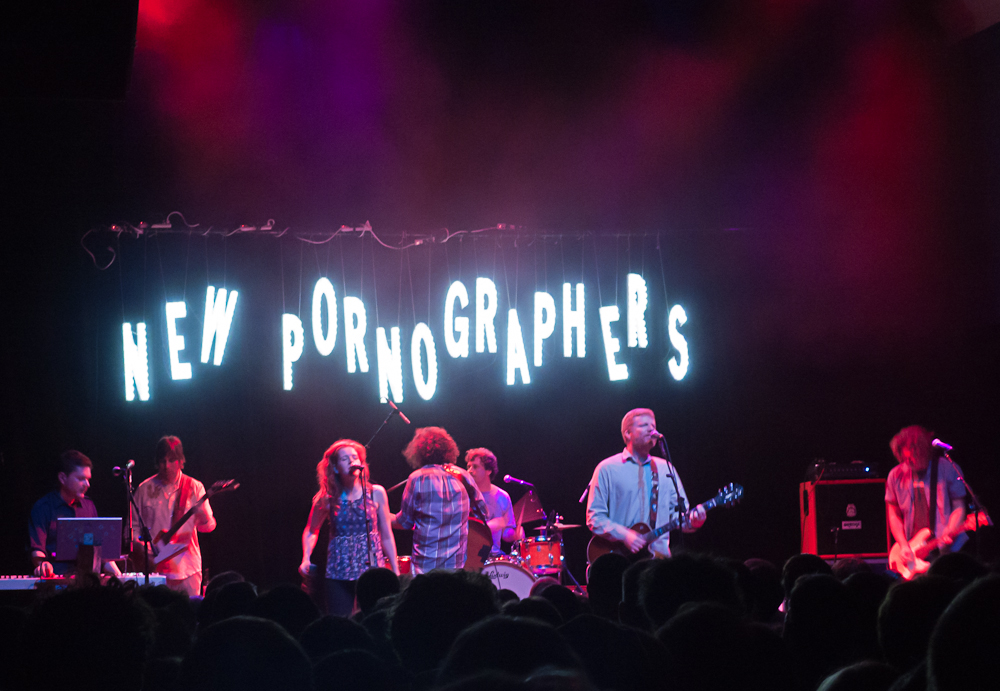
The New Pornographers’ Spectacular Show At The 9:30 Club

Posted in Music with tags , on June 23, 2010 by johnbuckley100

Leica Digilux 3

It was not merely the best New Pornographer’s show we’ve seen, it may have been the best show we’ve seen in some years, full stop. Occasionally Neko’s vocals slipped the track and the band rode on for a mile or two with sparks flying.  But for the most part, the harmonies flew like the Blue Angels in formation, Kurt Dahl continued to rack up points in the computer rankings of the #1 drummer in the universe, and the band rocked with the precision of a synchronized swim team.

Starting with “Sing Me Spanish Techno” is always a challenge, in the same way that starting the NASCAR circuit at Daytona is a challenge — there are going to be wrecks, even as you’re thrilled that the show is underway.  By the time Dan Bejar appeared onstage in a beer bubble, descending like Pink at an awards ceremony to play “Jackie, Dressed in Cobras,” it all gelled.

May we offer special thanks that two-thirds of the way through the sold-out show, they played “We End Up Together,” not just the best song on Together, but once again a song where the New Pornos drop the ironic armature and stand there unprotected.  Our breath ended up one county over.

Neko was in really fine form on all the old showstoppers, not to mention “All The Old Showstoppers.”  On songs like “Letter From An Occupant” or “The Laws Have Changed,” which call for vocal gymnastics, she flipped and bounced in perfect pitch, but in a seemingly easier song to sing, such as “These Are The Fables,” things were a little shakier.

Still, not just a good show, but a great show.  On “Jackie, Dressed In Cobras,” you would have thought Vollman and Kaylan were once again joined with the Mothers of Invention.  A band that plays with such an effort at precision may get a little too loose and chatty between songs, and Canadian humor may in fact be an oxymoron.  But who cares.  After an album (Together) that did slightly disappoint, nice to see it all come together for the funnest band on the planet.

First Communion Afterparty Heard From

Posted in Music with tags , , on June 21, 2010 by johnbuckley100

It’s been lo about two years since First Communion Afterparty, Tulip Frenzy’s favorite unheralded American band, released new music to their adoring fans.  Skyline, Starlight is a three-song EP available as a 7-inch and download through their Minneapolis label, and each of the platter’s potential chart toppers has been streamable through the band’s MySpace page for some time now.  Still, being able to grok on the dreamy “Time Between” at an hour of our choosing, or getting into “Featherhead” whene’er the spirit waggles is a cheese and cracker for an appetite worked up to Mama Carin proportions.  And then there is the slow, deliberate title track, which builds and builds like it’s that great soundboard master Mr. S. Owsley himself at the dials, and all you’re left with is a firm hope that the band gets Earth Heat Sound, the promised follow up to the incredible Sorry For The Mondays and to Those Who Can’t Sing, out of the studio and onto our hard drive. We’re waiting patiently, but only cuz there’s no other choice.

Sam Cutler’s Nuanced View Of Altamont

Posted in Music with tags , , , , on June 19, 2010 by johnbuckley100

Everything appears to be ready, are you ready? Thus are Sam Cutler’s introductory words from the Stones’ ’69 tour memorialized on Get Yer Ya-Yas Out, introducing, in his lifted superlative, “The Greatest Rock’n’Roll Band In The World.”

Now, more than 40 years on, Cutler has written a superb autobiography entitled “You Can’t Always Get What You Want,” the best parts of which center around his stint as tour manager for the Stones on their epochal ’69 tour.  Less than a year ago, we had Ethan Russell’s great book of photos from the tour, Let It Bleed, along with written accompaniment, but Cutler’s book is a well-told, up-close look at interactions the Stones had along the way, the most historically important element being his telling the tale of what happened at Altamont in a nuanced manner that not only names names, but gives a different interpretation of events.

Cutler imparts like a slow-motion car wreck the events that led to Meredith Hunter’s death at the hands of Hells Angels.  The San Francisco bands and forces that encouraged the Stones to do a free concert in the Bay Area, but were organizationally too diffuse to think through the implications of a December outdoors concert.  The sleazy moves of the mysterious hood John Jaymes who attached himself to the Stones and with no actual authority, claimed the right to commit to the Altamont site, which proved to be so inappropriate.  The buckets of bad acid that were passed through the crowd, leading to a cacophony of bad trips.  The way the San Francisco bands who’d egged the Stones on into throwing the concert all disappeared when it hit the fan.

He describes how the chief instigators of violence against the crowd — the pool cue thugs, the puffed out sadists — were for the most part either Angels in training, on probationary status, or hick Angels from, like, San Jose, not the main branch in San Francisco lined up, mostly by Rock Scully of the Dead, to provide stage security.  Now, this is a little like blaming the Cambodian Holocaust not on Pol Pot but on the notion that the Khmer Rouge were from the country and just didn’t like those effete Phnom Penh residents.  But throughout the book, there’s the ring of truth, and Cutler is a straightforward, organized writer.  You get the feeling that he writes the way he probably ran the tour: no BS, just a workmanlike effort to get the job done.

His story of abandonment by the Stones within literal hours of their return to San Francisco from the concert, their leaving him to hold the bag, his sense of duty and honor infusing a possibly suicidal effort to straighten things out with the Angels afterward, is absolutely fascinating.  Makes it harder to see Mick’s remorseful face in Gimme Shelter watching the death of Hunter — for very quickly, Mick was out of the country, in his safe European home.  The Angels immediately  wanted to get their hands on the Maysle Brothers’ film to see what evidence of murder might be pinned on which Angel.  It’s a great read, and we’re glad that Cutler took the opportunity to write it.

Brian Jonestown Massacre At the 9:30 Club Was The Eye, Not The Hurricane

Posted in Music with tags , , on June 10, 2010 by johnbuckley100

Lord knows The Brian Jonestown Massacre have had their share of tumultuous shows, but last night at Washington’s 9:30 Club, they were an island of calm amidst a sea of chaos.

Consider: coming home from a dinner out before heading to the show, a deranged driver of a pickup truck shot across four lanes of avenue traffic and headed directly for our car proceeding up one of Upper Northwest D.C.’s narrowest streets.  We pulled over as the truck shot by going upwards of 50, and it just barely missed us moments before it drove over a curb and through a hedge, its brake lights never glimpsed.  Or this: an hour before we arrived at 9:30, three young men were shot right in front of the club, which was then surrounded by police and crime-scene tape.  Think of it: the Brian Jonestown Massacre played a locale surrounded by police and crime-scene tape, and it had absolutely nothing to do with them.

They played a calm, ultimately moving, pretty glorious set, turning the set lists from the 2008 and 2009 tours inside out.  Instead of opening with “Whoever You Are,” the band followed Anton into “Super-Sonic.”  “Wasted” was the third song of the night, and with its chugging refrain of “I want to know,” the band kicked hard, but were as impassive as jurors settling in for a long trial.  Sure, Joel Gion got worked up when Matt Hollywood sang “Got My Eye On You,” and the drumming, as always, was an artful pneumatic drill, but when you think about the way the BJM live meld three and four strumming guitars against Anton’s methodical leads, it’s a speedball combo of the constant and the virtuoso.  Thick layers of six- and twelve-string guitars, powerhouse drumming, an emollient organ, and Anton plinking his notes, one at a time, putting in Sterling Morrison fills, and singing, shyly.

Calm as they were, as professional as they are, the impression should not be conveyed that they failed to produce a big ruckus. “Not If You Were The Last Dandy On Earth” had the whole, nearly sold out crowd singing, and it was just a practice run for a raucous “Who?”  I’d never heard them play “Going To Hell,” and it was an up-tempo delight.  Something was slightly off in the mix, or the tuning, for “That Girl Suicide,” but this is a mild kvetch.  With the exception of “Hide and Seek, ” “Straight Up And Down,” and “Nailing Honey To The Bee,” they played all the songs you’d want them to (and they may even have played those, but after almost a two-hour set, we braved the D.C. streets.) “Servo,” and  “Vacuum Boots” and “Anemone” were all quite fine.

Anton seemed stronger than he has the last few tours: still hidden behind a burka of forelocks, saying virtually nothing, standing as he always does playing to the stage, not to the crowd.  But his voice was strong, and he’s still with us.  As are those three guys shot out on the street just before the show, and since we haven’t heard otherwise, the driver of that pickup truck terrorizing the leafy interior suburbs of the Nation’s Capital.  Whowouldathunk that The Brian Jonestown Massacre would be the steady counterpoint to the chaos of the streets, or even that in 2010, they’d still be around and kicking hard against beautiful songwriting strummed in perfect unison.

The Decline And Fall of New York Times Rock Writing

Posted in Music with tags , , , , , on June 6, 2010 by johnbuckley100

Once upon a time, John Rockwell of The New York Times had power, and he used it brilliantly.  When he wandered down some obscure Downtown alley and found, say, Teenage Jesus and the Jerks, when he used his taste-maker’s wand to deem Ms. Lunch important enough to write about, we took notice.  Wow, Lydia, way to go. Rockwell may only have one eye  but his good eye was sharp, his ears pricked, his mind open.  And the guy could write.  I would venture that in his own way, Rockwell was as important a player in our understanding that the Eno-Talking Heads nexus was of world-historical importance as, say, Clement Greenburg was in ensuring Jackson Pollack was taken seriously, or John Swarovski in getting us to understand the meaning of Stephen Shore’s arrival as a photographer.

When Robert Palmer ruled the roost, you had someone who as authentically could tell you about the Jelly Roll Kings playing in a Helena, Arkansas juke joint as he could review Bowie’s new phase.  He could wax passionately about Ornette Colman, The Rolling Stones, or Iggy Pop.  When he wrote, such was our respect that we stepped back to contemplate what he was saying, which sometimes became apparent on more than one level.

That was then. For the past twenty years, the Times has been Pareles-ized, its power diminished by the one-man wrecking ball known as Jon Pareles.  Pareles is the anti-Christgau.  Whereas everything Bob writes is well crafted, and when he offers one of his real raves, you have to give the artist well-earned props.  But Pareles is a truly horrible writer, a man who could render ecstasy on a stage into cardboard prose, filled with faux-learned music terms.  And I’m afraid he’s had the effect of ruining the writing of all around him.

Sure, we liked Ann Powers, and miss Kristine McKenna, and even Neal Strauss had his day.  But then recently, when we read Ben Ratliff pompously harumph about the Stones’ reissue, “I find Exile good, not great,” we realized: these days, the Times’ entire batch of rock critics produce irremediable mush.  Take Nate Chinen’s write-up today of the new Deer Tick album: “These are bright, durable songs, and Mr. McCauley liberates them from any telltale sign of artifice, whether he’s caressing them alone or roughing them up with his band mates, who manage a credible honkey-tonk snarl.”

Oh, puh-leeze.

Dear Mr. Chinen, and Mr. Ratliff, and your colleagues, too: you must leave the Times at once and not return Jon Pareles’ phone calls or email, if you have any prayer of rediscovering that rock’n’roll music is about passion, and feeling, and what moves the listener, not to mention the artist.

It is not to be studied in a dusty library.  It is about sweat, and gyrations, and occasionally about fearfully walking through back alleys, or into juke joints in Arkansas, on the off chance you’ll discover something that moves you.  Being a rock critic is not the same thing as being an actuary in an insurance company, no matter what Jon Pareles says.

Much has been written about the decline and fall of journalism.  It is genuinely sad to say that if you dropped the entire print run of the Times Arts and Leisure section off the Staten Island Ferry, the world of rock music would actually be a better place.
Fleshtones Were Best At 9:30 Club 30th Anniversary Fest

Posted in Music with tags , , on June 1, 2010 by johnbuckley100

They only got to play four songs, but at the 9:30 Club’s 30th Anniversary party on a sweltering D.C. Memorial Day, the Fleshtones made the most of their brief opportunity, so much more entertaining than *The Fall, The Pixies, Cracker, X, Luna, Tom Verlaine, Brian Jonestown Massacre, Calexico, Nirvana, Joe Strummer and the Mescaleros, Wilco, Jesus and Mary Chain, The Mekons, Mazzy Star, The Soft Boys, The DBs, The Apples in Stereo, Lou Reed, The Jayhawks, Alejandro Escovedo, Camper Van Beethoven, Sonic Youth, Ryan Adams, The Feelies, New Pornographers, and all the rest who’ve graced the club.  (*Okay, okay, not all of these bands played at the party today, but this is a representative sample of bands we’ve seen at 9:30, in its stanky ol’ F Street origins, as well as its more commodious, air conditioned, smoke free and damned near pleasant home on V Street, which it’s inhabited since the early Clinton Administration.)

It also was great seeing the Slickee Boys play today — the first band I ever saw at the old 9:30 Club, on New Years Eve 1983-84 — and though it’s been more than twenty years since they’ve regularly played together, you wouldn’t have known it from the way Kim Kane and the gang played “When I Go To The Beach.”

The ‘Tones were in excellent shape for a 6:20 PM set on a scorchingly hot holiday.  Fortunately, they’d been able to get over to Tulip Frenzy World Headquarters for a hotdog and a burger each, and maybe a cooling swim.

The 9:30 Club was instantly turned into “Hitsburg USA,”  and every boy and girl started to do the Frug. “Feels Good To Feel” had Ken and Keith kickin’ to Bill’s beat, and when Peter whipped out the  harp, the place just swooned.  “Way Down South” was a reminder that New York’s pride was playing South of the Mason-Dixon Line.  Next thing you knew, Seth Hurwitz, who says The Fleshtones were the first band he ever actually booked at the old 9:30 Club, muscled his way onto Bill’s stool to play drums to “Ride Your Pony.” Thankfully, while standing next to his kit, Bill kept the beat while Seth earnestly kept up.  And then it was over, and not even the promised reunion of Creedence coulda possibly been better.

All of D.C.’s music fans cheered these American treasures — The Fleshtones and the 9:30 Club.  The show may still be going on — there was a rumor the Bad Brains and Fugazi were going to reform for the occasion… okay, I started it…but thank Heaven that America’s hardest working combo set up shop on V Street to get us all in the holiday spirit.  Summer’s here and its time to hear Solid Gold Sound.

“Exile” Reissue On Day Two: Listening To The Stones Peak

Posted in Music with tags , , , , on May 20, 2010 by johnbuckley100

Some thoughts, after having lived with the deluxe set (including the DVD and the booklet):

  1. Anthony DeCurtis has put together an elliptical, very well crafted set of notes on the creation of Exile On Main Street.  One point Jagger makes, and which Anthony wisely develops, is that by having Nicky Hopkins, Bobby Keys, and Jim Price on premises, rather than calling in a piano player or charting horns as needed, their very proximity insured their organic use.  With all the mythology around Nellcote, with Keith talking about “living above the factory,” perhaps the biggest impact on the music from that working arrangement is that the Stones’ optimized sound, which sprang to life in that basement, came from something so simple as the availability not just of heroin and hangers on, but killer instrumentalists who could add such a great dimension to the sound.
  2. Now that the Stones have released excerpts from Ladies and Gentlemen, The Rolling Stones” — on the DVD, we have “Happy” and “All Down The Line” — what, exactly, is the reason this movie can’t now find its way into an HD DVD release?
  3. The credits, both on the original and on the deluxe re-release, don’t seem to tell the whole story.  David Gates’ Rolling Stone piece states that Jimmy Miller needed to play drums on a key passage of “Tumbling Dice” — no credit here.  Aren’t those steel drums at the end of the original “Loving Cup”?  No credit, if that’s the case… There are more mysteries.
  4. The narrative about Exile has pretty much centered around Keith.  It was his house, the riffs the songs are wrapped around have his DNA, and his is the larger-than-life eminence over all.  And yet it must be said, Jagger never sang better than on this album.  If you look at the credits, the photos, Jagger is everywhere.  Sure, maybe he was tending to the pregnant Bianca in Paris some of the time, and yes, while Keith nodded out, the Stones could not really come out to play.  But Jagger’s impact on this record is extraordinary and every bit the counterpart to his Glimmer Twin.  Never really thought about that til now, but listening to the gloriously remastered CD several times in succession, the standout presence is Mick.
  5. Has there ever been an album where the drums sounded better?  Think of Charlie’s entrance on just these songs: “Rocks Off,” “Tumbling Dice,” and “Loving Cup.”  Kickin’ the stall all night.  In the booklet, he says that the basement created a great sound for the drums.
  6. The combination of Nicky Hopkins and Mick Taylor — both incredibly lyrical musicians, virtuosi, clearly gentler souls than some of the rougher blokes around, but musically no pushovers — are the ingredients that make the confection work.  There have been thousands of words written about the Stones’ Golden Age centering on portentous world events, the death of the ’60s, revolution in the air, etc.  Methinks it can be traced to two elements. Nicky and Mick.
  7. Although live, the Stones still had the three great tours ahead of them (’72 America, ’73 Hawaii, Australia, Nicaraguan Earthquake benefit, ’73 Europe tour with Billy Preston, not Nicky), there is a late August feel to Exile. The leaves are just about to turn, but damn, the sunsets are beautiful, the light clear, the days crisp and clear. By the time Andy Johns mixed the tapes in Sunset Studio, the Stones had nowhere to go but down.  There were some good moments — a song or three on Goats Head Soup, a brief rebirth with Some Girls and Emotional Rescue. But the saddest thing about listening to Exile On Main Street is the knowledge that when the Stones came up out of the Nellcote basement, The Greatest Rock’n’Roll Band In The World had peaked.