Yep, he’s heard it’s a good ‘un, and is making his way to the record store, a long way away. Leica M, 50mm APO-Summicron-Asph. Above the Yellowstone River. Mountain goat, in case you are wondering.
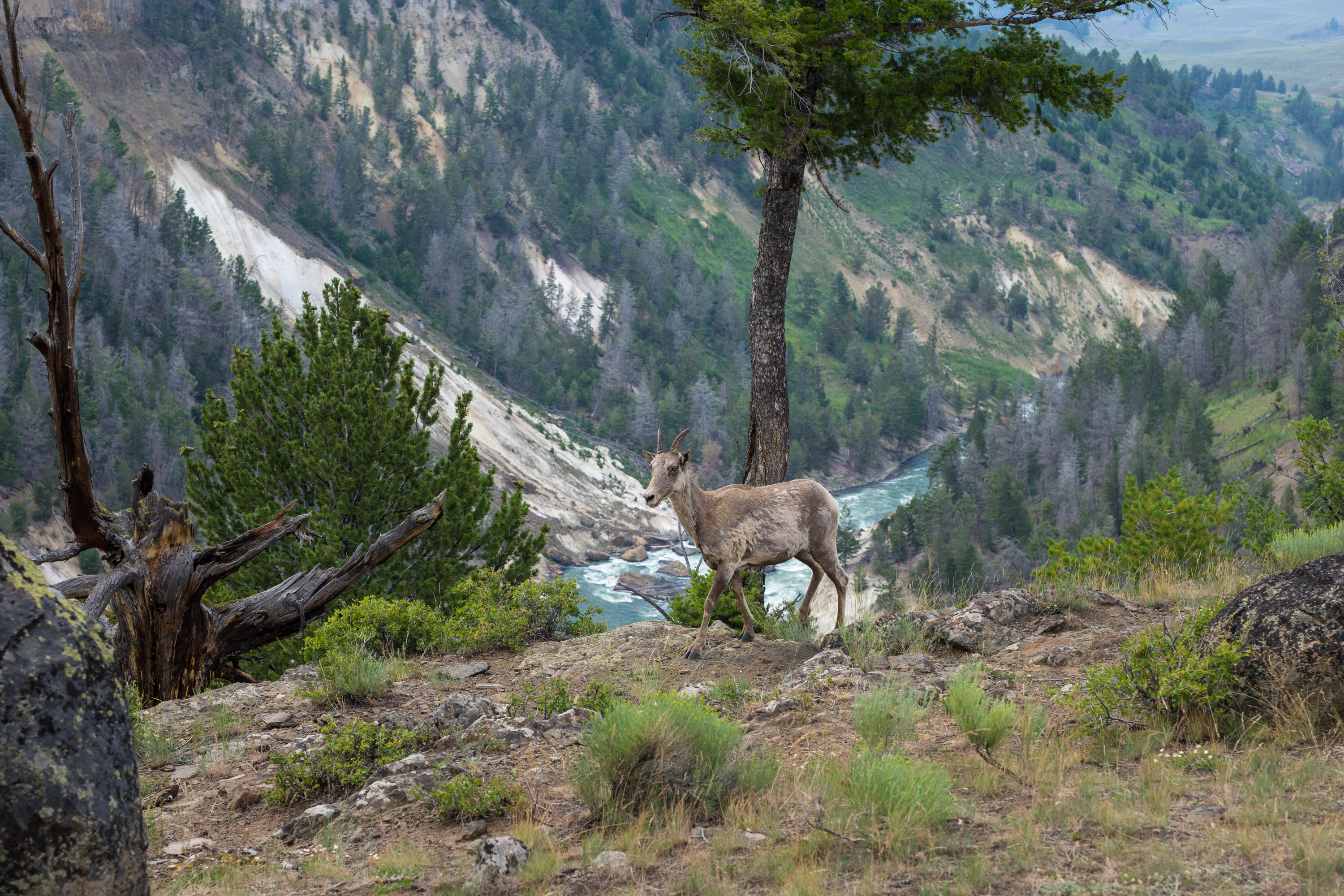
Yep, he’s heard it’s a good ‘un, and is making his way to the record store, a long way away. Leica M, 50mm APO-Summicron-Asph. Above the Yellowstone River. Mountain goat, in case you are wondering.
Keith Richards tells the story of how the hollow-sounding chords at the beginning of “Street Fighting Man” were recorded on a little cassette in a hotel room. We were beginning to get the feeling that if Tim Presley wrote such a masterpiece — he’s written others — he would have released that hotel output, never bothering to go into the studio. Thank Heavens the Stones had the good sense to release the song in its full sonic glory, studio treatment and hotel track, tinny chords and all. And thank God that Ty Segall — maybe that’s redundant — persuaded Presley to go into a studio to create For The Recently Found Innocent, because this seventh White Fence is a beaut.
We knew what Presley could do, not just because his band Darker My Love released Tulip Frenzy’s #1 album in 2010, Alive As You Are. And in 2012, Presley and Segall collaborated on Hair, which qualified as no less than that year’s 2nd best album. And then, after we complained for what seems like ever that we wished Presley would get out of the bedroom and take his talents to a proper studio and record with a proper band, not to mention straighten up and comb his hair etc., he closed out the year with a live masterpiece — White Fence’s Live In San Francisco, which made our Top Ten List(c). What a hootenanny that one is! Maybe the best punk rock record of the last five years! You could hear John Dwyer of Thee Oh Sees chortling at the knobs, as he recorded Presley in all his barrre-chord glory. And now we can hear the impact of his friend Ty Segall, who plays drums and produces what is already apparent as the best batch of White Fence cookies to come out of the oven. Ever.
Whether he’s an introvert, or just likes the freedom of recording at home, the intervention by friends Dwyer and Segall to get Tim Presley to share with the world a better sounding version of the magic that takes place the moment he picks up a guitar is surely welcomed. We are done comparing Presley to Kurtz, gone up the river. On For The Recently Found Innocent he has brought his jangly guitar, his reverence for early Who and Kinks dynamics, his fondness for psychedelic chords, wispy vocals, the patchouli ambience… brought it all to a studio where Mr. Segall himself plays drums and marshals the Dolby hiss fighters to render this in damn near high fi!
If you think we’re enthusiastic about this, you’re right, and aside from dropping a big hint that you’ll hear more about this when it is time to lasso the best o’ 2014 into our little compendium, we should quit the writing about it and get back to nodding our heads to the beat. Yes, it has one. Tim Presley has recorded a proper studio album and White Fence can get the Spotify airing and due it is so solemnly owed.
Throughout this summer of triumphant European tours by both the Brian Jonestown Massacre and the Dandy Warhols, our Twitter feed has been stuffed with the retweets of avid fans overflowing with excitement over having just seen one band or the other.
On a given July morning, you might see this retweeted by Anton Newcombe (band leader and skillful social media tour director of BJM):
Or this tweet posted by The Dandy Warhols:
Given that alternate nights at this year’s Austin Psych Fest were headlined by the two bands — famous for their friendship, rivalry, their frenemy status — and that day by day, as we would see these alternating reports on how great their shows each were the night before — the Dandys in Dusseldorf, the BJM in Oslo (or wherever) — a few days ago, on a long plane flight, we were compelled to re-watch Dig!, Ondi Timoner’s 2004 film that chronicles seven years of the two bands each struggling up the greasy pole of rock music success. Based on what we know about the two bands from just the Summer of 2014 — sold out shows across Europe, Anton/Brian Jonestown Massacre playing no doubt great sets featuring songs from their magnificent new album, Revelation… the Dandys bringing big crowds to their feet by playing mostly songs from their back catalog… how would Dig! hold up? What would viewing it ten years after its release be like?
Well, it’s not surprising that it is still so fine, so amazingly entertaining, still sad (watching the Anton Newcombe of those days, um, not succeed), still compelling. It remains one of the handful of really excellent movies ever made about rock’n’roll. The master narrative, for those who haven’t seen it, is that the Brian Jonestown Massacre and the Dandy Warhols were, in the 1990s, trying to revolutionize the world of rock music, and not incidentally, become huge. Courtney Taylor and the Dandys both worshipped and were exasperated by the unrelenting, unfocused genius of Anton Newcombe, who no matter what else was going on — fistfights on stage, drug busts by Georgia sherifs, editions of the band imploding mid-tour — was capable of getting BJM to create album after album of important and meaningful music. And while the Dandys got the big record contract, not all was groupies and cocaine in their world; they were subject to the machinations of a suppurating record industry, ultimately making fine records that were poorly promoted, even as they found a big audience, particularly in Europe, for their live shows.
Though it is narrated by Courtney Taylor, the movie is really the story of Anton Newcombe. Dig! is a chronicle of a genius whose career flounders due to his peccadilloes, urges and addictions, his borderline behavior — even as we repeatedly come to understand how, of the two bands, it is the Brian Jonestown Massacre that is jacked into the live wire of real rock’n’roll. Even when Peter Holmstrom of the Dandys is bitching about something that Anton has done to alienate them, the last sentence in each soundbite is some variation of, “And yet their music is just always that much more brilliant than anything anyone else can do.” The movie ends with Antone not quite as a young and beautiful as he was in the early scenes, still flailing away at success, as the rival Dandys have settled into a niche of creative and commercial success. Even though by 2004, BJM had released three score songs that will live forever, even though our record collection is fat with their multiple great albums, there was no sense of whether they would ever make it, and particularly whether Anton would survive from all the different ways he beat his head against the wall.
Flash forward to this summer and both bands have “made it.” No, neither band sells millions of copies of their records. But both bands — BJM and Dandys — are killing it each night on stage, with big crowds and happy tweeters. Anton is broad of face, no longer handsome, but certainly healthy — his Twitter feed filled with shaky pictures of the sushi he’s eating, not lines of various powders — and he is back to putting out great records. The Dandys may no longer be changing their world through their new records, but they are certainly worth seeing, one of the best live bands working today. Both bands have adoring fans, and there is room for each to be the headline act in that alternative world in which alternative music — music that matters — still exists, record companies be damned.
It is a seemingly happy time for both bands. But what really is most delightful is that Anton Newcombe, the troubled genius of Dig!, today is sober, productive, and still every bit the innovator he was in the 1990s. Rock’n’roll does not have a wealth of happy stories. This is one.
Yellowstone’s marvels can been quite shocking. Leica Monochrom, 28mm Summicron. Click on the image for full effect.
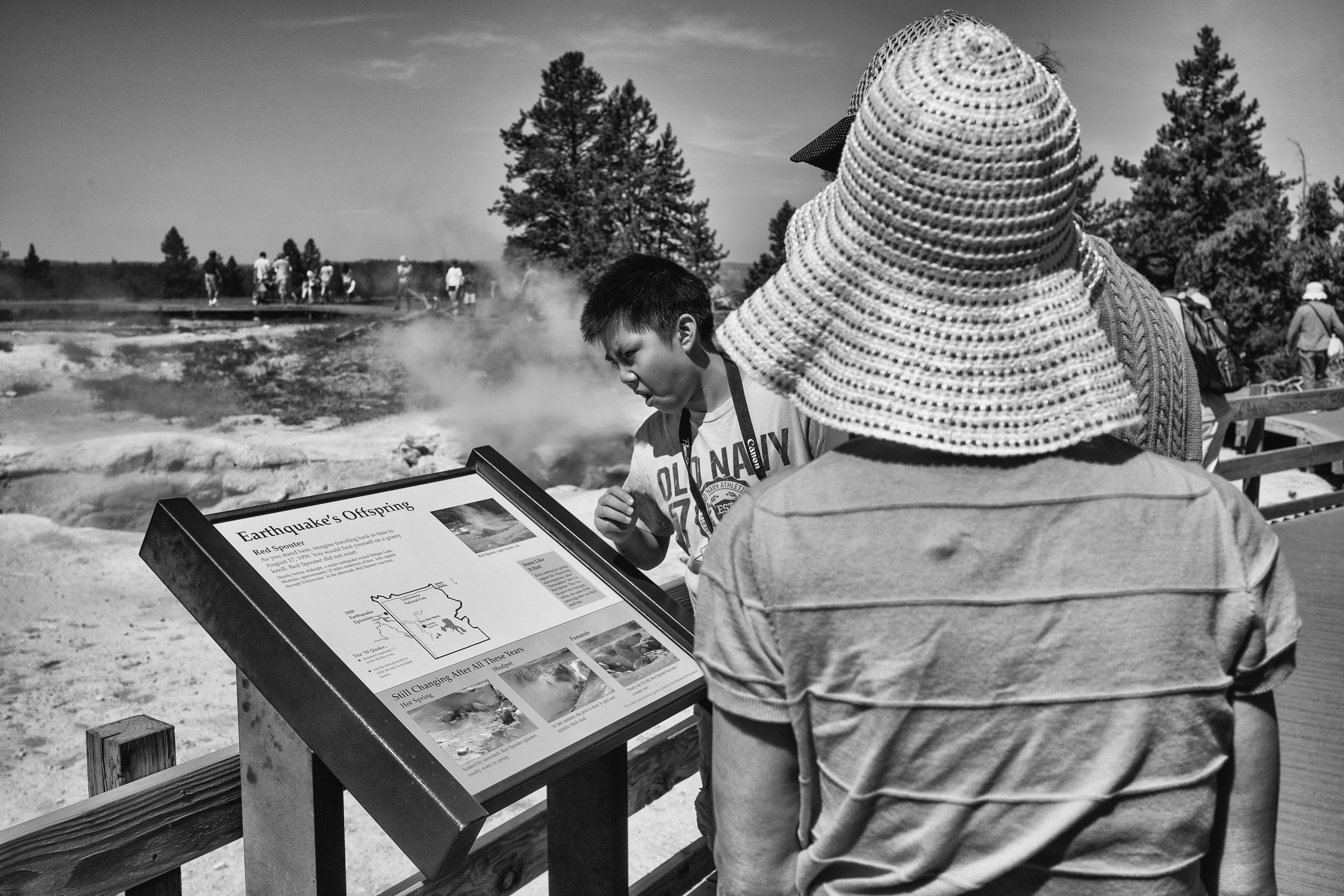
At Yellowstone National Park. admirers of America’s beauty come from near and far. Leica Monochrom, 28mm Summicron.

When Nik Software was bought by Google, we worried there would be no more investment in new products from what we believe is the best of the Lightroom plug-ins. And in fact, since that purchase — and since the various plug-ins such as Silver Efex Pro and Viveza are no longer available a la carte, but must be purchased as “Google Nik Collection” — there have been no announced upgrades of the best individual products. Recently, though, they released Analog Efex Pro, which is clearly aimed at photographers that wish to get in on the Instagram fun, even as they use their DSLRs or other “good” cameras, not their iPhones, to take pictures.
We recently read an essay about how modern-day Leica photographers take little advantage of the great lenses and sharp processing inside the digital Ms, because they are too busy reducing their images through software to mimic the look of film from the 1960s. There may be something to this. And it may be wrong to do — using your brand new Porsche to travel the Go-Cart track. But then again, sometimes it’s quite fun. Well done, Nik.

It was through a retweet by Anton Newcombe that I discovered the Twitter feed of @Edward__Abbey, purporting to convey, if not actual quotes of the late environmentalist radical, then his sensibility a quarter century after his death. There are many such posthumous tweeters, from Richard Nixon to Oscar Wilde, and several are quite amusing. The Abbey feed, however, is a travesty.
Edward Abbey was many things — an entertaining novelist, a crackling wit, the desert Southwest’s poet laureate, a fiercely radical opponent of unchecked growth and sprawl that led to environmental desecrations such as the Glen Canyon Dam. He was wrong and illiberal on many things, particularly in what today we would recognize as a racist opposition to immigrants from Mexico, which he couched in terms of trying to protect the Southwest from a population explosion, but which was ugly any way you slice it. But he was funny. And persuasive in his humor. What he wasn’t was a one-dimensional, self-parodic purveyor of the communist dialectic. You wouldn’t know that from this disgraceful feed.
We don’t know if many of the purported quotes in the feed are actually from Abbey. We’ve given Abbey close study over many years, and the quotes in the feed just don’t quite sound like him. They are close, but no cigar. They read like the product of a humorless teenager who knows enough about Abbey to echo some of what he wrote or said, but not enough to be able to convey the nuances. There is a notable absence of Abbey’s humor, which aside from his passion, was his most attractive quality. Whomever is behind the feed makes Abbey sound like the biggest bore on the campus quad, not the writer of Desert Solitaire or The Monkey Wrench Gang.
As is its practice, after following Abbey, this morning I received an email from Twitter with “Suggestions based on Edward Abbey.” The first suggestion was @Che__Guevara. Of course it was. What a reprehensible hijacking of one of America’s great treasures.
The MacArthur Boulevard Parade in NW Washington, D.C. would certainly not — to much of Red State America — represent the nation as a whole. To us, it was a remarkably apt depiction of America circa 2014 in all of its glory, from the tackiness of the purple dog to the self-parody of the plutocrats, but particularly the joy of the Bolivian immigrants celebrating their new home. Here are seven pictures that sum it up.






Leica M8, 50mm Summilux, July 4th, 2009, Jackson, WY.


Saul Leiter: Early Color
When Saul Leiter died over the Thanksgiving weekend in 2013, he finally got the full appreciation for his artistry that he had always deserved: a big New York Times obit, a loving remembrance in The New Yorker, an outpouring. He was honored in death beyond the recognition he had received in life.
It’s tempting to think of him as a version of Vivian Maier who at least lived to be discovered in his lifetime. But Leiter was not an unknown; he was an acknowledged member of The New York School of photographers, which included Bruce Davidson, William Klein, Diane Arbus, and Helen Levitt. Some two dozen of his photographs were included, as early as 1953, in a MoMA exhibition curated by Edward Steichen. He had friendships with artists such as Richard Pousette-Dart, Merce Cunningham, and W. Eugene Smith, for years shared his life with the artist Soames Bantry, and worked as a fashion photographer. He was not an isolated nanny whose images were discovered only after his death.
But where Leiter’s story competes with his art for its sheer romantic power lies in the notion that he was not fully appreciated as one of the 20th Century’s masters of photography — not recognized as one of the greatest artists in the history of the medium — until relatively late in his career, when more than 40 years after many of his early pictures were taken, he shared with Margit Erb, who worked for his longtime gallerist Howard Greenberg, prints of his early color photographs, and was discovered anew. It was Howard Greenberg who fought for the recognition of his artist, even though it appears that he had, until the mid-Nineties, an incomplete sense of Leiter’s talents.
The 1996 exhibition entitled “Saul Leiter: In Color,” and the subsequent book entitled Saul Leiter: Early Color, can fairly be described as revelations, as exciting as the discovery of a Mayan city, an unknown manuscript by Joyce, the lost print of a film by Von Stroheim. What the world discovered was that, long before William Eggleston or Stephen Shore brought respectability to color photography, Leiter was producing work that bridged some magical cusp between painting and photography, his images taken looking out into the streets from inside the damp windows of New York City restaurants as striking as anything framed by urban Impressionists seventy years previously. His framing of subjects — in some cases half of the image given away to a window shade, leaving only a sliver of life to be depicted in an otherwise completely dark rectangle; his eery and precise geometry; his peering through windows of taxis and coffee shops; his use of reflections to shatter an image into multiple parts — was even more powerful than that of HCB, who had a Surrealist’s eye and an architect’s sense of balance.
And now, eight months after his death comes Saul Leiter: Early Black and White, a two-volume companion from Steidl, with a strong assist from Howard Greenberg, and we can now see many of the antecedents and parallel discoveries of Leiter as a black and white photographer. The volumes are divided, intelligently, between Interior and Exterior images, though Interior can also reflect portraits taken outdoors. There is no gainsaying that it is Leiter’s color photography that stirs the heart and guarantees his stature. But the black and white photographs, in many cases, show the same sense of geometric division of a particular scene that his color photographs depict, and which only a painter, or a genius — both of which describe Leiter — could have rendered.
Saul Leiter: Early Black and White is the most important photography book published this year, with the possible exception of the monograph accompanying the great Gary Winogrand shows in San Francisco and Washington. It is best to start with the color photographs and work backward to these monochrome images. Any photographer who wants to get a sense of how a painter would frame and envision a scene should immerse herself in Leiter’s work. And anyone who appreciates powerfully disruptive art should check out Leiter’s work. Less than a year after his death, with new books about him and his life celebrated in a documentary film, Leiter is finally getting his due. He received real appreciation in his lifetime, but it was incommensurate with his value, his importance, his unquestionable genius.
http://www.steidl.de/flycms/en/Books/Early-Black-and-White/0223414951.html
 Tulip Frenzy