Leica M9, Noctilux 0.95
Leica M9, Noctilux 0.95
And so let us stipulate that the Duke Spirit is one of Tulip Frenzy’s favorite bands, and has been so since we first heard the title track from their debut, Cuts Across The Land , which came out six years ago. In 2008 they released on these shores a follow-up album, Neptune, which was less magical, but nonetheless quite powerful. We’ve been waiting ever since for that make’r’break third album, and when we found out that Bruiser, released last month in Albion, wasn’t being released in the States ’til sometime in November, well, we felt we had no recourse but to pass the hat around the office. Once we had enough coin, we sent off to London for what used to be the sweetest words in the rock hound’s lexicon: a British import.
Bruiser has arrived, and it packs a wallop. The Duke Spirit is not a particularly fancy band — they are a rock band (no real need for a modifier, though we’ll throw in the letters “alt” lest anyone confuse ’em for, like, Def Leppard), with two guitars, bass and drums, and in Liela Moss, they have my favorite female singer in the world. Save for, well, Neko Case. And Sally Timms. They don’t layer acoustic guitars and glockenspiels into the mix. Instead, they drive over you with a dark blue Range Rover. Their music is powerful, and stylish, and very direct. Six years since their first album, it is possible that the Duke Spirit have reached musical middle age, since Bruiser is perhaps a bit thick around the middle. Yes, this is a darkly melodic album whose songs often begin with the bass and drums accelerating into about third gear before we hear Liela’s gorgeous voice or the two guitarists crash the party. There’s a reason they didn’t name this album Floats Like A Hummingbird or else Stings Like A Bee. A heavyweight British bruiser Bruiser turns out to be.
‘Cept, of course, for Liela’s voice. There is that. If Liela’s voice were a character in literature, it would be Katje in Gravity’s Rainbow: flirtatious, incredibly sexy, continental, chamelon-like, dangerous, and tough. If Liela’s voice had a face, though, it would be the young Jacqueline Bisset: beautiful, intriguing, though not particularly mysterious. There is sometimes, we have to admit, an astringency to Liela’s tones, and she has a way of treating a man who’s pissed her off with the dismissive dispatch of a British nanny. But what’s also great about the way she sings is the almost perverse phrasing, the defiant tonal shifts: just when you think she’s going to take a note higher, she takes it lower. Did not see that coming! She’s that athlete whose canniness is built upon incredibly natural moves.
Is the whole band Liela? Far from it. We love the way either guitarist will only play five notes where ten could fit, love the Oasis-like rumble of the rhythm section, the Garbage-like presence (with no discernible electronics, other than mikes and amps.) What we love most of all are the songs. On Neptune, we could easily imagine “The Step And The Walk” used in a Victoria’s Secret commercial, or maybe one for a new Jaguar. (This is a compliment.) Since it’s taken so long for Bruiser to come out, we’ve had the lovely “Don’t Wait” to listen to for many months, and “Everything Is Under Your Spell” came out earlier this year. Either song can get under your skin and settle in for a long stay.
With The Duke Spirit, what you see is what you get: a band informed by punk and the blues, but determined to hew to the middle of the alternarock genre, with killer songs that are plenty catchy, and a singer whose voice you want to just pet. Bruiser takes on all comers, even if it moves a little slower than did The Duke Spirit’s earlier work. It’s taking waaaaay too long to get to America. When it gets here, pounce.
Leica M8, Apo-Summicron 75mm.

Captain Beefheart – Under Review | Watch the Documentary Film Free Online | SnagFilms.
Free streaming. All you can watch.
It emerges from fog. Leica M8, Apo-Summicron 75mm.
Leica Digilux 3
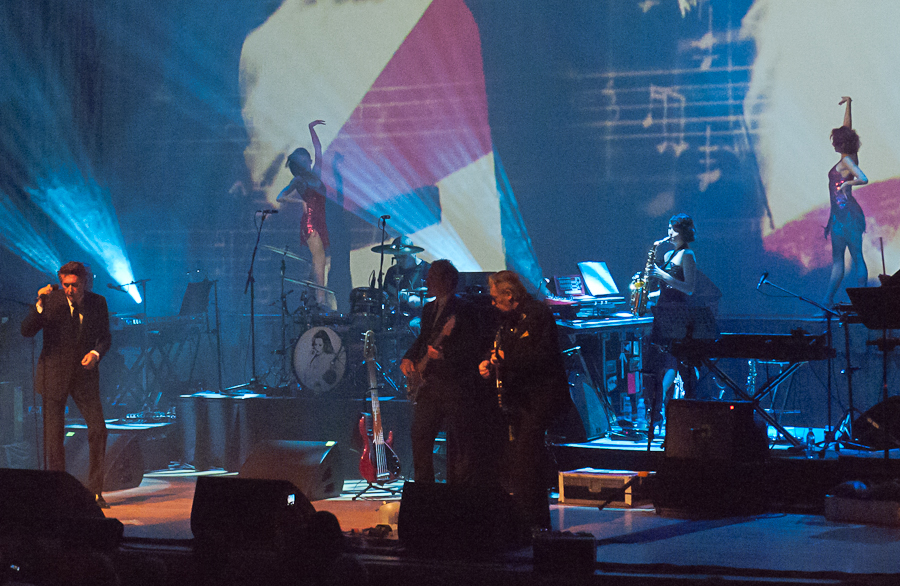
Before seeing Bryan Ferry for the first time since Roxy Music’s Siren tour — which occurred right around the time Gerald Ford was handing out WIN buttons — we wondered which Bryan Ferry would show up. Would it be the hurricane that hit rock as a Category Five force, adding art and glamour to the old three-chord shuffle? Or the Eurosmoothy whose solo albums since the ’80s have been like a ride in a Bentley, elegant but sensationless?
It’s such a pleasure to declare that Ferry played two-one hour sets reminding us how great Roxy Music and those early solo albums were. Maybe his audience has forgotten just how revolutionary a song like “If There Is Something” was when that first Roxy Music album came out, but judging from the enthusiasm with which Ferry and his 9-piece band played it, he hasn’t.
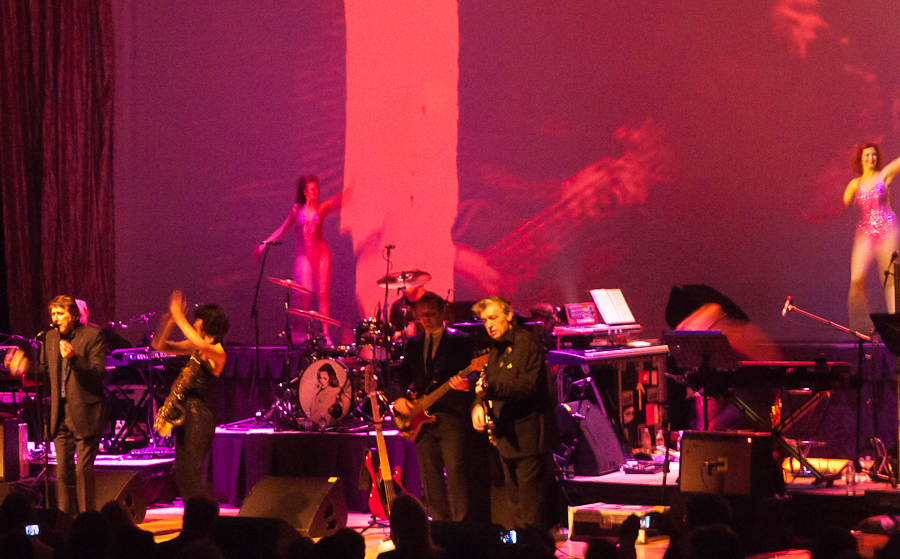
It’s not often that you come back from a concert and comment on how well it was art-directed, but this is who we’re dealing with. While the two go-go dancers writhed, and the chick singers sang along, the screen behind the band was a roiling sea of images, some from cameras on the band, some from a familiar iconography of party scenes that may as well have been the Titanic, so doomed and distant was that world. The band was fantastic — with Roxy’s Paul Thomas on drums and the great Chris Spedding putting on a guitar clinic. The flash young guitarist on the other side of the stage would wind up to take a furious solo, and when he was done, the old pro would barely tip his quiff toward his axe before blowing the young ‘un off the stage with a solo as concise as it was explosive.
Leica Digilux 3
Ferry’s voice was hoarse, and missing its trademark warble. What once was so dominant and yet so easy to parody that Eno could nail it in “Dead Finks Don’t Talk,” was now sufficiently limited that Ferry sort of hid within the mix, the big band, the four other singers. No matter. Ferry’s choice of songs was exemplary, even if he no longer felt able, or willing, to give us “Tokyo Joe,” or “When She Walks In The Room.” The first set heated up with “Just Like Tom Thumb’s Blues,” and included Roxy Music highlights like “Casanova” and the aforementioned “If There Is Something.” The second set included “Love Is The Drug,” and “Let’s Stick Together,” and of course Roxy Music’s only #1 hit, John Lennon’s “Jealous Guy.” Along the way he covered Neil Young’s “Hurricane,” as well as “All Along The Watch Tower,” both of which were fine enough, but we wish he’d covered more of the work of that great songwriter, Bryan Ferry. We wish he’d spent more time on those immediate-post Roxy Music solo albums, In Your Mind, and The Bride Stripped Bare. After all, he had Chris Spedding standing four feet away.
It has been easy to forget the revolutionary influence that Ferry and Roxy Music had . Ferry’s career arc has taken him from genuinely disruptive genre-bending to a self-conscious effort at invoking elegance, which is the antithesis of what we love about rockn’roll. It’s as if Miles Davis’s evolution saw him eventually playing smooth jazz. It is possible that generations have grown up not realizing that Ferry started as a musical bomb thrower. Happily, the complete package was on display last night, a madeleine, lost time found again.
The newly released Olympia, which Ferry’s touring to support, started life as a Roxy Music reunion album, and yep, even Eno decided to show up. But we’re glad it doesn’t have the band’s name attached; with it’s deep bottom and granite-smooth perfection, it’s closer to being one of those scented-candle mood albums, with Ferry, dressed in an Anderson & Sheppard suit, playing a world-weary Barry White rather than the high-strung artist who declared it was time to do the Strand. We say Roxy was influential, and it surely was, though Ferry’s Roxy Music eventually begat bands like Duran Duran and Spandau Ballet, while the departed Brian Eno went on to influence bands like Garbage and the New Pornographers, to say nothing of Talking Heads and U2. But at it’s peak — Country Life, with a hat tip to the albums that came just before and after, Stranded and Siren — Roxy Music was Bowie’s only competitor for the mantle of early ’70s greatness. For after the Stones’ 72 tour, the entire rock infrastructure began to collapse. Even though some bands (Stooges & Dolls) anticipated punk without knowing what was coming, even with the advent of Big Star, it was a fallow period. It diminishes Roxy Music not one whit to declare it was the most fascinating band around, circa 73′-’75. From the moment we heard “Amazona” — the moment we realized Phil Manzanera’s muscular guitar was the butch answer to the seemingly fey Ferry — we knew the post-Eno Roxy Music could be every bit as evocative as it had been before the little genius bid adieu. Maybe we didn’t know just how important he would turn out to be, but from “Amazona” on, it was clear that even with Eno gone, Roxy Music would continue to push all boundaries. Which they did, for one more album, and parts of the one after that. And then it was over.
If you don’t remember those days, Ferry does, thank Heaven. He may have become the de facto spokesmodel for Savile Row, but last night’s re-make, re-model was a remembrance of just what wildness beats beneath that surface calm.
Leica M9, 35mm Summilux (with floating element).

Ancient and Modern is the perfect title for a new album by the Mekons, because of course they are both. Thirty-three years after we heard “Where Were You” for the first time, nearly dropping both pint and jaw, the Meeks have released an album filled with modernistic ensemble charms, as the redoubtable Jon Langford, youthful vixen Sally Timms, and the publican crooner Tom Greenhalgh once more destroy their safe and happy lives in the name of rock’n’roll. It is, for them, a pretty straightforward affair, as the whole tribe shows up in force — there’s Rico on the accordion, and surely that’s Susie on the fiddle — to update Leeds punk with Chicago grit, modulated by folky purrings from a green and pleasant land.
Over the years — the decades — the Mekons have turned out some records that produced smiles if not long-lasting joy. When on form, though, they’ve produced artifacts that future rockologists will dig up and behold with wonder, thence to try answering the riddle of why they weren’t the hugest band around. And should one of those future rockologists seek out Tulip Frenzy for guidance, let us be clear where we stand: we believe that the Mekons, from the moment in 1978 they entered a studio to record “Never Been In A Riot” without any previous experience playing their instruments, to this day, when a merry band of first-rate singers and musicians can still make great music, live and in the studio, the Mekons have produced more great rock’n’roll music than any of their contemporaries, which include the Clash, and Gang of Four, and the Buzzcocks, and whatnot. (More is too easy, as they’re the only one of those bands never to have broken up in more than 30 years of playing together – Ed.) And not just more, but in many ways better albums than their contemporaries. For perhaps other than London Calling, has any of their peers produced an album as fine as Rock n’ Roll? We think not. (Ok, ok, you made your point – Ed.)
Ancient and Modern will not likely be played as long, or as often, as we play those albums produced during the Mekons’ Golden Age (from roughly the mid-80s to the mid-90s; from The Edge Of The World until the under-appreciated Retreat From Memphis.) At the pinnacle — from So Good It Hurts, through Rock n’Roll and I (Heart) The Mekons — the Mekons could at once make you remember they were contemporaries of the Clash, and admire them all the more for never giving up. Later, they posted some remarkably great late-innings performances, in particular Journey To The End Of The Night. Ancient and Modern, both as a collection of songs and as a performance, doesn’t reach those heights, but come on, the mere fact they still grace us with their music is reason to wake up in the morning.
Over the years, the key indicators for a Mekons album have been: are Langford’s rockers memorable, did Sally Timms get some melody to which she could apply her sultry vocals, and is Tom Greenhalgh noodling, or singing a song as perfect as “Heaven and Back.” “Space In Your Face,” “Honey Bear,” “The Devil At Rest,” and “Warm Summer Sun” are reminders of how much we owe to Ancient Civilization, and just how much life there still is in those old bones.
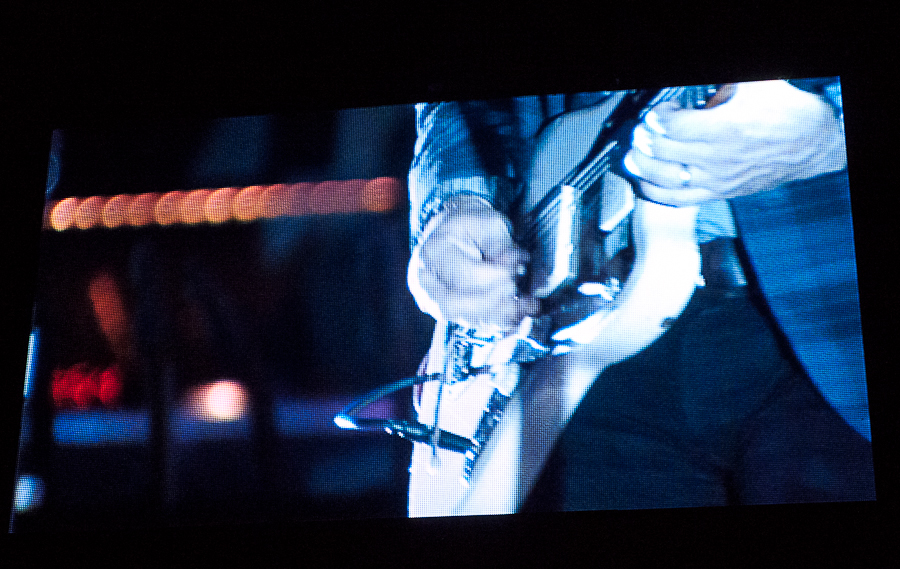
Leica D-Lux 3, ISO 800
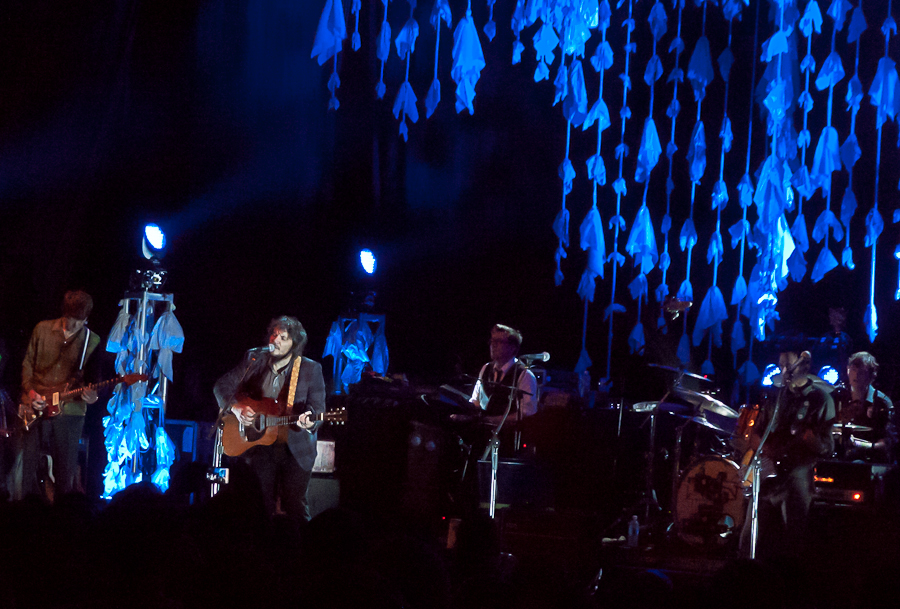
Modern Wilco, the hip band that from Yankee Hotel Foxtrot on tuned us in to mysterious frequencies and gibberish language floating on the radio waves, is hellbent on showing their breadth. So it is they could play a languid folk song like “One Sunday Morning (Song For Jane Smiley’s Boyfriend)” at Merriweather Post the other night, immediately following the Television-like “Black Bull Nova.” Sometimes their folky consonant impulse is trumped by their noise-rock dissonant impulse in the same song, such as “Via Chicago,” which led off their encore, and includes the band just wailing, from out of nowhere, while Tweedy sings on as if nothing were amiss, his youthful voice prettily keeping to the melody.
There’s something oddly satisfying about their sweet’n’sour approach, even when it’s revealed as schtick. When “I Am Trying To Break Your Heart” led off Foxtrot a decade ago, it was at once a reminder of the junkie cadences of Tom Verlaine’s “Yonki Time,” mashed up with the raw angst expressed by Alex Chilton in Sister Lovers — an in-the-moment, off-kilter, druggy song charming mostly in the way melody fought through entropy. But now when they come out and they play it note for note — well, it’s incredibly powerful, but it’s show biz, right, an amazingly proficient band able to re-manufacture the moment of creativity, on stage, before 10,000 people, night after night.
I’ll take Wilco’s perfectionist absence of spontaneity over a less ambitious band’s more sincere raucousness, so long as they keep churning out albums with the scope and ambition of The Whole Love, released today, and with enough grist that we’ll be working through it for months, maybe years.
We’ve previously referenced how The Whole Love invokes Wilco’s Beatles impulse. On Sky Blue Sky, we loved the tongue-in-cheek evocation of Abbey Road‘s sound — from Ringo’s plodding drums to the Billy Preston keyboards during the bridge of “I Hate It Here.” On The Whole Love, we have Tweedy invoking John Lennon on “Sunloathe,” and “Capitol City” could have fallen off the back of the truck carrying The White Album master to the factory. Just as we don’t begrudge them their consummate professionalism onstage, we love the fact that only Wilco and Olivia Tremor Control have figured out how to sound like the entire quartet, the complete Fab 4 — a little Macca vocal, a-a-nd here’s that George slide sound…
The first three songs of the concert the other night, all from The Whole Love — “The Art of Almost,” followed by “I Might,” followed by “Black Moon” — could be Wilco in miniature: experimental art-rock building to a psychedelic crescendo, followed by an homage to the New Wave soul sound of Get Happy, followed by a tuneful acoustic picker of almost breathtaking delicacy. Sometimes the live band consists of three guitars and a keyboard, or two keyboards and two guitars, but its sound is always dense and layered, with multiple virtuosi — talents on the order of Nels Cline and Pat Sansone aren’t usually teamed in the same band, just like baseball teams don’t usually have a rotation like the Phillies’ — and always there is Tweedy, the Everyman with the rumpled, just-out-of-bed-even-if-I’m-dressed-up look, and the voice that is astonishingly even, steady, youthful, deceptively elastic and true. We used to think it was anodyne, now we think it’s genius.
Longtime readers of Tulip Frenzy know that, over the years, we’ve been ambivalent about Wilco, for one reason in particular. We don’t like bands that lull people into singing along with what we’ve perceived as heroin-chic lyrics — “Guess all I need is a shot in the arm… there’s something in my veins bloodier than blood”– etc. In fact, the other night, we saw a dad lifting his little tow-head girl into the air while singing those words, and we thought, “Good God, man, listen to what you’re singing!” On the other side of the ledger, when critics put down Sky Blue Sky because after Foxtrot and A Ghost Is Born, it supposedly lacked “an edge,” it was a dumb allusion to Tweedy’s post-recovery sobriety, and one that pissed us off.
We’re done wrestling with Wilco. The band that once titled an album Being There is — if you are there and in the moment, as they say — incredibly entertaining and enjoyable. They also are, by dint of their accumulated songbook and the weight of their albums, the most “important” band of the present age, and what they produce achieves genuine greatness. From the Southern rock of A.M. to the encyclopedic The Whole Love, Wilco’s growth curve puts a fair number of pantheon cohabitants — we’re talking about you, U2 — to shame. We throw in the towel, and not with reluctance. Wilco has earned full rights to our devotion.
UPDATE: Anyone noticed how near the end of “One Sunday Morning (Song For Jane Smiley’s Boyfriend),” Nels Cline and Mikael Jorgenson/Pat Sansone sound EXACTLY like Fripp and Eno on Evening Star?
UPDATE 2: Dig the way on the D-Lux version on iTunes, includes the song “I Love My Label,” which is a direct invocation of Camper Van Beethoven. Anyone can invoke the Ramones, but only the very cool dare sound like Camper. Nice move, and happy about the record label, guys.
It was a magnificent show at Merriweather Post Pavilion. Leica D-Lux 3, ISO 800, a little noise reduction in Lightroom 3. More tomorrow when the album’s officially out.
 Tulip Frenzy