
Botswana, August 2014
Botswana, August 2014
Bardists, as they like to be called, dream of finding an unpublished Shakespeare play. Our needs are simple: we’ve only been waiting for 40+ years for a decent live album from the greatest tour of all time — the Rolling Stones’ 1972 foray across the U.S. — to emerge from the gauze of bootlegs and into the bright shimmering light of an official release. As of today, we’re very, very close.
For those who signed up for the Extra Super Duper release of Sticky Fingers, or whatever it’s called, last night came a happy email: all 33 tracks had, like the Midnight Rambler himself, vaulted our hedge and hidden away deep in our iTunes collection. Yeah, yeah, an acoustic version of “Wild Horses,” and all that. As far as we’re concerned the release of the Eric Clapton version of “Brown Sugar” simply drives down the value of our red vinyl pressing we’ve carried us with everywhere since 10th grade. The good stuff is the 18-songs worth of live material, recorded on the Stones’ 1971″Farewell Tour” of England, prior to loudly going off as exiles on the main street near St. Tropez.
It’s not the ’72 tour, but it’s the same band with the essential sidemen: Mick Taylor on guitar, Nicky Hopkins on piano, and Jim Price and Bobby Keys on horns. We call Taylor a sideman, and that’s not really fair, but let us just posit that these four, added to Jagger, Richards, Watts, and Wyman completed what is unquestionably the greatest rock’n’roll live band of all time — a band that could swing, and turn on a dime, and kick at the stall all night.
Some weeks ago, a friend sent us someone’s long rave about how the version of “Midnight Rambler” on the officially released “Brussels Affair” is, I don’t know, the Stones’ most transcendent moment. Yeah, but that had Billy Preston on it, playing organ! These tracks have Nicky Hopkins. On piano. Game over.
It’s weird that we have a partial album recorded at the end of the tour at the Roundhouse in London — “Live With Me,” “Stray Cat Blues,” “Love in Vain,” “Midnight Rambler,” and then “Honky Tonk Women.” Where’s the rest of me? Then there is what we assume was the entire set of a concert at Leeds University — “Jumpin’ Jack Flash,” “Live With Me,” “Dead Flowers,” “Stray Cat Blues,” “Love In Vain,” “Midnight Rambler,” “Bitch,” “Honky Tonk Women,” “(I Can’t Get No) Satisfaction,” “Little Queenie,” “Brown Sugar,” “Street Fighting Man,” and “Let It Rock.” (An aside: whomever was student music coordinator at Leeds U in the ’70/’71 school year deserves to be knighted, for he/she booked, in the same year, the Stones and The Who, out of which came Live At Leeds, and now this. But we digress.)
We’ve heard much of the Leeds set on the bootleg Get Your Leeds Lungs Out, but the sound here is just: So. Much. Better. We always knew what that show musta sounded like, because the version of “Let It Rock” has been around forever: it was what they had to press onto the Spanish release of Sticky Fingers after the Franco government banned “Sister Morphine.” Here everything is to that level, though perhaps not at a Get Yer Ya-Yas Out level of fidelity.
On both collections, the Stones have some ragged moments, as of course they did: Keith singing off key, Mick Taylor missing his entrance. But all in, these are fantastic performances by a band approaching its peak. A song like “Stray Cat Blues” isn’t improved over what came out of the ’69 live recording — you don’t need piano and horns on this relic. And of course on the ’72 tour, and subsequently over the years, “Jumpin’ Jack Flash” came near the end of the set, and Taylor had developed an entire vocabulary of tricks to work into his leads as the show climaxed. But what’s apparent here is how quickly the Stones incorporated horns and piano into what would become the ephemeral, yet greatest sound of their career, rambling on, as it has done, for 50 years and counting.
We can see why they included the Roundhouse set — it’s better, the band a little crisper, the sound a little warmer. And after listening to, oh, two dozen boots of different shows from the ’72 tour — such that we can tell you, definitively, the version of “All Down the Line” recorded in New York on July 24th was better than the version they’d played in Ft. Worth — we really don’t mind having versions of “Live With Me” to choose between. If you are downloading songs one by one, start with the Roundhouse versions.
Last year, when Reprise, or whomever controls the Captain Beefheart estate, released the full Lick My Decals Off, Baby, we checked off one of the key missing pieces of our musical collection. I guess we can say we are still living for the digital release of Henry Badowski’s 1981 masterpiece, Life Is A Grand. But honestly, now that we have heard Nicky Hopkins tickle the ivory while the greatest Southern horn duo ever backs up the Stones on a non-bootleg version of “Bitch,” we are just that much closer to the Promised Land.

Almost 40 years since creating the most intriguing, and in many ways, long-lasting debut of the punk era, Wire came to DC last night to play a show that was sinewy, powerful, and occasionally transcendent. From the opening “Blogging” — which kicks off their eponymous 2015 album Wire — to the gorgeous encore close of “Used To” from 1978’s Chairs Missing, Wire proved they are no oldies act. This was one of the strongest shows we’ve seen in years, old masters comfortable in their skins, who can still show the young ‘uns a trick or two.
When you’ve been around as long as Wire, there are distinct eras, or at least clusters of albums connected by time and personnel. What’s most delightful about the Wire of today is that, like Dylan on his great run between Oh Mercy and Modern Times, they’ve shown themselves at ease working within the construct that made them great as young men, while still putting out music more vital than most other working bands. With 2011’s Red Barked Tree, 2013’s Change Becomes Us, and this year’s Wire, their output is, sure, not as “important” as 154 was in 1979. But that’s like saying Love and Theft isn’t as important as Bringing It All Back Home. Who cares? Wire’s most recent albums make the case for one of the most vital acts in rock music history, and it’s an exceptionally high quality output for any band, not to mention one formed in 1976.
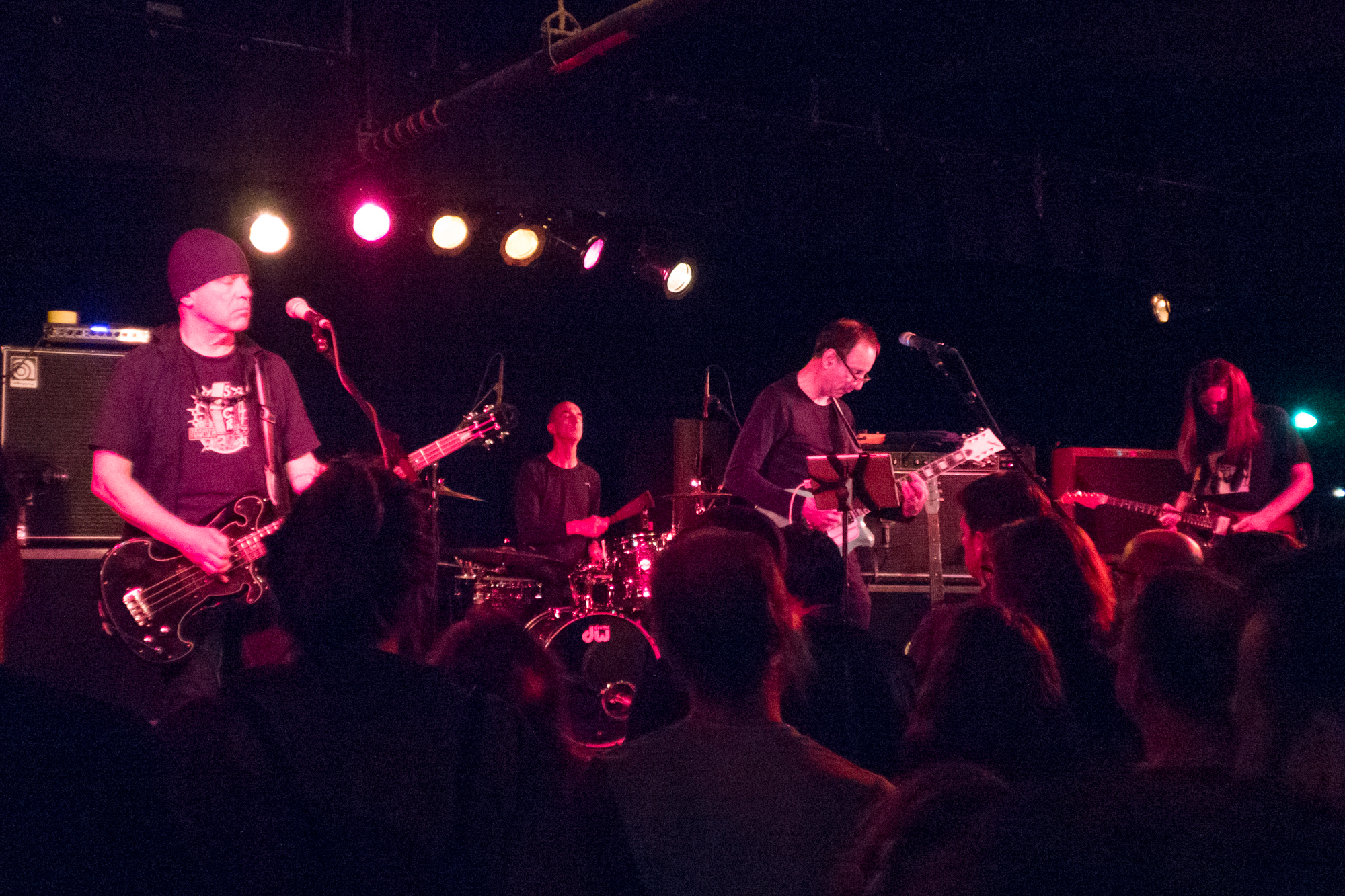
Robert (Gotobed) Grey and Graham Lewis still have the metronomic precision of the Atomic Clock, and it was a joy to hear Lewis sing “Please Take” and “Blessed State.” Grey looks like a beatific and elongated version of Jeff Bezos, closing his eyes in meditation as he directs the band with the certainty of a Swiss train conductor. Colin Newman has always done double duty as an effective punk shouter and a pretty pop singer; harder to do these days live, but all in, his voice was fine. What was really fun to see was how young Matthew Simms can extend and augment Newman’s guitar playing, occasionally playing these John McGeoch-like leads, often letting Newman carry the song on his electric 12-string.
Many years ago, when assigned to review Document And Eyewitness for NY Rocker, and thinking that the band was kaput (they broke up in 1980, only to come back five years later), we said that Wire was at its most interesting precisely at the moment when its reach exceeded its grasp. That was true then, but there’s little outside its grasp today. Last night’s show at The Black Cat saw a band pulling off the hardest trick imaginable: playing a set mostly with songs from albums four decades into their run, leaving no room for nostalgia.
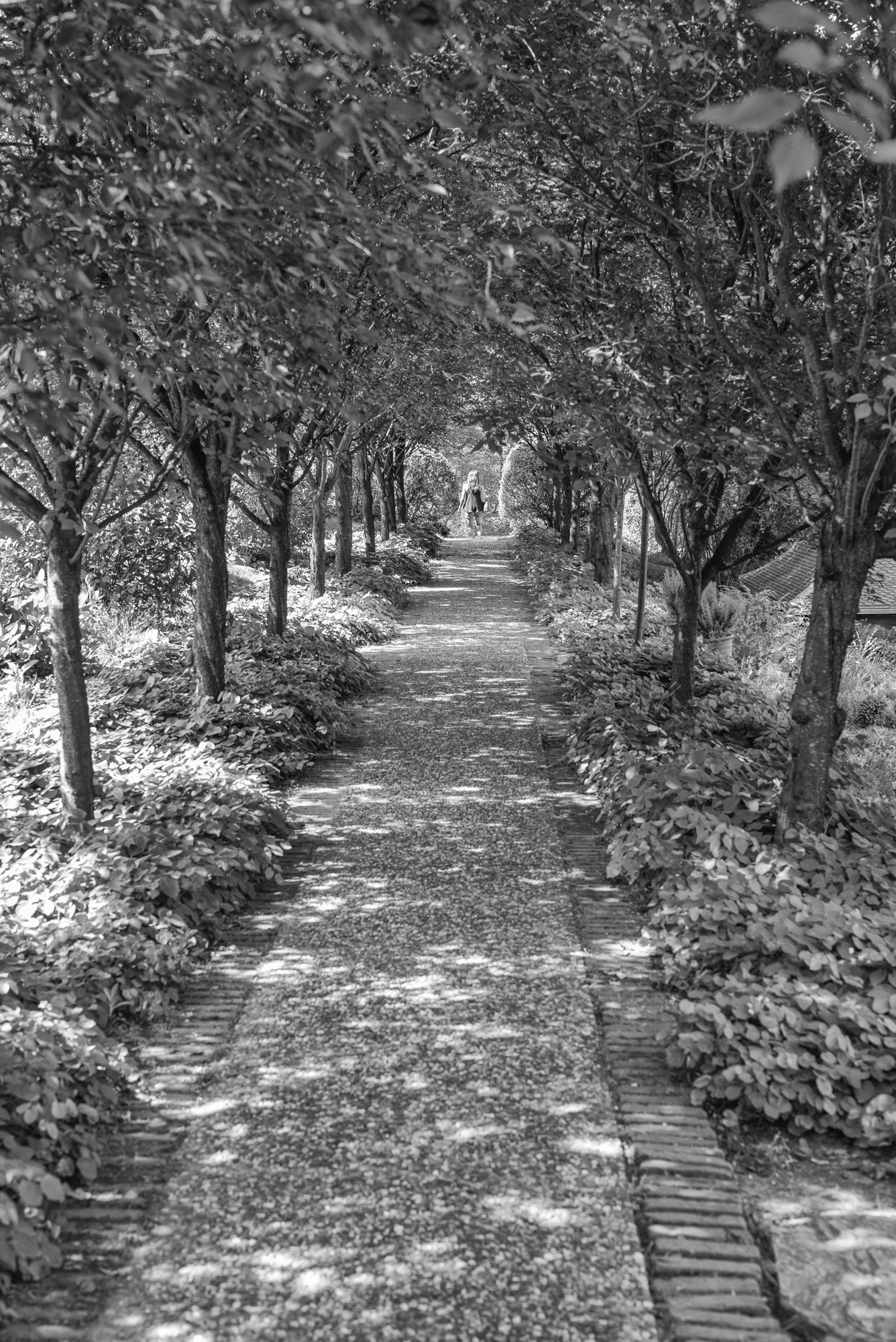
Leica Monochrom (Type-246), Dumbarton Oaks.
John Dwyer of Thee Oh Sees is the only Boy Scout in rock’n’roll. I’m not referring to his lifestyle, about which I know next to nothing. I am talking about his resourcefulness, in which he can take virtually any material — a button, a line scrawled on a napkin, a rhythm and ragged riff — and fashion it into a song.
Sure, leave Ty Segall in a room with a guitar and he’ll have a song in an hour. Give Joyce Carol Oates a typewriter and she can probably write a novel in that time. But Dwyer crafts the most amazing rock’n’roll songs out of single guitar lines, a little falsetto here, a yip there. At least since 2011’s Carrier Crawler/The Dream, everything Thee Oh Sees have done puts them in the same rare category as young Mr. Segall and his buddy Tim Presley of White Fence: collectively they are saving rock’n’roll, and in Dwyer’s case, seeming to have a real good time doing so. He is the Happy Warrior: a calm and articulate ringmaster in the eye of a sonic storm. And now we have Mutilator Defeated At Last, and with it comes assurance that our entire blessed summer looms before us, its soundtrack loaded on our iPhone.
The entire crew at Tulip Frenzy was devastated when word came, late a couple years back, that Thee Oh Sees were going on hiatus. We hate us bands on hiatus, and it hurt particularly because damn if Floating Coffin wasn’t #2 on Tulip Frenzy’s 2013 Ten Best List (c). The situation clarified a bit not long after: while we were despondent that this particular lineup of Thee Oh Sees was taking a break, Dwyer was just moving to LA and working with a different gang o’ kids. Drop had some good songs on it, but we chalk up 2014 as a transition year. All the more reason we were so excited both to see ’em at Levitation: Austin Psych Fest earlier this month, and to learn that the road band was holed up in the studio long enough to record Mutilator Defeated At Last.
And the verdict? The equal of Floating Coffin, for sure, and better than Putrifiers II. This is the highest praise! We see a few more of Mr. Dwyer’s catholic influences — no, not the church, but Jimi Hendrix (on the intro to “Lupine Ossuary”) and Joy Division (on “Withered Hand.”) We have all the ingredients that make Thee Oh Sees so boss: double drums powering the proceedings, Dwyer’s deceptively amazing guitar work, and his vocal range, which we think of as the opposite of Don Van Vleet’s. (Whereas Captain Beefheart had an alleged seven-octave range starting from the bottom, rising from beneath the basement steps, Dwyer’s range starts from the attic, his cool falsetto, occasionally invoked, descends from there.)
At 33 minutes and change, it is of Goldilocks length, even though we coulda stood another song or two. But look, a guy who is sophisticated enough as a magpie that he could take a little bit o’ rockabilly rumbling, the traditional verse/chorus/nuclear war set up worked over by bands like the Pixies and Nirvana, add a dollop of Fripp and Eno, and on this one even throw in an acoustic song, and you get a sense of what pure genius consists of. It is a staple of bad advertising to extol the virtues of those who “think outside the box,” and the paradox of John Dwyer is that he does that — oh yeah, there has never been a songwriter who can make so much of so little, and have it be so original and true — even as he plies the very lines of rock’n’roll idiom.
If you’ve yet to dive in, here’s the place to start. Close your eyes and he’s burning the house down. Open ’em again and all is right in the world.
Memorial Day’s eve, Washington, D.C., May 24th, 2015



In a fantastic piece by Charles Blow in today’s New York Times, Civil War historian David W. Blight is quoted on the solemn event at war’s end when freed African-Americans reburied dead Union prisoners of war, and “staged a parade of 10,000” around the cemetery where they lay.
“After the dedication, the crowd dispersed into the infield and did what many of us do on Memorial Day: enjoyed picnics, listened to speeches, and watched soldiers drill.”
“The war was over,” wrote Blight, “and Memorial Day had been founded by African-Americans in a ritual of remembrance and consecration.”
We thought of these words this morning, at the Vietnam Memorial.

Memorial Day is a memorial, not a celebration. Right?

Whether it is a single shot, unposed, a moment of time, or a series to show how an incident unfolded, street photography is the depiction of a slice of life, a moment in time. There are certain ethical rules we abide by that perhaps others don’t: Vivian Maier has an entire subchapter of photographs of drunken stumblebums, which she may or may not have ever intended the world to see. To each his own, though for the record, we don’t take pictures of the homeless, of panhandlers, those whose misery and vulnerability is paramount, even as they lay defenseless before the lens.
Ah, but what about lovers in the middle of some drama? Is it ethical not only to take their photograph, but to post it, as we do here?
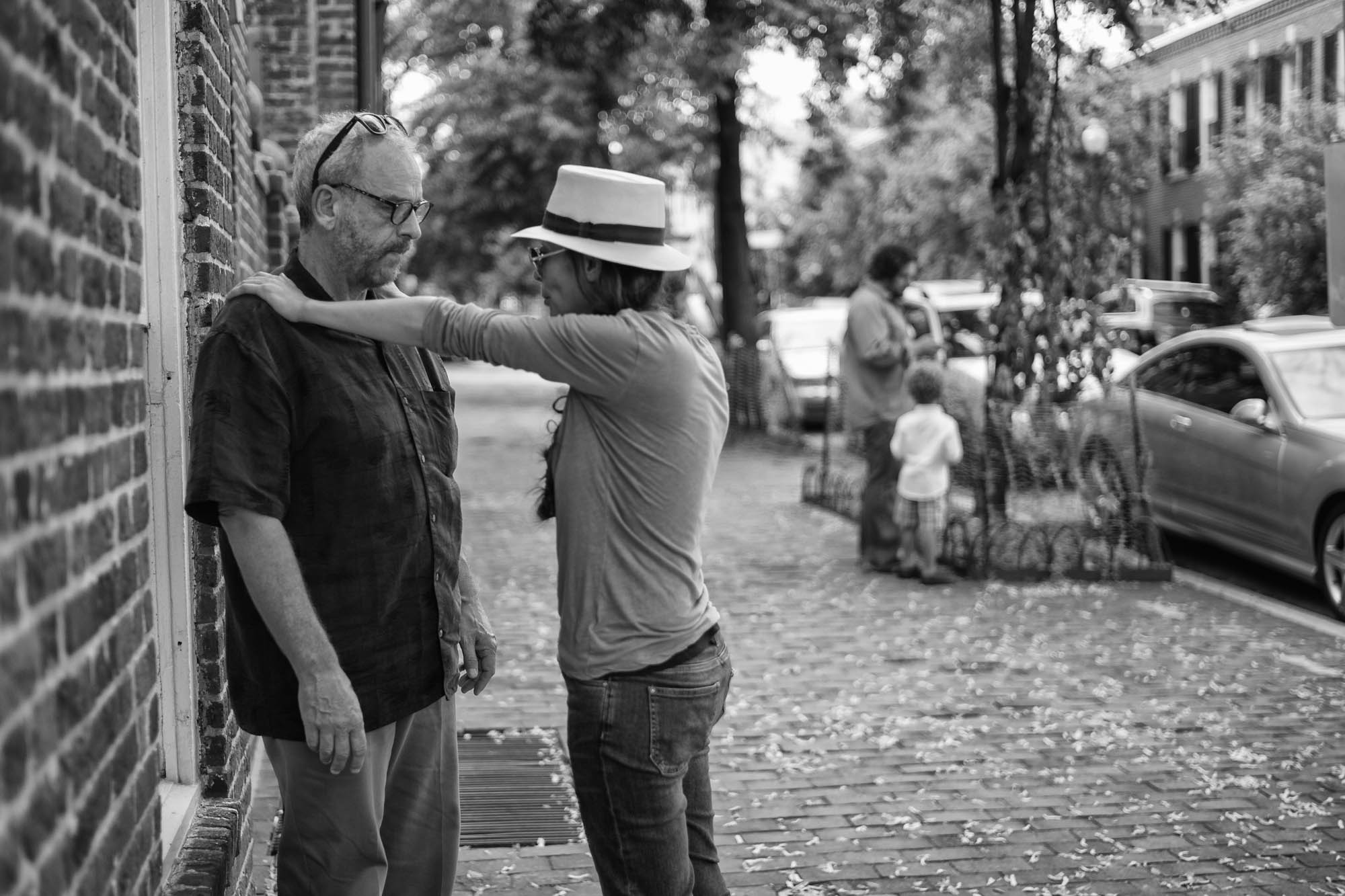
We came across the above scene as we were walking home some days ago. As soon as we saw the woman with her arms on the man’s shoulder, our camera went to our eye. We didn’t really have time to wonder what was going on between them, though the body language triggered our awareness that we were an eyewitness to a searing moment of intimacy. Was it right for us to take this picture? To now display it? And if so, what was she saying? What is passing between these two?
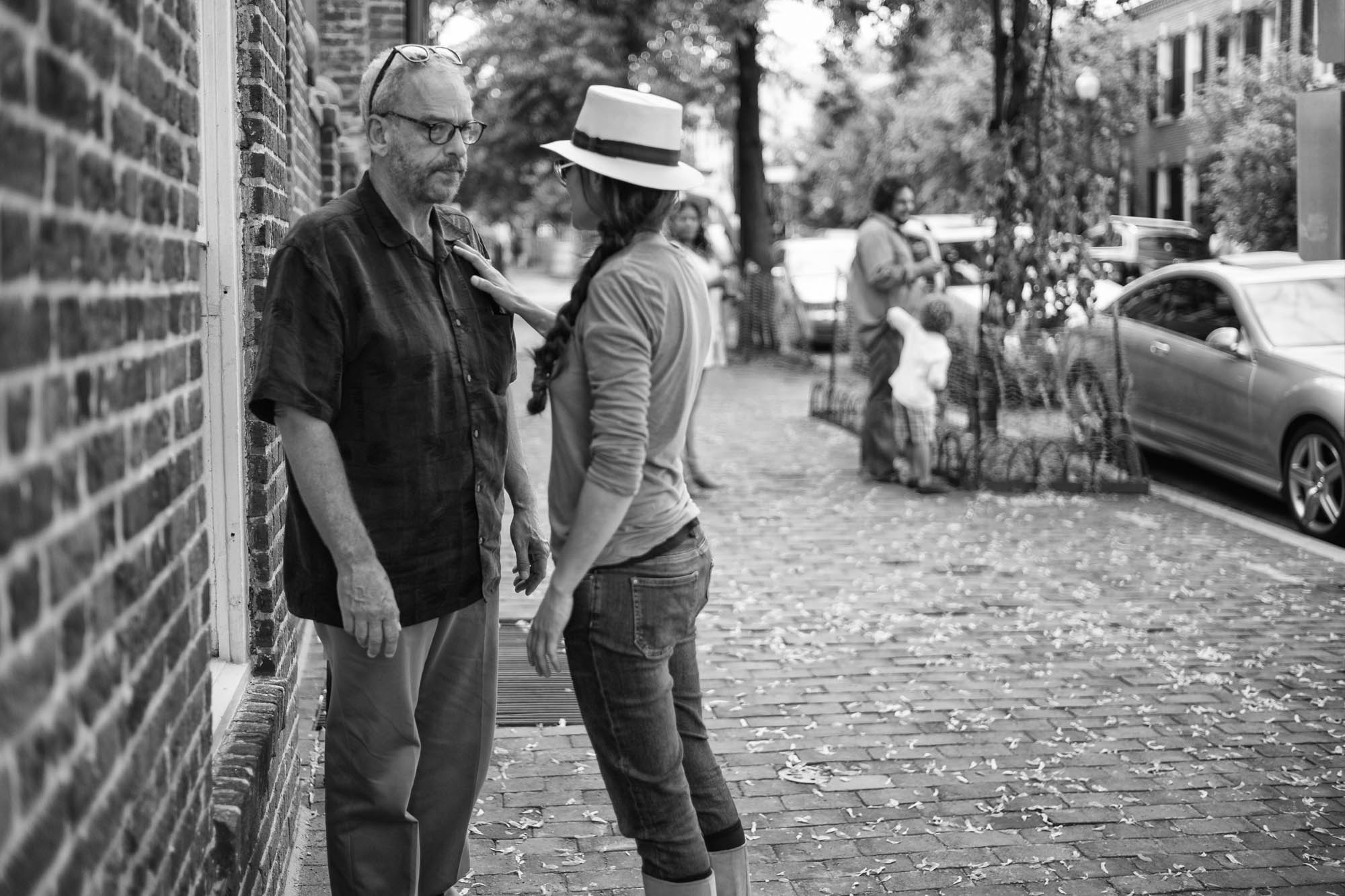
He’s clearly affected by it; the look on his face seems to be hurt, suppressed anger. She’s trying to get him to understand something. Is she leaving him? Trying to get him to do something? There’s a tenderness that suggests she’s not leaving him, or at least not parting without affection.
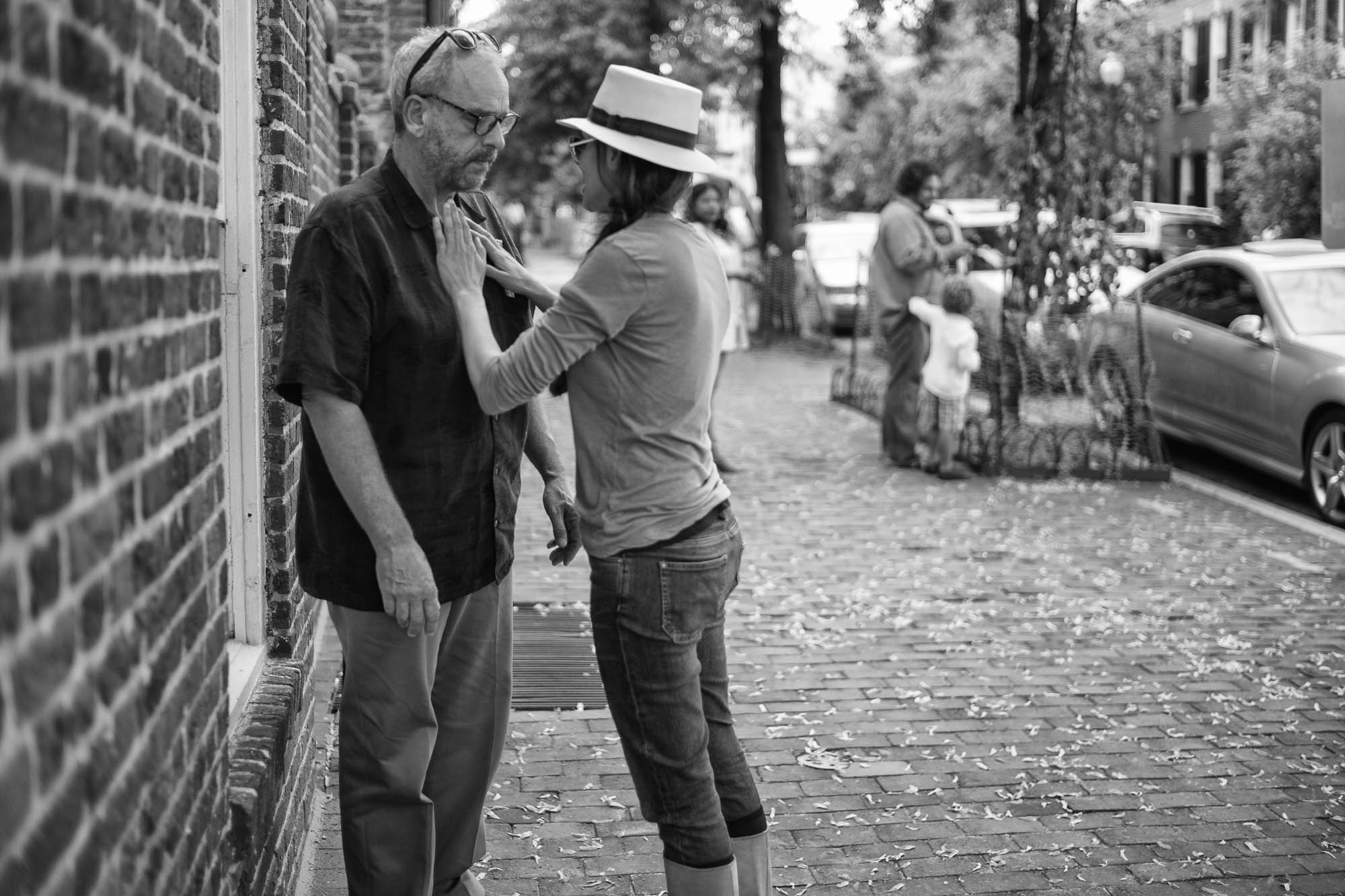
One last try at getting him to understand, or at least accept, some decision or admonition or directive on her part. We don’t know what it was, and on some level, this is clearly an invasion of their intimate moment. And yet it was on the street, so we literally have the right to have captured it. And the poignancy of the moment is, to us, sufficiently dramatic that of course we would have tried capturing it. The correctness of whether we properly should now be sharing this with the world hangs before us. We choose to believe, however, as a storyteller, as a dramatist, that a moment such as this, taking place on a stage such as that, captured as it was, deserves to be shared. And so we have.
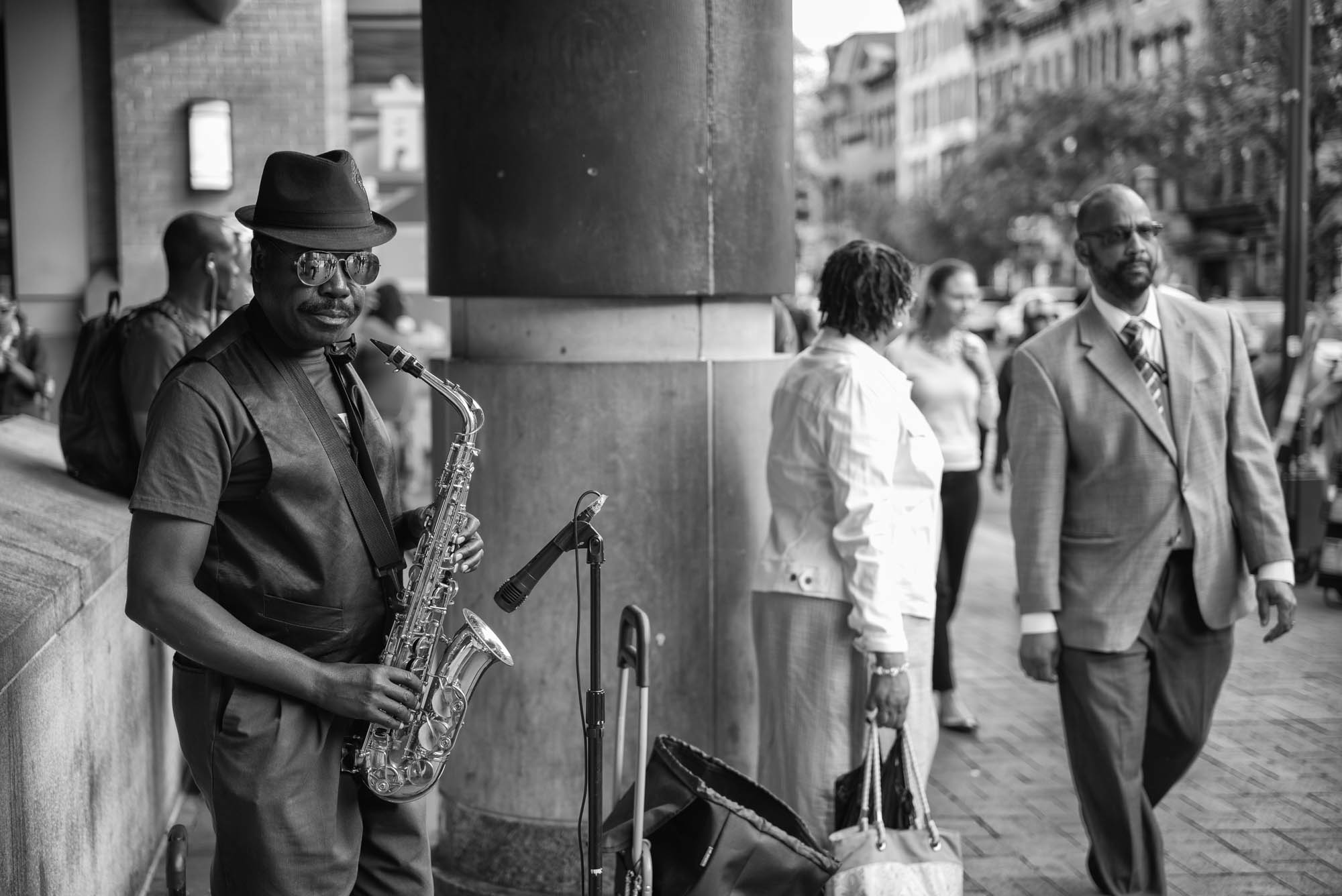
On Thursday, we received the happy call from the Leica Store in D.C. that the second version of the Monochrom had arrived in stock, and they had one for me. Even though my original Monochrom, which I’d had since September 2012, was in fantastic shape and gave me pleasure every time I took it out of the house, I wanted a version built on the same CMOS platform as the Leica M-240. I did so mostly for practical reasons — the desire to take only one battery charger and a couple of extra batteries when going on a trip, rather than taking one for the M (Type-240) and another for the Monochrom; wanting to be able to use the external viewfinder at times, particularly with a Noctilux; wanting to use Leica R lenses, including telephotos. If the files themselves were richer, if the ISO performance was even better than the original Monochrom, then great. But, I told myself, I really wanted the platform upgrade from a Monochrom built on the M9 chassis, to one built on the M-240.
I had an hour to kill before a dinner at a nearby restaurant, so having brought along a lens, a live battery, and an SD card, I took the new Monochrom out for a pre-dinner walk. And lo and behold, even just looking at images through the new, larger LCD, the tones seemed richer, the 50 zillion shades of grey seemed to have greater depth.
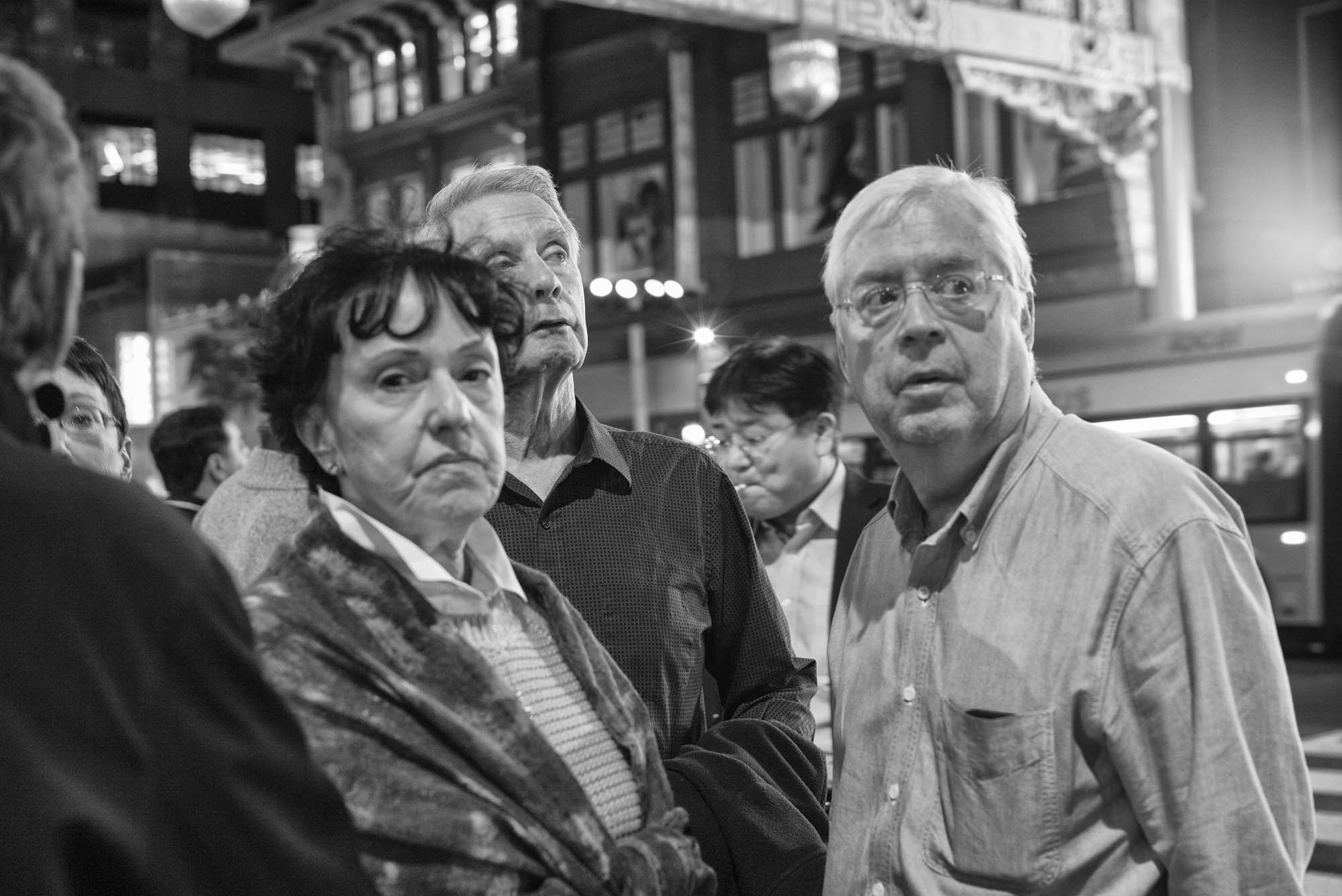
After dinner, walking around downtown with the ISO set to 3200 and the 50 APO-Summicron-Asph set to f/4.8 — which previously was about as high as I would ordinarily take a picture at night in the city — I soon learned that I could have gone several stops higher, and I would have caught the censorious look of the woman in perfect clarity. Almost immediately, it was clear that the Monochrom-246 had greater gifts in store than simply platform conformity.
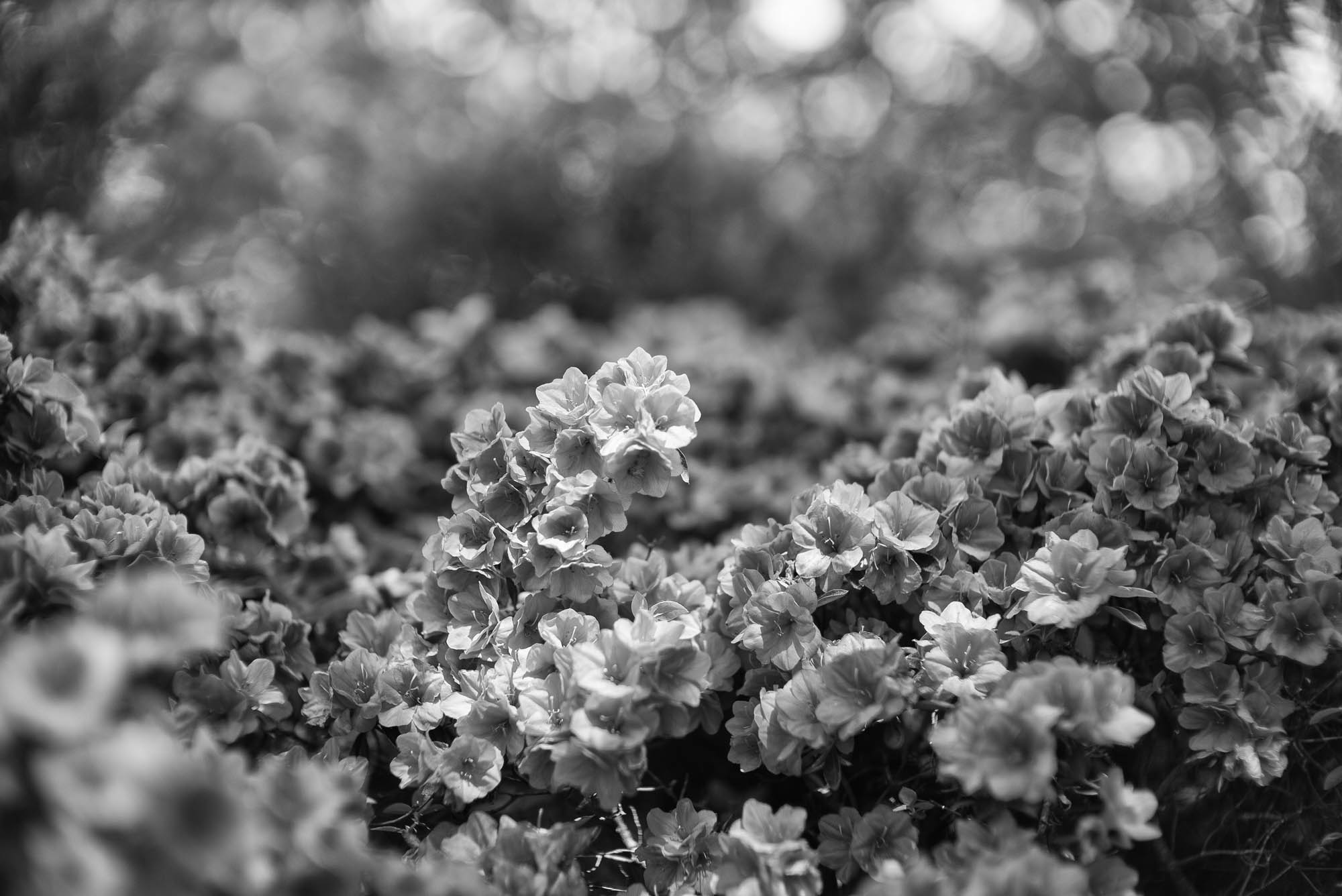
The first Monochrom changed the way I saw the world. That’s a big statement, but hear me out. Like many people my age, I began my photographic life taking black and white pictures and developing and printing them in a darkroom. But then, for so many reasons, I began shooting color film and virtually never thought simply in terms of luminance and form — my mind’s eye was drunk with chroma, with color. When I bought my first Leica in 2002 — an M7 — I gravitated to shooting with Fuji Velvia, as color-rich as could be. Later, when I had an M8 and then an M9, I loved Leica’s rendering of color images. But as I explained after one year of shooting with my Monochrom, the shift to using a black and white-only sensor brought me back to my roots as a photographer. It enabled me to go out into the back yard when, say, the azaleas were in bloom, and rather than get bowled over by the color, I wanted to capture what was there in black and white. I wanted to capture the forms and the light differently from the way my mind perceived it. Garry Winogrand’s aphorism about taking pictures because he wanted to see what the world looked like in photographs stayed present in my mind. It was an epiphany.

It is springtime in Washington, colorful and gorgeous. But I find myself wanting to see what it looks like as a black and white picture. What the Leica Monochrom (Type-246) lets you do that the original Monochrom didn’t is use an electronic viewfinder to focus with. After more than a dozen years shooting rangefinders, I have become adept at focusing quickly. But when you are taking a picture like the one above, using a Noctilux with a razor thin focal plane, being able to use an EVF in the evening hours with very little light and no margin for focus error is a dream come true.

Some will remember a photo quite similar to the one above that I took with my original Monochrom. In some ways the original is better — wilder, weirder, given that it was taken in September and overgrowth was different than what is above. But when it comes to whether what was intended to be in focus in both pictures actually is in focus, well, the one above wins, hands down.

I have taken many pictures of the roses in the Bishop’s Garden at the National Cathedral. It was a delight this evening to be able to precisely focus on that rose, knowing that having it sharply defined would render the Noctilux’s creamy bokeh that much more startling.
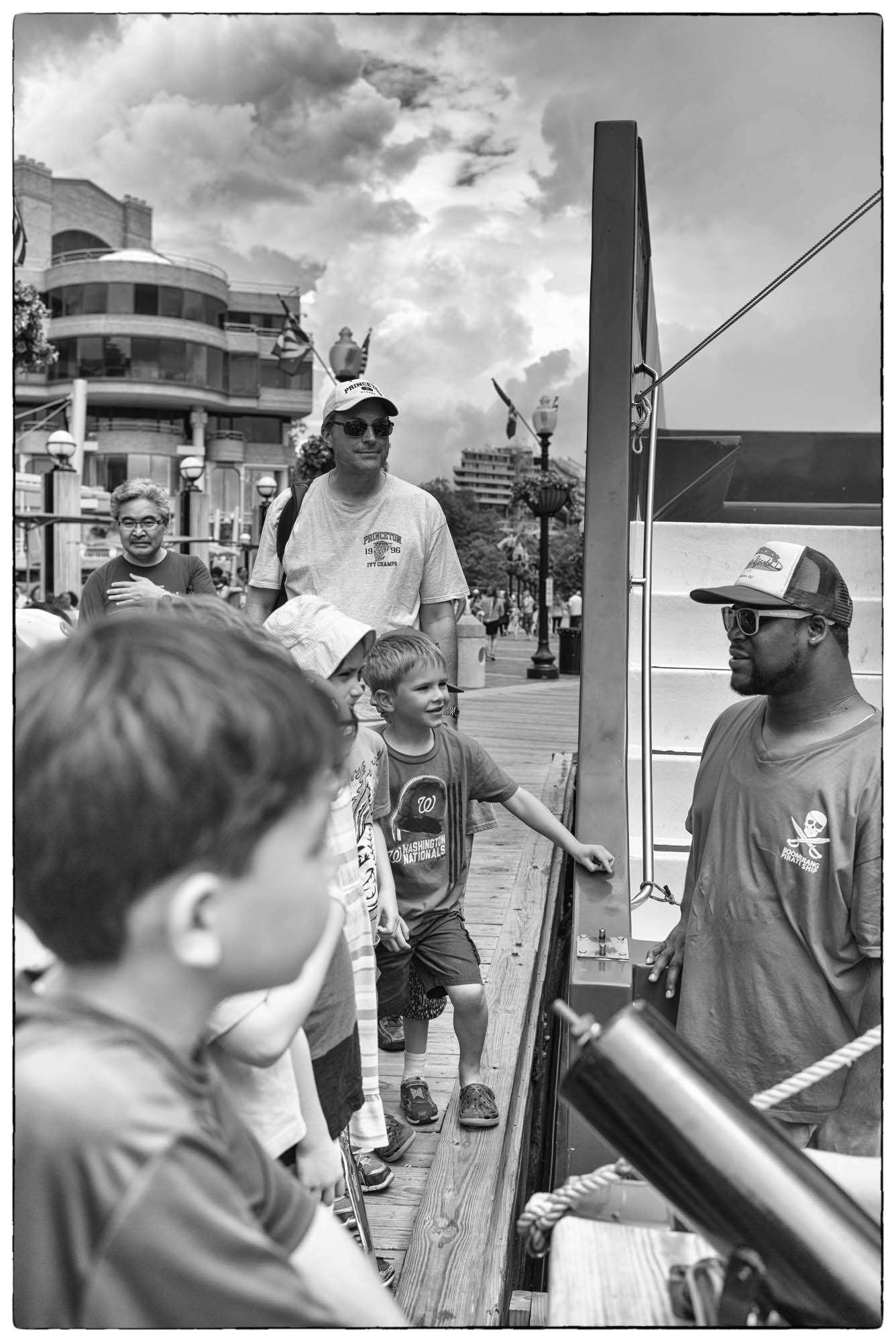
When you go out walking with a camera that only takes black and white images, you see the world differently. And of course, that was true with the original Monochrom. Why, beyond using the EVF, or perhaps Gear Acquisition Syndrome, would I sell it in order to purchase the new Monochrom? Well, when I got my M-240, after years with M8s and M9s, I said that I thought it was a perfect camera — perfect for our use, anyway. Oh sure, like all Leicas, it has some quirks. But the images that come out of the M-240 platform, with its CMOS sensor, are, to me at least, every bit the equal of what comes out of an M9, with its CCD sensor, and the M-240 also has a) better high ISO performance, b) the ability to use an EVF when needed, and c) the ability to use telephoto lenses. With a Leica rangefinder! That’s a big deal. And now the Monochrom can do the same tricks.

In the end, the original thrill we got from using a Monochrom — all of the advantages of having a digital Leica rangefinder, coupled with the deliberate limitation of shooting in black and white — are replicated in the Monochrom (Type-246), in what clearly is, after just a few days using it, a superior camera. It is missing nothing that was available in the original Monochrom. Yet tt has gained greater flexibility and even clearer high ISO files. It is the same step up from the M9 Monochrom that the M (Type-240) was from the M9.

You can still walk down the street and see the above image and without any hesitation, take the picture.
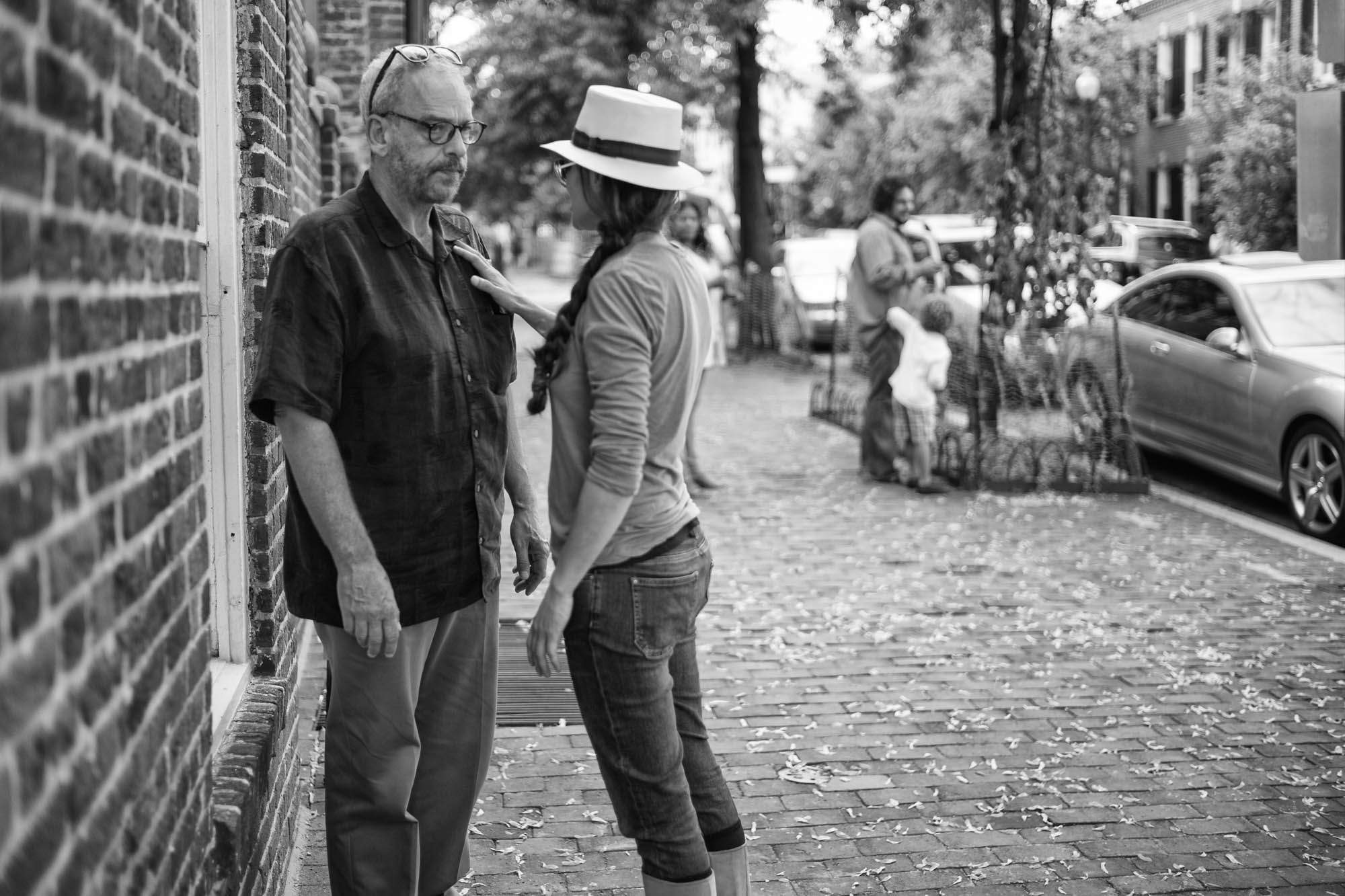
And you can follow it up with a second one, because you’re just taking a picture with a small old rangefinder, right, and no one knows the capabilities of this plain black camera with no markings on it. You have possibly the world’s greatest camera in your hands. And you are invisible.
(You can follow John Buckley on Twitter @johnbuckley100
 Tulip Frenzy