Playing songs from his latest album album all the way back to Galaxie 500’s “Tugboat Captain.” More anon.
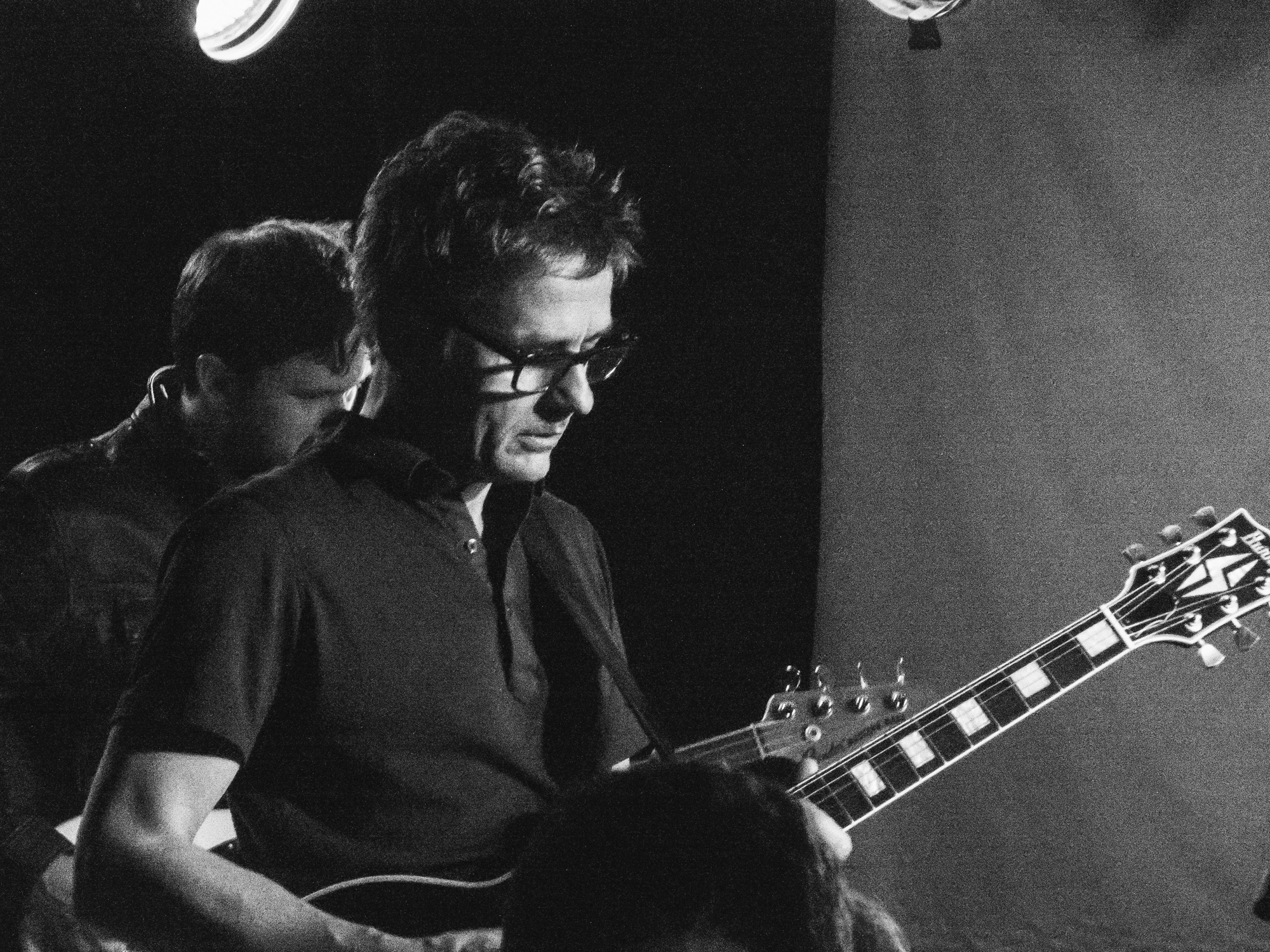
Playing songs from his latest album album all the way back to Galaxie 500’s “Tugboat Captain.” More anon.
“Do The Manta Ray,” kept going through our heads, and let us say, when you are snorkeling in water the color of Gatorade Cool Blue you really don’t want to be thinking about the Pixies. Do you? Leica M, 50mm APO-Summicron-ASPH.

The evolutionary trend by which rock critics become rock’n’roll musicians seems more typical than a rock star becoming a critic, but it’s not like the latter is a crime against nature or anything. After all, said rock musician probably gravitated toward his calling out of a deep love for music, and certainly we know bands going all the way back to the Beatles and Stones began to bash around on guitars out of the sheer cussed joy of wanting to emulate their idols. So let’s just take as a given that rock’n’rollers have great knowledge about the music that lit their particular match. Nonetheless, it’s unusual for a musician to become a rock critic, and highly unusual for one to become anywhere near as erudite as Richard Hell is.
Last week, we wrote with admiration that Richard Hell’s piece on the Velvet Underground in New York Magazine was the best essay ever written about that band. We were right and wrong. Hell did write the best essay ever on the Velvets. The thing is, it was a different essay, published in 2008 in a book called Rock And Roll Cage Match, edited by Sean Manning, in which Hell had the Velvets post up against the Stones, out of which he called a winner.
We’d never seen the book or read the essay ’til Richard pointed it out to us in the series of emails in which he let us know that the new Velvets essay was, in fact, online. He sent us the earlier essay, and we also went out and found the book. And we have to say, his piece on the Velvet Underground vs. the Rolling Stones is one of the best essays about rock’n’roll we’ve ever read. We won’t go so far as to mimic the book and set up a fantasy cage match battle between Hell and Lester Bangs, or John Mendelsohn, or Byron Coley, or Richard Meltzer, or even Robert Palmer. Let’s just say that posting Hell up against any of our fave rock critters, he’s indomitable.
The Velvet Underground are not our all-time favorite band, but they sit cross-legged near the settee in the middle of our pantheon, and let us give ourselves credit where it’s due, they have been so since we were a mere boarding-school vinyl-head, and we glommed onto Loaded upon its release. Yes, the last of their albums released while the band was extant, even if the worst of their four core albums (VU, which came out in ’85, had enough good stuff on it that at the time we’d never before heard that it deserves to be considered as one of their original records.)
But much as we have loved the Velvet Underground for more than 40 years, if we had to testify to who our favorite band ever was, it would be the Rolling Stones. Yes, we’ll admit it, even though if you look at the Tulip Frenzy “About” section, we make no mention of the Stones. That’s because, from the moment that Ron Wood replaced Mick Taylor, from the time Nicky Hopkins no longer got their phone calls, and Bobby Keys and Jim Price were no longer paired as the horn section, it has been all downhill. But no band has ever had that command of our attention, that claim on our affection, as the Stones did in the early ’70s. We were out-of-our-heads excited in ’79 to see the Clash; it doesn’t begin to compare to how excited we were to see the Stones play in Boston Garden, and then Madison Square Garden, in 1972.
So Hell writes an essay about both bands together, or shall we say, about the Velvets and Stones in opposition, and it is brilliant. He sets up the hugely successful Stones versus the commercially unsuccessful Velvets in a way that is incredibly insightful and amusing. And then he does a position comparison like it’s the first game of the World Series and you have to give one team or the other the edge at First Base. We’re not going to quote it here. We’re going to try sending you to the book, so you can buy it. But let us just say that Hell gives the best description ever of what one wants from a front man in a rock’n’roll band, defines the essence of the Rolling Stones — which of course we already knew was Keith, but also — by a single word: soul. He gets a few things wrong, in our opinion — we are higher on Beggars Banquet than he is. He gets so much else so right.
Okay, okay, we have to quote, listen to this insight on Lou Reed’s songwriting: “Reed’s lyrics probably do come the closest to poetry of any in rock and roll. Dylan is his only competition. Dylan rules, but I’d venture that the lyrics on The Velvet Underground are the best as a suite, as an album set, of any in rock and roll history.”
So true! If we were a teenage girl reading a favorite novelist, we might even underline that six times and put an exclamation point in the margins. As it is, we just have to nod and agree. As we do, interestingly enough, with his ultimate conclusion. (You already know from what he wrote in New York that he would put the Velvets on the podium just above the Stones. In our rock’n’roll dotage, we are now inclined to agree.)
Go buy the book. Better yet, go buy his books, especially I Dreamed I Was A Very Clean Tramp. We’ve long known the man can write. His essay on the Velvets vs. the Stones is even better than his recent essay on the VU, and one of those pieces of rock critterdom that is as breathtakingly thrilling as even Richard Hell and the Voidoids playing “Time.”
Sometimes nature does all the work, and you’ve only to point the camera, in this case, down. Sebastiao Salgado brought back the most beautiful untouched regions in the world depicted in black and white. We’re not sure what’s below is untouched. We are sure it deserves to be rendered in color. Leica M-240, 50mm APO-Summicron-ASPH, very light touch in LR5, colors certified accurate.

Leica Monochrom, 50mm APO-Summicron-ASPH. Oh, in case you’re wondering, that’s not Dan Snyder.

There’s not much Richard Hell can’t do — practically start punk all by himself, propel Television out of the Bowery before wandering off, put out great albums with the Voidoids, write entertaining novels, oh, and one of the three or four greatest rocker memoirs ever. But now he’s up and done it: in the new New York, which has a pretty great series of essays about New York musicians going all the way to the middle of the last century, Hell has written an homage to the VU in which he says the magic words: “In my opinion the Velvet Underground are the best rock-and-roll band in history.”
Now, we find this remarkable, in two ways. We agree with it, of course, even as we argue with those voices in our head that are shouting out “Rolling Stones circa ’72!” and “what about the night in 1979 you saw the Clash and thought you’d achieved satori?” Yeah, we hear ya. What he said.
One remarkable thing, though, is how either he — or the phalanx of editors at New York — spelled “rock’n’roll” as “rock-and-roll.” When we worked at New York Rocker — when Richard Hell would shamble in and drop off copy, being paid the same $25 an article as the rest of us — the house rules were “rock’n’roll,” and we’ve always accepted that as definitive. Now our certainty is shaken.
But the other thing is, did we think Hell would call The Velvet Underground THE BEST? I didn’t, but am always happy for the surprises sent straight from Hell. Like the email I got from him in early December when he presented Tulip Frenzy with the most excellent remastering of The Richard Hell Story. (Hey Richard, while we did thank you, I don’t think we passed on how incredible it is to hear those Dim Star tracks sounding bright and clear. Amazing. Please, release the whole thing, ok?)
We would link to the piece, but it’s not available yet. And I would quote from it at greater length, but that’s not kosher. All we’ll say is this one essay by Hell is worth the price of admission. And is a reminder that, “in my opinion Richard Hell is the coolest man in rock’n’roll history.” Or is that “rock-and-roll history?”
UPDATE: Richard Hell, bless his soul, emailed to inform us that, actually, the essay is available online, right here. So do go read it.
He also added that, in re: how to write rock und roll properly, “I settled on ‘rock and roll’ some time back (it’s done that way in Tramp too. The ‘n’ just felt too contrived to me, maybe even condescending, ultimately, now…”
Then moments later he wrote back, “”Wait a minute… They added hyphens, the fucks!”
He went on to write other things, but just as it’s bad form to reveal too much about your conversations with the President of these United States, or like the Pope or someone, we will not reveal all.
And damn, forgot to ask him if they will ever release a remastered version of the epic Dim Stars album, featuring him and Thurston Moore…
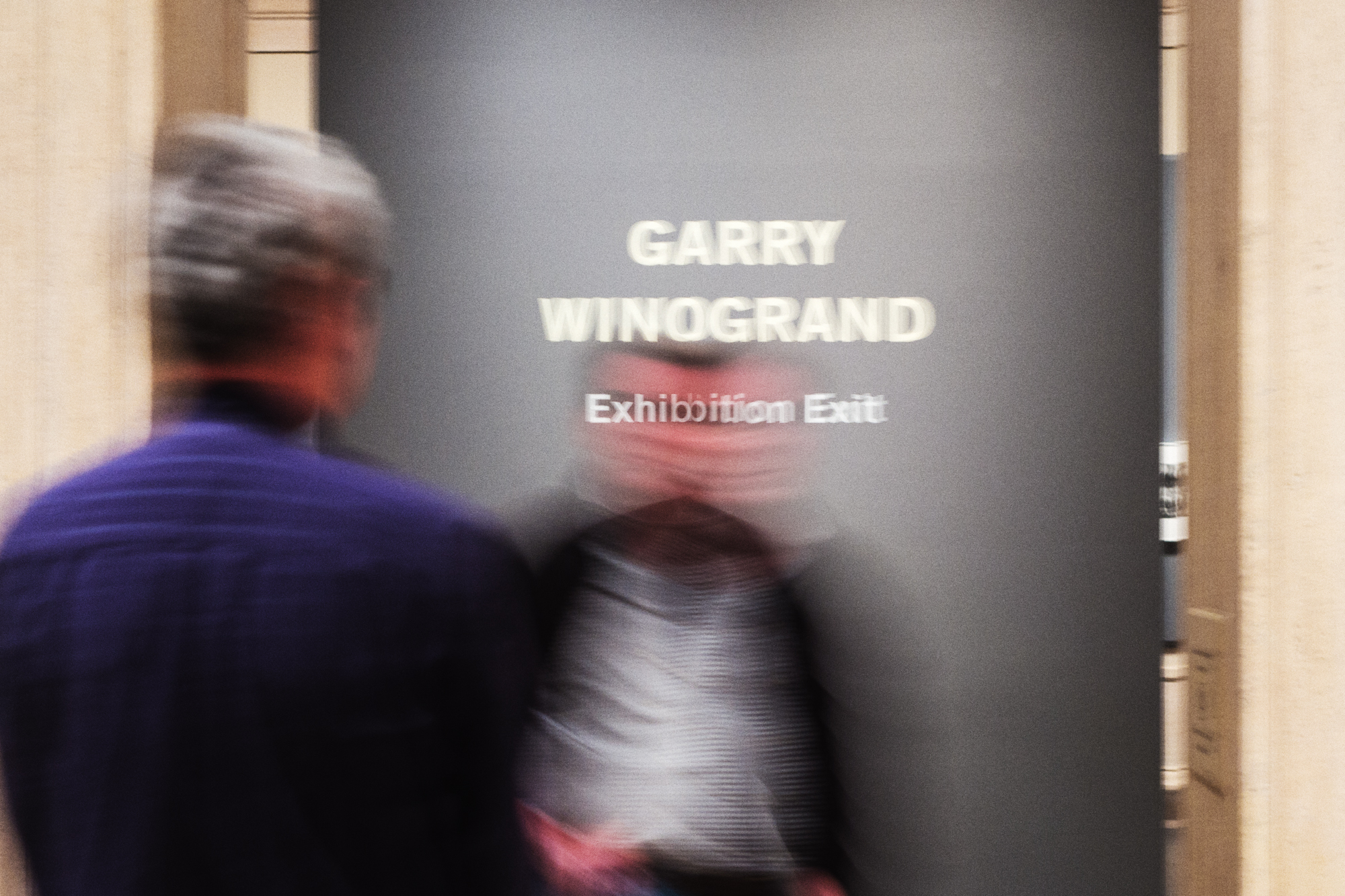
The Garry Winogrand exhibition at the National Gallery of Art is a stunner, the best photography exhibition in D.C. since the Andre Kertesz show in 2005. It’s a very well-thought through combination of Winogrand’s iconic images, some of the pictures he took in his final years that he never even had the patience or interest to review, punctuated by a filmed interview from 1977 that so perfectly captures the man and his approach that it’s worth the price of admission. (Okay, so admission’s free, better to say, worth the effort to get to the National Gallery of Art.)
They couldn’t have been more unalike as people, but the exhibition makes one realize that in many ways, Winogrand was our Henri Cartier-Bresson. HCB was an aristocratic French communist, as reserved and formal in his Surrealism-influenced compositions as the Bronx-born, deliberately informal Winogrand was outwardly, and in every way, sloppy. But Winogrand’s images of America in the ’50s-’70s are every bit as iconic as HCB’s images of Europe, Mexico, and Asia between the ’30s and the ’60s.
See Winogrand’s photograph of the man flipping in the air in the streets of New York. Then look at HCB’s man leaping across the puddle.
In Winogrand’s image, the man’s foot mirrors the bird’s wing on the billboard; in HCB’s image, the man’s movements mimic the dancer on the poster. Did Winogrand mimic HCB? We doubt it — much of what we know about Winogrand, from reading and from the show, would suggest he was too into the moment to have a formalist’s composition in mind as he squeezed the shutter. And yet is the image the equal of HCB’s? Maybe not, given that Winogrand was drawn to theatrical and staged events, and HCB seems to have captured his “Behind the Gare St. Lazare” from pure happenstance. But it’s a great picture.
Winogrand’s dictum — “I photograph to see what the world looks like in photographs” — is as important an influence on succeeding generations of photographers as Cartier-Bresson’s notion of The Decisive Moment.
The show gives a wonderful sense of Winogrand’s larger-than-life personality, his sheer voraciousness as a photographer in his prime, the intelligence that bristled when he took pictures, even as he denied there was a real intelligence at work. His was a very ’60s philosophical attitude, eschewing meaning from the photographs other than a meta consideration of the photographs as more than the events they depicted. “How do you make a picture that is more interesting than what actually happened?” he asked, sincerely, which is the photographer’s equivalent of Philip Roth asking how it was possible for fiction to keep up with the absurdity of the world, circa 1968. When the events in life were so over the top, only a true artist could exceed them.
Winogrand’s ability to fit everything into the frame was both his strength and weakness. So much of what he captured with his machine-gun overshooting of everything he observed was perfect, and so much was excess, in need of cropping, that you begin to realize that out of the hundreds of thousands of pictures he took, these mere hundreds in the exhibit represent a frustrating ratio. In Winogrand: Fragments From The Real World, MOMA photo chief and Winogrand champion John Szarkowski writes with ill-hidden frustration about Winogrand’s indiscipline, the pictures compulsively taken in his final years that he barely even bothered to have developed. The responsibility for someone else to have to sort through them all was too much even for the man who, through his including of Winogrand in photography’s pantheon, helped make the case for him as more than a street photographer. And yet the greatness of this show, and the excellent monograph that accompanies it, is how well the two aspects of Winogrand’s art — the incredible energy of events squeezed in the frame, even as later in life he seemed less inclined to push for absurdism and meaning — are reconciled into a whole. Not coherence, perhaps. But the life’s work of a troubled and brilliant artist.
The show at the National Gallery has all the great pictures we remember, and it reminds us of how things looked in the NYC of our youth, of how LA looked when we first saw it in the early ’80s. That his appetite for life seemed finally to run out of energy, even as he compulsively snapped away, takes nothing away from Winogrand’s importance. It’s a great show.
D.C. Street Portrait II. Leica Monochrom, 50mm APO-Summicron-ASPH, yellow filter, LR5 and Silver Efex Pro 2.
Clementine Creevy is the Mikaela Schiffrin of indie rock. Where the latter won her first World Cup Slalom globe by her 18th birthday, Creevy’s band, Cherry Glazerr, released its excellent first album Haxel Princess just weeks past Creevy’s 17th birthday. Drummer Hannah Uribe is a sweet 16. (The only male band member, bassist Sean Redman, is 22.) There have been L.A. teen phenoms going all the way back to The Runaways, but few have produced as pleasurable fluff as this.
This is not the 17-year old James Joyce reviewing Ibsen’s “When We Dead Awaken,” and shocking the old Norwegian playwright when he finds out a mere kid has done the trick. There are songs here about grilled cheese sandwiches (“Grilled Cheese”), so anyone looking for profundity will have to wait for the next, dunno, Fiona Apple album. But if you like albums with lyrics like “I’ve got a crush on you” while the band picks up momentum with song structures familiar to The Breeders or Veruca Salt or other punk-pop outfits from the decade in which all of Cherry Glazerr was born, this rec will bring a smile to your face.
Cherry Glazerr: feel free to quote this in your college applications: “Tulip Frenzy believes that [fill in name of college] would greatly benefit from this band playing on the lawn of the quad on sunny Fridays, while the Red Bull flows and the frisbees fly.”
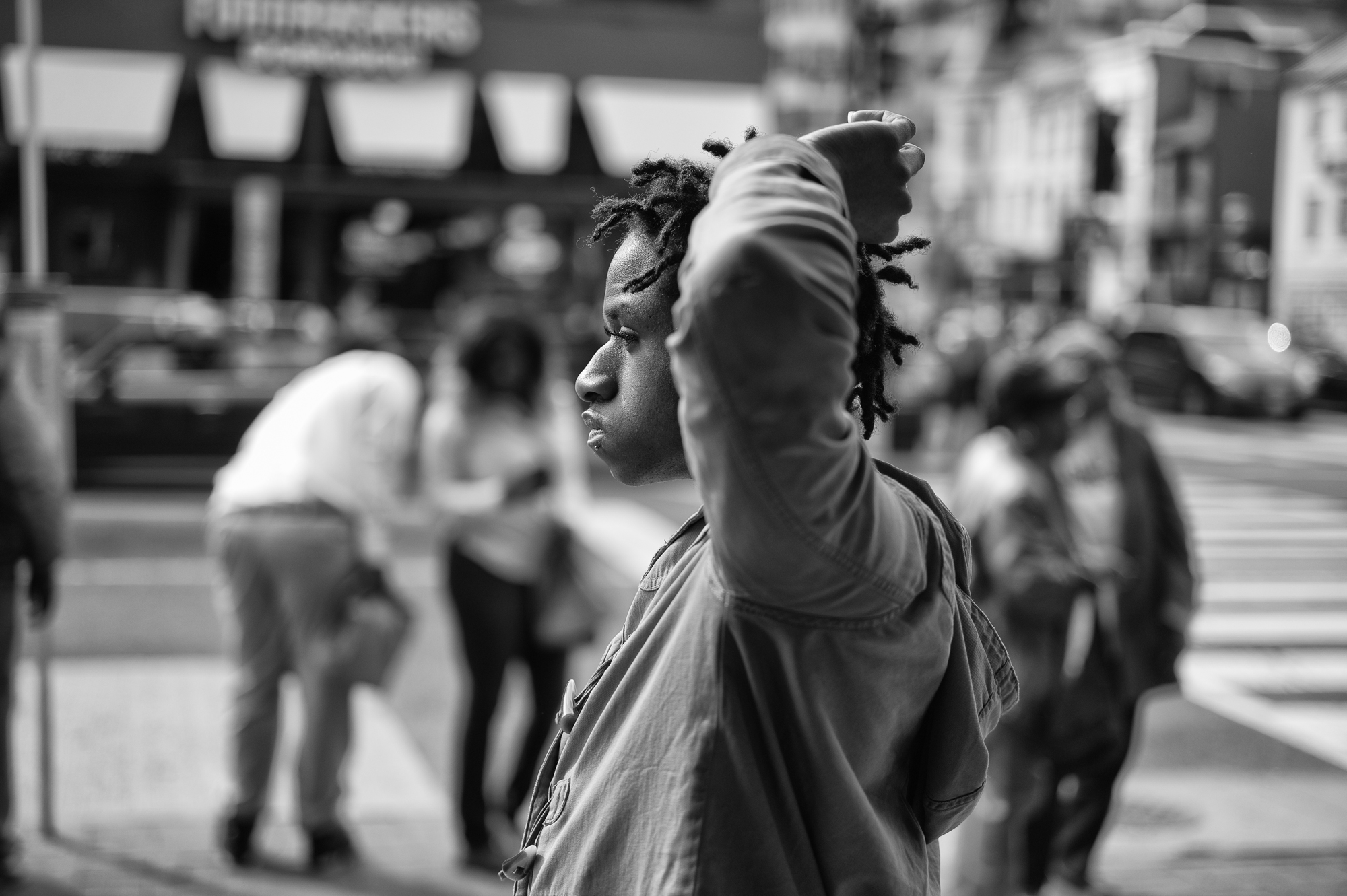
Sometimes it’s hard to get a reflective moment when out on the city streets. We’re not sure exactly what he was thinking. We’re glad we were there to make a picture from it. Leica Monochrom, 50mm APO-Summicron-ASPH, yellow filter, wide open, LR5 to Silver Efex Pro 2.

 Tulip Frenzy