
Leica M, 35mm Summilux ASPH FLE.
Leica M, 35mm Summilux ASPH FLE.
Leica M, 50mm APO-Summicron-Asph, Novoflex LEM/VIS II. Yeah, go ahead, click on it.

Beginning in 2010, when Who Killed Sgt. Pepper was the follow-up to My Bloody Underground, we began to think of the Brian Jonestown Massacre as a superb live band with one of the great back catalogues in rock, but not really a band whose who new album would engender much excitement.
But then came 2012’s Aufheben, which had a number of songs as good as anything Anton Newcombe had ever written, with “I Want To Hold Your Other Hand” and “Blue Order New Monday” taking up permanent residence inside our earbuds. We began to get excited about what tricks Anton still had up his sleeve.
Revelation, which officially comes out tomorrow but happily was available to download last night, is so good, we wonder if it might be the Love and Theft to Aufheben‘s Time Out Of Mind, a portent not just of a return to greatness after a less-than-great creative patch, but an indicator that Newcombe’s best work, like Dylan’s, might someday be understood to have been made when his youth was behind him — to be not what he produced when he was a young and brash punk, but what came after a hard-earned perspective. I mean, there were days when few people might have expected Anton would be around to make an album in 2014 — but to discover that he’s produced one of the best albums of his career? Yeah, it’s got the right name: Revelation.
The album begins wonderfully, with the Swedish rocker “Vad Hande Med Dem” giving way to the Kurt Vile-ish “What You Isn’t.” By the time we get to “Memory Camp,” it doesn’t matter which members of the large tribe that have variously performed as BJM are playing behind Anton, it doesn’t matter that we’re in Berlin, not California, no other band or set of musicians — not even ones like the Morning After Girls who worshipped the sticky ground on which Anton walked — could produce a Brian Jonestown Massacre album half as good as this. By the time we got to “Food For Clouds,” we were grinning ear to ear. At “Memorymix,” we were ready to take the day off and just hole up, having committed to memory the phone number to the Dominos delivery folks. By “Xibalba” we were dancing around the house.
Over the past few weeks, as Dan and Joel and Matt, as Ricky and Frankie descended upon Austin like the Hole In The Wall Gang getting together with Butch and Sundance to go rob a bank, excitement mounted. They came together to play at the Austin Psych Fest, and then do a few West Coast shows before heading off to Europe, and reports came fast and furious that the band was in fine form. Interviews with Anton found him completely on his game, honest about the past, a sober father with a great sense of humor. Revelation reveals marriage, fatherhood, and sobriety have not diminished his creativity one wit. And of course, as is so often the case, as a sober artist, these days he’s more capable of hitting his mark.
We expect to be playing Revelation until the hard drive on our device gives out. Most important — and we are struggling to convey this to the band of weirdos to whom this really matters — based on the evidence available here, it’s time to raise our expectations and settle in for a late run. The albums the Brian Jonestown Massacre are producing in the mid-’10s are as good as what they produced in the ’90s. We may be ahead of ourself thinking that Anton’s on a run like the one that Dylan went on between ’97 and, oh, 2010. But our hopes are high again.
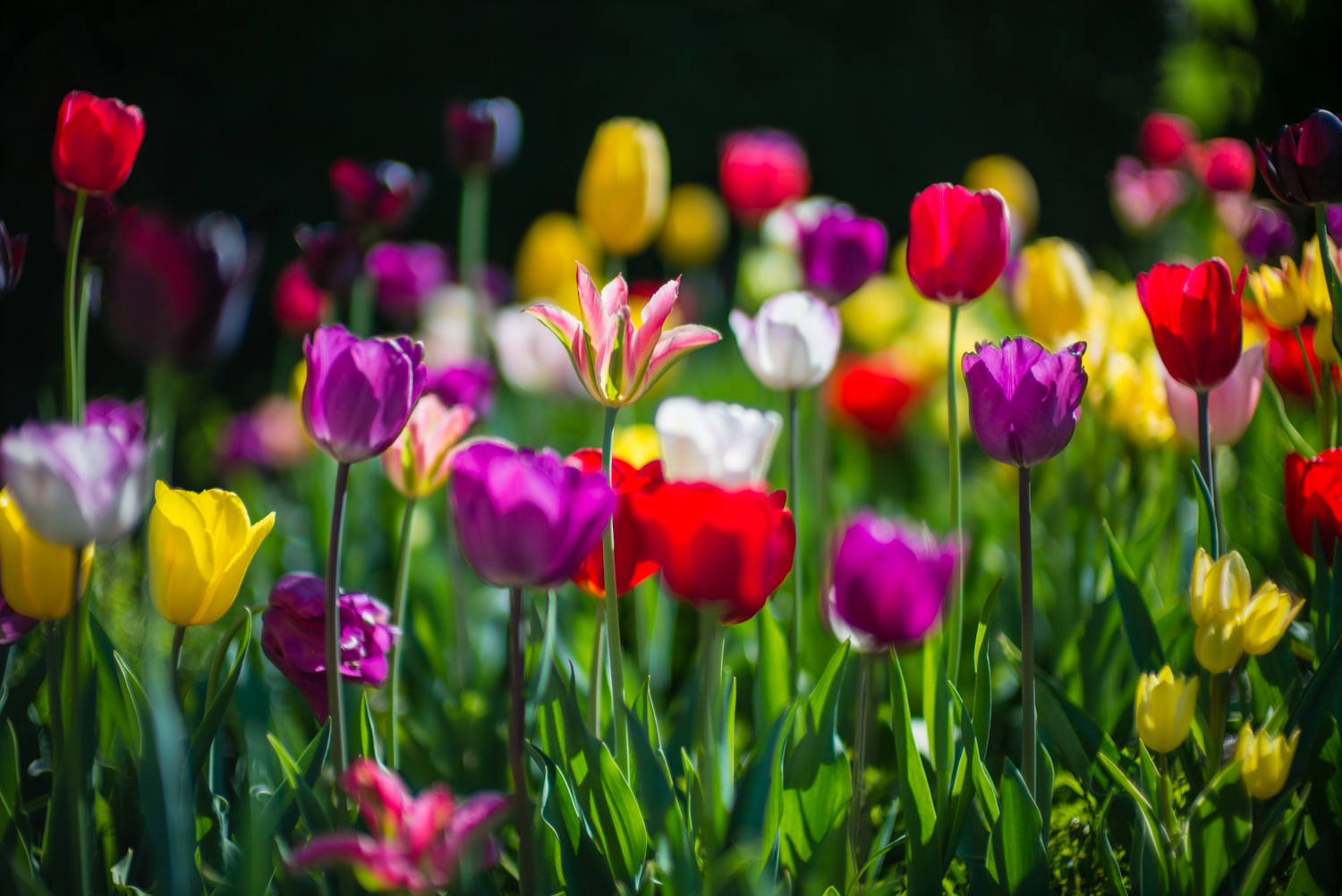
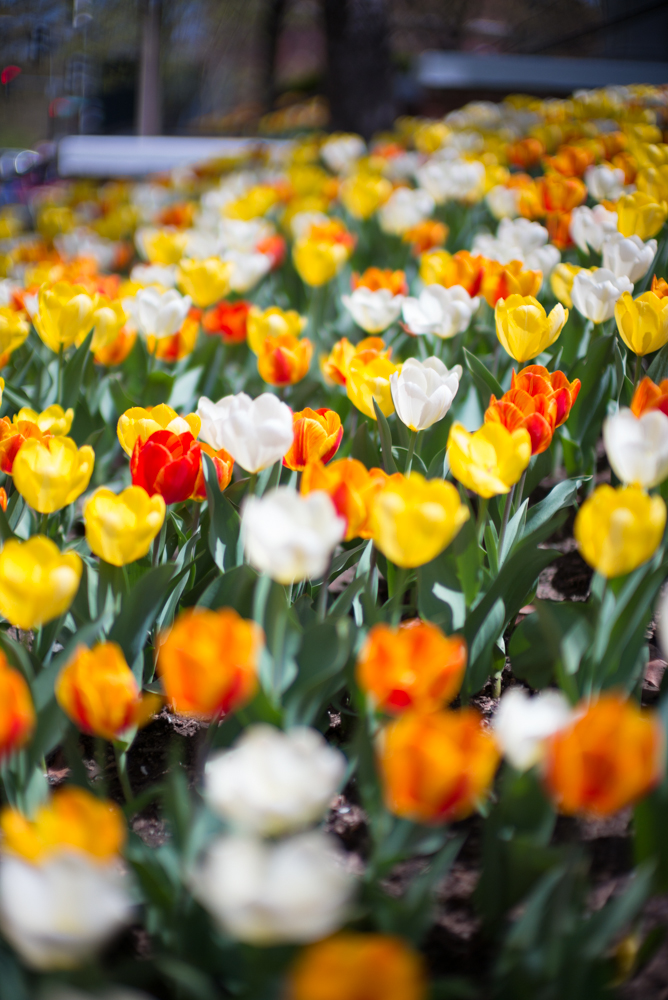
Well, the last ones we likely will post ’til the next Tulip Frenzy! Don’t worry, we have Azalea Frenzies, and Rose Frenzies, and other delights of the season yet to come. Leica M, 50mm Noctilux, ND Filter, Dumbarton Oaks, of course.

For the past several weeks, we have followed two feeds emanating from the same source in some mythic Norse lair that unspools, 140 characters at a time, both Ulysses and Finnegans Wake. Every five minutes, Timo Koola, who goes by the Twitter handle @tkoola — and who either is in Helsinki or Paris, the information on his various feeds contradict — posts, or has posted by computerized elves, consecutive segments from Joyce’s work. Like Finnegans Wake itself, the two texts are in a continuous loop, again at the beginning five minutes after Molly has uttered “yes I will Yes.,” five minutes after “a long the.” And so we plunge back in, to “Stately, plump Buck Mulligan,” and “rivverrun past Eve and Adam’s,” and the cycle begins again.
On weekend mornings when we wake up and check our Twitter feed, we find that the lull in tweeting in the wee hours, as practiced by our usual crew, has allowed the stream from both books to wash together in consecutive counterpoint, and the quotes from both get our day off to a magical, musical beginning. We might see this from Finnegans Wake:
https://twitter.com/finnegansreader/status/462958077244088321
Or this from Ulysses:
https://twitter.com/UlyssesReader/status/462921617069592576
But when you see such quotes together, it makes you realize, first, how much less of a leap it was for Joyce to go from Ulysses to Finnegans Wake than is commonly imagined, and second, how broken up into 140 character segments, atomized in random excerpts, both books are long poems from an imagination that sparkles today every bit as much as it did in 1922, or 1939, when the two books were published.
And then you come across a sequence in succession and it just blows your mind.
https://twitter.com/finnegansreader/status/462984000911708160
https://twitter.com/finnegansreader/status/462985763882561537
https://twitter.com/finnegansreader/status/462986518064537600
https://twitter.com/finnegansreader/status/462988278804021250
In the Ulysses feed, I can pretty much always guess where we are within a few tweets, but you can begin to pick up patterns that, out of context of reading the book, make you wonder how you could have spent so much time engrossed in the text and not have the least remembrance of a particular passage.
And I can’t, right now, find the tweet itself, but on Friday, at lunchtime, when I checked Twitter, the first 140 characters I read were the following quote from Ulysses, and I laughed so hard, my lunch was nearly propelled across the desk:
“the rustle of her slip in whose sinuous folds lurks the lion reek of all the male brutes that have possessed her.)”
Whether or not you have read the two books — and I admit to never having made it through Finnegans Wake — these two feeds are worth following. You will waste a lot of time reading, or re-reading, these two works of genius in a such a manner. Ah, but you will gain some poetry in your life, some kismet and joy. Go for it.
The usual gear: Leica, 50mm Noctilux, ND filter.
In the early years of Black Mountain and Pink Mountaintops, the meme developed that the latter band was an “alternative side” of Stephen McBean’s personality. In retrospect, that’s a little hard to figure, or it is at least a little simplistic. Stephen McBean is such a protean figure that his constant alternatives to his last invocation could rapidly resemble a hall of mirrors.
And anyway, are the two bands, the two… aspects… of McBean’s songwriting, singing, and most excellent guitar playing, really so different? Let’s rewind to the beginning. Pink Mountaintops’ brilliant 2006 album Axis of Evol could easily be seen as coming from a similar sensibility as, say, Black Mountain circa its first record or the Druganaut E.P. “Cold Criminals” sounded like it was the product of someone who’d spent a lot of time listening to Pere Ubu’s The Modern Dance, while “Bicycle Man” was steeped in the No Wave sound of New York circa ’78. Are those different sides? So far away from one another? Not really.
To us, McBean has always been one of the great dabblers, an ambitious throwback who could in the span of two years record one of the best Velvet Underground-sounding songs — Pink Mountaintops’ “The Gayest of Sunbeams” — and one of our favorite invocations of Led Zeppelin — Black Mountain’s “The Hair Song.” The only people who split the difference between Zep and the Velvets while in the same rough phase of their careers are those who, as the lyrics to the great Black Mountain song “Voices” would have it, have come down with the same bug all of us at Tulip Frenzy are riddled with: “Rock’n’roll voices on the radio/I’ve been in love with you since I was five years old.” He loves it all: all those rock’n’roll voices: Lou’s, and Bowie’s, and Robert Plant’s, and often in harmony with a singer as great as Amber Weber, which brings us to such pairings as Exene and John Doe and Sonny and Cher.
While his shambling, hippy-era countenance might give off a hash and patchouli perfume, leading you to think of McBean as a slacker, and while the pace of releases since 2005’s eponymous Black Mountain album might not seem like he breaks a sweat, the sheer volume of not just good, but thoroughly excellent music McBean’s been responsible for over the last nine years is pretty remarkable. If his interest was simply in being a rock star, he probably would have helped corral the Black Mountain Army to keep pushing through in support of Wilderness Heart, which caused a stir in 2010. But instead the band put out some new songs on the Year Zero film soundtrack, toured a bit, and did not sustain the momentum. It’s easily recaptured, they’ve built a good following. But McBean’s not interested, it seems, in such straight forward careerism.
Enter Pink Mountaintops’ Get Back, in which with an imposing posse behind him — J. Mascis on guitar, Daniel Allaire from Brian Jonestown Massacre on drums, Rob Barbato of Darker My Love on bass, etc. — McBean invokes everything from Station to Station-era Bowie to “All Along The Watchtower.” Ensconced in Los Angeles these days, McBean continues a Canadian-style assault on greatness: low-key, humorous, thoroughly competent.
We think “Ambulance City” may be the most infectious rocker out this year, which is saying something since John Dwyers’ Thee Oh Sees have already released an album. “Through All The Worry” sounds like something you wish Social Distortion was still putting out. “Wheels” is the “All Along The Watchtower” analogue, though obviously invoking the Hendrix version. Whether that’s Mascis or McBean on lead, we don’t know, but it is like sonic dental floss, cleaning out the cavity between our ears. We can see the members of Crocodiles smiling when they hear “Sell Your Soul,” one of those songs that makes you remember how mid-70s Bowie was so influenced by early Springsteen, he borrowed Roy Bittan to play piano. “North Hollywood Microwaves” is Not Safe For Driving With Children Or Spouses, an hilarious novelty. By the time we get to the closer, “The Last Dance,” we’ve returned to mid-’70s pre-punk, to the Station To Station sound with which the album began. It’s an impressive, Rockist tour de force.
How Get Back ultimately fits into McBean’s canon is unknowable at this time. What we know is that his multiple personalities are given full vent, and that a figure whose bands have called to mind Deep Purple and Led Zeppelin, the Velvet Underground and Pere Ubu, and Bowie, always Bowie, is as well-rounded an artist as there exists today. Selfishly, we can’t wait to see the set of characters McBean inhabits on the next slab of Black Mountain.
Dumbarton Oaks on a sunny April Sunday on the tail end of the Tulip Frenzy is a magnificent setting for portrait-taking, even if the model is posing for someone else. Leica M, 50mm Noctilux.

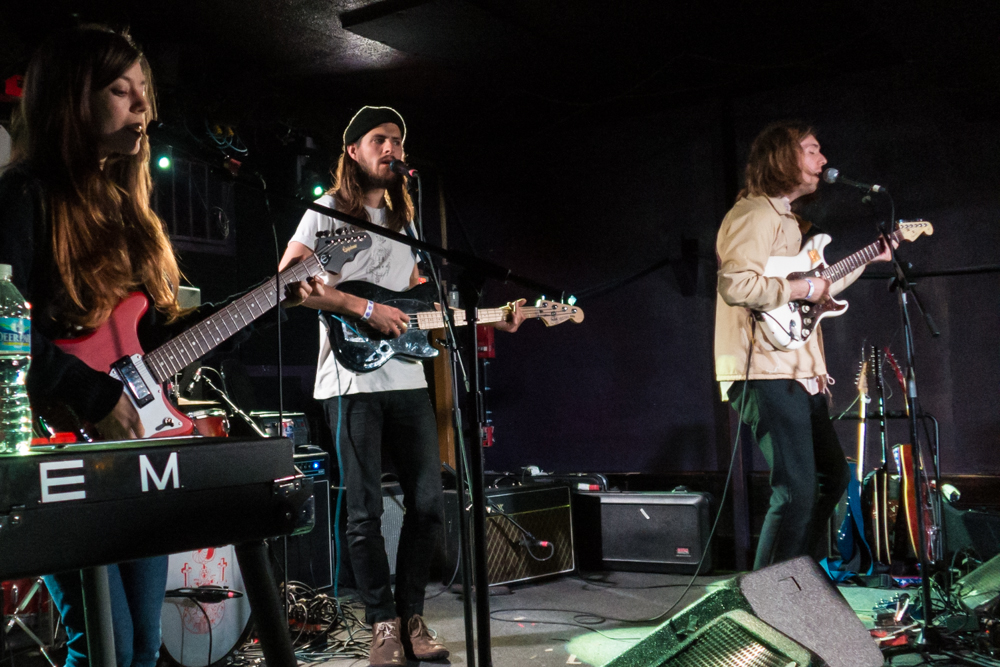
Quilt, Leica C
It wasn’t accidental that two bands that each have produced one of the best albums released so far in 2014 played last night at D.C.’s Rock & Roll Hotel, for Quilt and Woods are, at present, joined like family members. Woods’ Jason Taveniere produced Quilt’s second album, Held In Splendor, and on this tour at least, Quilt drummer John Andrews plays organ with Woods. They have more kin connections than a village in West Virginia, and the show last night was one long stream of gorgeous melodies, guitar wizardry, a solid backbeat, and the occasional psychedelic rave-up.
Quilt wrapped us in Held In Splendor, their warm and radio-ready platter o’ harmonic convergence punctuated by intricate pop finger picking and gritty power chords. Anna Fox Rochinski is a lyrical lead guitarist and an understated, somewhat shy front-woman, but when she and Shane Butler matched their vocal interplay with guitar fire, it brought to mind favorite two-guitar bands like Luna, the Soft Boys, even Television. Quilt’s sound is jangling ’60s pop with three-part harmonies contained within the parameters of garage, folk, and psychedelica, which is pretty great territory to ply. In fact, their new album is desert isle material, and the set last night proved they can do it live every bit as powerfully as in the studio.
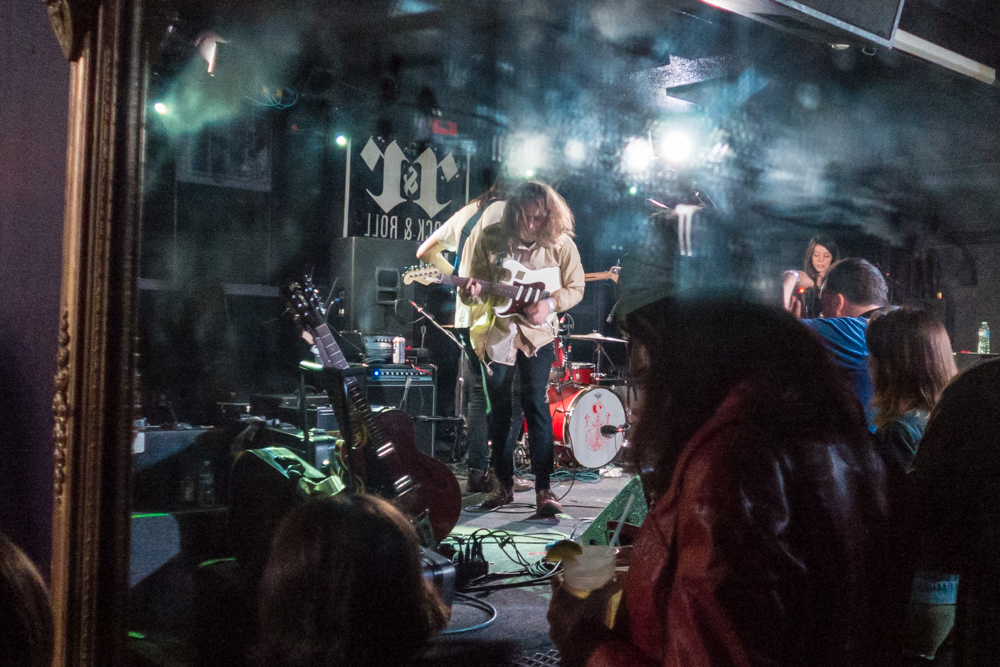
Quilt, Leica C, via the Rock & Roll Hotel’s mirror.
The crowd’s reaction to the best songs — “Mary Mountain,” “Just Dust,” “Tired & Buttered” — proclaims Quilt has, by their sophomore outing, established themselves as one of a handful of American bands worth tracking as they rise to what, should the cosmic order be proven, can only be inevitable world conquest.
Since the release a few weeks ago of Woods’ With Light And Love, we’ve concluded it is every bit the equal to Bend Beyond, which some will remember we called 2012’s best album, and even more than that: an absolutely perfect record. It should go without saying, this is a hard feat to pull off once, never mind twice. But With Light And Love is astonishing — even prettier than its predecessor, and last night, despite a bad sound mix from the club, Woods revealed just what a treasure they’ve become.
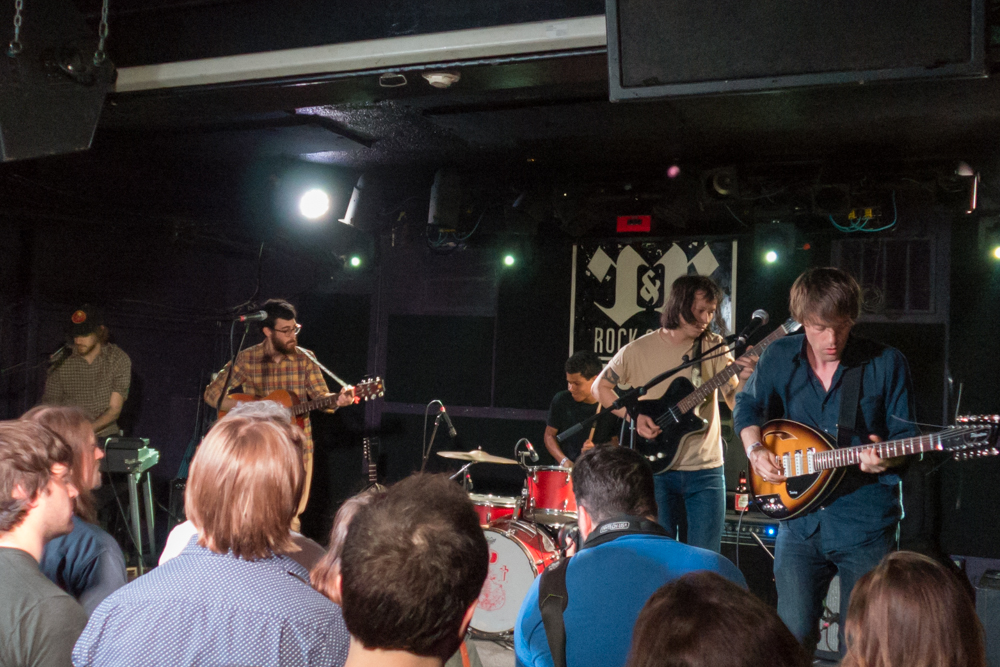
Woods, Leica C
The new bass player, Chuck Van Dyke, steps well into Kevin Morby’s shoes, and with Quilt’s John Andrews playing organ throughout, Woods’ sound had an emollient undercurrent that was as surprising as it was delightful. They started out with “Leaves Like Glass,” which on the album sounds like an outtake from a mythic Dylan set and last night sounded like it was a jam in Memphis’ Ardent Studios. Jeremy Earl played acoustic through the early songs, including “Cali in a Cup,” but it was later in the set, when he had strapped on his electric guitar to play two of the highlights from the new album — “Moving To The Left” and “Twin Steps” — that it became clear how, even as amazing an album as Bend Beyond was, With Light And Love takes a giant step into the commercial mainstream, which we mean as a compliment. They played the title tracks to both recent albums, which means 20 combined minutes of getting your head scalped, and we survived the pyrotechnics, a groggy smile on our putzes. But it’s where Woods now confidently step into well-crafted pop songs that perhaps the band’s hidden ambitions begin to see the light.
A clue to the ground they currently occupy can be found on the sequencing on the new album of the songs “Full Moon” and “Only The Lonely.” On the former, Jason Taveniere plays George Harrison-inflected slide, and the latter is the title of a different Roy Orbison song. Are they trying to emulate The Traveling Willburys? No, they’re still a Brooklyn-based band of artisanal pop craft, still weird and wooly, though it could be said that invoking Roy Orbison is one way of placing Jeremy Earl’s astonishing voice, his high plains croon, in a more recognizable context.
We’ve seen Woods three times in 18 months. In November 2012, when they played across the street at the old Red Palace, it was like seeing Sun Ra come back to Earth, fireworks going off in the mind. Last night, with a new bass player and the sound of an organ ladling sweet honey on the guitars, the band was every bit as remarkable, but in a way that those with less adventuresome tastes could relate.
How delightful it is to see two so great bands in a club with a couple of hundred souls. It’s only because of the injustice of life that we would see these bands on the H Street corridor and not downtown at the Verizon Center. Optimists that we are, we think both bands will get there.
It’s all downhill from here. Next up: the Azalea Frenzy. Leica M, 50mm Noctilux, ND filter.
 Tulip Frenzy